
JLRC Blogs
- Courses
- Study Japan
- Materials
- Community
- About
- FAQ's
- Careers
- Class Details
- Login


How Long Does It Take to Learn Japanese? Why Faster Progress Matters
JLRC - Content Team 2026/05/21

Many people who want to study Japanese ask the same question:
“How long does it take to learn Japanese?”.
The honest answer is: it depends.
Your progress depends on your goal, study schedule, learning method, teacher support, and how consistently you review. Some learners only want basic travel Japanese. Others want to pass JLPT N5, N4, N3, or higher. Some need Japanese for work, study in Japan, or long-term career opportunities.
However, there is one important point many learners overlook:
Slow progress has a hidden cost.
Every extra month without clear progress can mean delayed goals, missed opportunities, and slower career growth. This does not mean students should rush. It means that learning Japanese with the right structure can help students move forward more efficiently and avoid unnecessary delays.
In this article, we will explain what affects the time needed to learn Japanese, why faster progress matters, and how structured Japanese learning can support your future goals.
Table of Contents
- Why Japanese Learning Takes Time
- The Hidden Cost of Slow Progress in Japanese Learning
- Why Faster Progress Does Not Mean Rushing
- How Slow Progress Can Affect Career Opportunities
- How Faster Progress Can Support Study in Japan Goals
- Why Structure Matters in Japanese Learning
- How JLPT-Based Learning Helps Students Move Forward
- Learn Japanese More Efficiently with JLRC
- Start Building Your Japanese Future Sooner
- Start Your Japanese Learning Journey with JLRC
- FAQ
Why Japanese Learning Takes Time
Japanese is a rewarding language to learn, but it is also very different from English and many other languages. Beginners usually need time to build a strong foundation.
Japanese learners need to study:to understand through self-study alone, such as:
- hiragana and katakana
- basic kanji
- grammar patterns
- particles such as は, が, に, and で
- vocabulary
- listening and reading skills
- speaking practice
- cultural usage and politeness levels
For beginners, even simple sentences can feel unfamiliar because Japanese sentence order is different from English. Verbs usually come at the end of the sentence, and particles show the role of each word.
That is why Japanese learning should be done step by step.
The important question is not only “How many months will it take?” but also “Am I using my study time effectively?”
A student who studies with a clear structure may progress faster than a student who studies randomly for a longer period.
The Hidden Cost of Slow Progress in Japanese Learning
Many learners think slow progress only means taking more time. In reality, it can also affect future opportunities.
If a student spends months studying without clear improvement, they may lose motivation or delay important goals such as:
- taking the JLPT
- applying for a Japanese-related job
- preparing for study in Japan
- communicating confidently in Japanese
- moving to the next learning level
The hidden cost of slow progress may include:
- delayed JLPT preparation
- missed job opportunities
- slower career growth
- repeated study expenses
- reduced confidence
- longer preparation time for study abroad
For example, a learner who reaches JLPT N3 earlier may be able to apply for more opportunities sooner. A student planning to study in Japan may need a stronger Japanese foundation before moving forward.
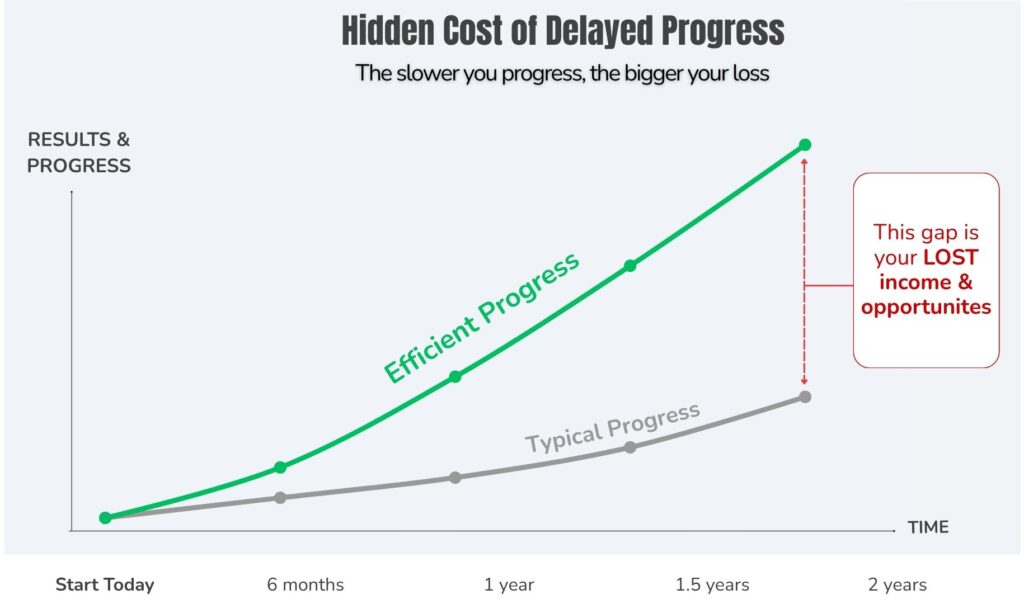
Every extra month without clear progress can delay the future you are trying to build.
Why Faster Progress Does Not Mean Rushing
Faster progress does not mean skipping important lessons or trying to memorize everything quickly.
In Japanese learning, rushing can be harmful. If students skip grammar basics, avoid hiragana and katakana, or memorize phrases without understanding sentence patterns, they may struggle later.
True faster progress means:
- learning in the correct order
- avoiding unnecessary confusion
- receiving proper explanations
- reviewing regularly
- using good materials
- following a clear path toward your goal
In other words, faster progress means reducing wasted time, not lowering quality.
A good Japanese course should help students build a strong foundation while moving forward efficiently. Students should not feel lost or wonder what to study next.
This is especially important for JLPT learners. Each level builds on the previous one. A weak foundation at N5 can make N4 and N3 much harder later.
How Slow Progress Can Affect Career Opportunities
For many learners, Japanese is not just a hobby. It can be connected to work, career growth, and income opportunities.
Japanese ability may be helpful for people who want to work in:
- Japanese companies
- BPO or customer support roles
- translation or interpretation
- tourism and hospitality
- IT or engineering companies with Japanese clients
- jobs in Japan
In many cases, Japanese ability can become a career advantage. Even basic certification such as JLPT N5 or N4 can show commitment, while higher levels such as JLPT N3, N2, or N1 can open stronger opportunities.
However, if learning progress is too slow, career goals may also be delayed.
A student may postpone taking JLPT, miss a hiring period, or lose confidence in applying for Japanese-related positions.
Career growth starts sooner when language progress starts moving clearly.
This does not mean Japanese alone guarantees career success. But it can be an important skill that supports future opportunities, especially when combined with work experience, education, and professional skills.
How Faster Progress Can Support Study in Japan Goals
Japanese learning speed can also affect students who want to study in Japan.
For many students, studying in Japan can mean international experience, cultural exposure, academic development, and future career growth.
However, students often need to prepare early. They may need to understand basic Japanese, communicate in daily situations, prepare documents, or meet language study expectations depending on their plan.
Slow Japanese progress can delay this process.
Faster progress can help students:
- prepare for basic communication in Japan
- build confidence before moving abroad
- work toward JLPT goals
- understand school or visa-related requirements better
- start their study abroad plan earlier
Your future starts sooner when your preparation starts moving in the right direction.
For students planning this path, JLRC also provides support through its Study in Japan Program, helping learners connect Japanese study with future academic and career goals.
Why Structure Matters in Japanese Learning
One of the biggest reasons learners progress slowly is not lack of effort. Often, the problem is lack of structure.
Many students try to learn Japanese by combining random videos, apps, social media posts, and free materials. These resources can be useful, but they do not always provide a clear learning path.
A learner may study one grammar point today, memorize random vocabulary tomorrow, then watch an unrelated video the next day. This can feel productive, but it often creates gaps.
A structured Japanese course helps students avoid this problem by providing:
- clear lesson order
- level-based progression
- organized grammar study
- vocabulary connected to each lesson
- regular practice
- teacher guidance
- review and reinforcement
Structure turns effort into progress.
Without structure, students may study for months but still feel unsure. With structure, students can see what they have learned, what they need to review, and what comes next.
You can also explore JLRC’s Japanese learning materials, which are designed to support structured and efficient Japanese language learning.
How JLPT-Based Learning Helps Students Move Forward
The JLPT provides a useful framework because it divides Japanese learning into clear levels: N5, N4, N3, N2, and N1.
For many students, this creates a practical roadmap.
JLPT-based learning helps students understand:
- what grammar to study
- what vocabulary to learn
- what kanji level to target
- how reading ability develops
- how listening skills should improve
- what level they are aiming for next
For beginners, JLPT N5 gives a clear starting point. After that, students can continue to N4, N3, and higher levels.
This type of level-based learning helps reduce confusion. Instead of asking, “What should I study next?” students can follow a clear path.
JLPT is not the only purpose of learning Japanese. Students should also practice speaking, communication, and real-life usage. But as a learning structure, JLPT levels can make Japanese learning more organized, measurable, and motivating.
Students who want a clear course path can check JLRC’s structured Japanese language courses including JLPT preparation from beginner to higher levels.
Learn Japanese More Efficiently with JLRC
At JLRC, we focus on helping students learn Japanese more efficiently through structured Japanese language training and JLPT-based courses.
Our goal is not to make students rush. Instead, we help learners reduce unnecessary delays by following a clear learning path, using organized materials, and receiving guidance from trained instructors.
JLRC’s approach is built around the idea that less time can mean reaching opportunities sooner.
This is especially important for students who are learning Japanese for:
- JLPT preparation
- career growth
- study in Japan
- work opportunities
- daily communication
- future personal goals
JLRC offers structured Japanese language courses from beginner to higher levels. Students can also choose group classes or 1-on-1 tutorial options depending on their schedule, learning style, and goals.
Through structured lessons, original learning materials, and instructor support, students can build their foundation step by step and move toward their next level with more confidence.
If you are looking for a Japanese language school in the Philippines that supports efficient progress, JLRC can help you start with a clear path.
For learners outside the Philippines, JLRC also offers options to learn Japanese online from anywheres.
Start Building Your Japanese Future Sooner

Learning Japanese takes effort, patience, and consistency. But the way you study can make a major difference.
If your learning is unstructured, progress may feel slow and unclear. But with the right course, materials, teacher support, and study habits, you can move forward more efficiently.
To make your Japanese learning more effective, remember:
- do not study randomly
- follow a clear structure
- review regularly
- build your foundation properly
- use materials that match your level
- choose a course aligned with your goals
- think about the future opportunities Japanese can support
The main point is simple:
Faster progress does not mean rushing. It means learning with better structure, clearer guidance, and fewer unnecessary delays.
Every learner’s journey is different. But when you make steady progress, you can reach your goals sooner — whether that goal is JLPT, career growth, study in Japan, or better communication.
Start Your Japanese Learning Journey with JLRC
FAQ
How long does it take to learn Japanese?
It depends on your goal, study time, course structure, and consistency. Basic Japanese may take a few months to build, while higher JLPT levels require longer study and regular review.
Can I learn Japanese faster?
Yes, but faster progress should not mean rushing. Students can progress more efficiently by following a structured course, reviewing regularly, using proper materials, and receiving teacher guidance.
Why do many Japanese learners progress slowly?
Many learners progress slowly because they study randomly, skip review, use disconnected materials, or do not follow a clear learning path. Structure is important, especially for beginners.
Is JLPT a good way to structure Japanese learning?
Yes. JLPT levels give learners a clear roadmap from N5 to N1. They help students organize grammar, vocabulary, kanji, reading, and listening goals step by step.
Why does faster Japanese progress matter?
Faster progress can help students reach goals sooner, including JLPT preparation, career opportunities, study in Japan, and daily communication. It helps reduce unnecessary delays in future plans.




Copyright © 2026 JLRC Inc.
All Rights Reserved
For international students, you may visit our Learn Japanese Online page.
For inquiries, you may call us at (63)2-7358-0565 or (63)917-163-3371
Japanese Language Research Center
Unit 506 Cityland Shaw Tower, Shaw Blvd, Mandaluyong, 1552 Metro Manila, Philippines
For international students, you may visit our Learn Japanese Online page.
For inquiries, you may call us at (63)2-7358-0565 or (63)917-163-3371
Japanese Language Research Center
Unit 506 Cityland Shaw Tower, Shaw Blvd, Mandaluyong, 1552 Metro Manila, Philippines
Copyright © 2026 JLRC Inc.
All Rights Reserved