
JLRC Blogs
- Courses
- Study Japan
- Materials
- Community
- About
- FAQ's
- Careers
- Class Details
- Login


Japanese Keigo for Work: Sonkeigo, Kenjogo, and Teineigo Explained
JLRC - Content Team 2026/09/01
Japanese workplace communication is not only about vocabulary and grammar.
It is also about politeness, respect, and choosing the right expression for the right situation.
This is where keigo becomes important.
Keigo is polite and respectful Japanese. It is used in workplaces, customer service, business emails, interviews, meetings, and conversations with clients, managers, teachers, or people you do not know well.
For many learners, keigo feels difficult because it is not just “formal Japanese.” It includes different levels and types of polite language.
In this guide, you will learn the basic difference between sonkeigo, kenjogo, and teineigo, and how they are used in work-related Japanese.
If you are still reviewing the difference between casual and polite Japanese, you may first read JLRC’s Formal vs Informal Japanese.
Table of Contents
- What Is Keigo?
- The Three Main Types of Keigo
- Sonkeigo vs Kenjogo: The Main Difference
- Common Keigo Phrases for Work
- Keigo in Job Interviews
- Keigo for Workplace Communication
- Why Keigo Is Difficult for Japanese Learners
- How to Study Keigo Effectively
- Why Structured Lessons Help with Keigo
- Learn Keigo Step by Step
- FAQ
What Is Keigo?
Keigo means honorific or polite Japanese.
It is a way of speaking that shows respect to the listener, the person being talked about, or the situation.
In English, politeness is often shown through words like “please,” “could you,” or “would you.” In Japanese, politeness can change the whole sentence, including the verb form.
Keigo is commonly used in:
- workplaces
- business meetings
- customer service
- emails
- job interviews
- phone calls
- school or training situations
- conversations with clients or seniors
For learners who want to use Japanese at work, understanding keigo is very important.
Students studying Japanese for career growth may also read JLRC’s Japanese for Work in the Philippines.
The Three Main Types of Keigo
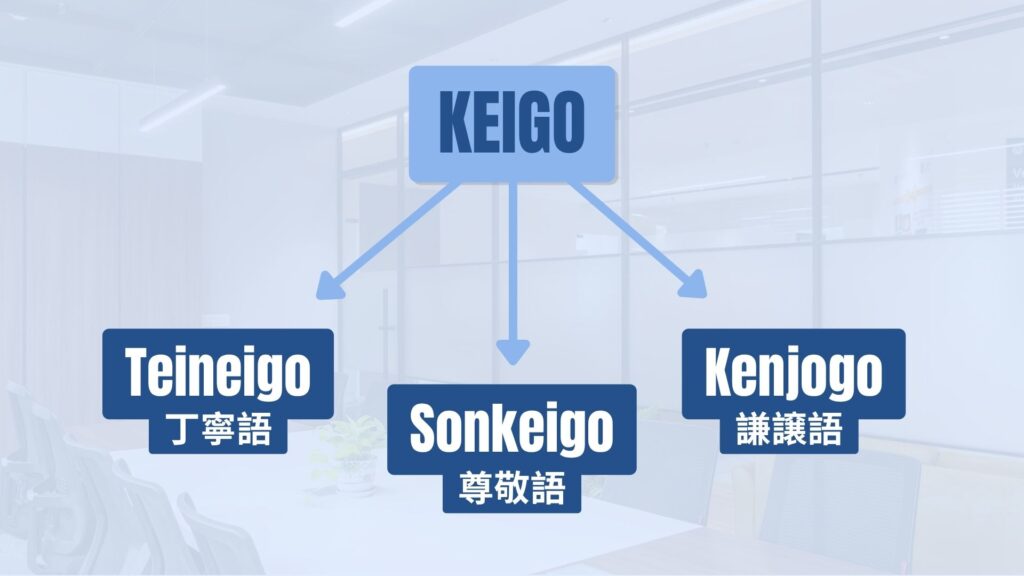
Keigo is usually explained in three main types:
| Type | Japanese | Main Function |
|---|---|---|
| Teineigo | 丁寧語 | Polite language |
| Sonkeio | 尊敬語 | Respectful language for others |
| Kenjogo | 謙譲語 | Humble language for yourself or your side |
Many learners confuse these three, but the basic idea is simple.
Teineigo makes your sentence polite.
SonkeigoSonkeigo raises the person you respect.
KenjogoKenjogo humbles yourself or your side.
Understanding this difference is the first step to using keigo more naturally.
1. Teineigo: Polite Japanese
Teineigo is the basic polite style that most beginners learn first.
It usually uses です and ます forms.
Examples:
| Plain /Casual | Teineigo | Meaning |
|---|---|---|
| 行く | 行きます | go |
| 食べる | 食べます | eat |
| 見る | 見ます | see / watch |
| する | します | do |
| です | です | is / am /are |
For example:
私は日本語を勉強します。
Watashi wa Nihongo o benkyou shimasu.
I study Japanese.
This is polite and suitable for many beginner-level situations.
Teineigo is commonly used in class, shops, restaurants, offices, and first-time conversations.
For beginners, mastering desu / masu forms is very important before studying more advanced keigo.
JLRC’s Japanese language courses help learners build this foundation step by step from beginner to advanced levels.
2. Sonkeigo: Respectful Japanese
Sonkeigo is respectful language used when talking about another person’s actions.
It is often used when speaking about customers, clients, managers, teachers, or people outside your company.
The purpose of sonkeigo is to show respect by raising the other person.
Examples:
| Regular Verb | Sonkeigo | Meaning |
|---|---|---|
| 行く | いらっしゃいます | go |
| 来る | いらっしゃいます | come |
| いる | いらっしゃいます | be / stay |
| 食べる | 召し上がります | eat |
| 飲む | 召し上がります | drink |
| 見る | ご覧になります | see /watch |
| 言う | おっしゃいます | say |
For example:
社長は会議室にいらっしゃいます。
Shachou wa kaigishitsu ni irasshaimasu.
The company president is in the meeting room.
Here, irasshaimasu is used to show respect toward the company president.
Another example:
お客様は何を召し上がりますか。
Okyakusama wa nani o meshiagarimasu ka.
What would the customer like to eat or drink?
Sonkeigo is especially important in business and customer-facing situations.
3. Kenjogo: Humble Japanese
Kenjogo is humble language used when talking about your own actions or the actions of your side.
The purpose of kenjogo is to show respect by lowering yourself or your group.
This is often used when speaking to customers, clients, or people outside your company.
Examples:
| Regular Verb | Kenjogo | Meaning |
|---|---|---|
| 行く | 参ります | go |
| 来る | 参ります | come |
| いる | おります | be / stay |
| 食べる | いただきます | eat |
| 飲む | いただきます | drink |
| 見る | 拝見します | see / look at |
| 言う | 申します | say /be called |
| する | いたします | do |
Example:
明日、御社に参ります。
Ashita, onsha ni mairimasu..
I will visit your company tomorrow
Here, mairimasu is used instead of ikimasu to humble the speaker’s action.
Another example:
資料を拝見します。
Shiryou o haiken shimasu.
I will look at the materials.
Kenjogo is common in business emails, meetings, interviews, and formal workplace communication.
Sonkeigo vs Kenjogo: The Main Difference
Many learners confuse sonkeigo and kenjogo.
The easiest way to remember the difference is this:
Use sonkeigo for the other person’s actions.
Use kenjogo for your own actions.
For example:
| Situation | Correct Type | Example |
|---|---|---|
| The client comes | Sonkeigo | お客様がいらっしゃいます。 |
| I go to the client | Kenjogo | 私が参ります。 |
| The manager says something | Sonkeigo | 部長がおっしゃいました。 |
| I say something | Kenjogo | 私が申しました。 |
This difference is very important in Japanese workplace communication.
If you use humble language for the client by mistake, it may sound unnatural. If you use respectful language for yourself, it may sound too self-important.
This is why keigo needs practice, not only memorization.
Common Keigo Phrases for Work
Here are some useful keigo phrases often used in workplace situations.
1. お世話になっております。
Osewa ni natte orimasu.
Thank you for your continued support.
This is very common in Japanese business emails and formal communication.
It is often used at the beginning of emails to clients, partners, or business contacts.
2. よろしくお願いいたします。
Yoroshiku onegai itashimasu.
Thank you in advance. / I look forward to working with you.
This is a more formal version of yoroshiku onegaishimasu.
It is useful in emails, requests, meetings, and business communication.
3. 少々お待ちください
Shoushou omachi kudasai.
Please wait a moment.
This is a polite expression often used in offices, stores, and customer service.
4. 確認いたします。
Kakunin itashimasu.
I will confirm.
This is more polite than kakunin shimasu.
It is useful when responding to a request or checking information.
5. 申し訳ございません。
Moushiwake gozaimasen.
I sincerely apologize.
This is a very polite apology used in business or customer service situations.
It is stronger and more formal than sumimasen.
6. かしこまりました。
Kashikomarimashita.
Certainly. / Understood.
This is often used in customer service and formal workplace situations.
It sounds more polite than wakarimashita.
7. 失礼いたします。
Shitsurei itashimasu.
Excuse me.
This can be used when entering a room, leaving a meeting, ending a phone call, or interrupting politely.
8. 拝見いたします。
Haiken itashimasu.
I will look at it.
This is humble language used when you look at something from the other person, such as documents, materials, or an email.
Keigo in Job Interviews
Keigo is also useful in Japanese job interviews.
Even if your interview is not fully in Japanese, knowing polite expressions can help you sound more prepared and professional.
本日はよろしくお願いいたします。
Honjitsu wa yoroshiku onegai itashimasu.
Thank you for your time today.
マリア・サントスと申します。
Maria Santos to moushimasu.
My name is Maria Santos.
本日はありがとうございました。
Honjitsu wa arigatou gozaimashita.
Thank you very much for today.
If you want more interview-related examples, you may also read JLRC’s Japanese Job Interview Questions and Phrases.
Keigo for Workplace Communication
Keigo is not only for interviews
It is also used in daily workplace communication, especially when speaking with:
- customers
- clients
- supervisors
- managers
- teachers
- business partners
- people outside your company
For example, in the workplace, you may need to:
- confirm information
- apologize
- ask for help
- respond to a request
- answer a phone call
- send an email
- join a meeting
- speak with a customer
Learners who want practical workplace expressions may also read JLRC’s 25 Japanese Phrases for Work.
Why Keigo Is Difficult for Japanese Learners
Keigo is difficult because learners need to understand both language and social context.
You need to know:
- who is speaking
- who is listening
- who is being talked about
- whether the situation is formal or casual
- whether the person is inside or outside your group
- whether you should use respectful or humble language
This can be confusing at first.
For example, when speaking to a client about your manager, Japanese workplace logic may be different from simple English politeness. You need to think about relationships and business context, not only grammar.
This is why keigo should be learned through examples, role-play, and guided practice.
How to Study Keigo Effectively
To study keigo effectively, learners should not memorize random phrases only.
A better approach is to study keigo by situation.
For example:
- keigo for greetings
- keigo for emails
- keigo for meetings
- keigo for interviews
- keigo for customer service
- keigo for phone calls
- keigo for requests and apologies
Learners should also compare regular Japanese, teineigo, sonkeigo, and kenjogo side by side.
This helps students understand not only the phrase, but also why it changes.
It is also important to practice speaking. Keigo can feel unnatural if learners only read it from a textbook.
Why Structured Lessons Help with Keigo
Keigo is one of the areas where structured lessons can make a big difference.
Because keigo depends on situation, relationship, and purpose, learners often need clear explanations and guided practice.
JLRC’s Japanese language courses help students build Japanese step by step, from basic polite forms to more advanced expressions used in work, JLPT, and real communication.
Students who want to improve Japanese for work, JLPT, or career growth can explore JLRC’s Japanese language courses.
JLRC also provides Japanese language training for companies and organizations that need structured Japanese communication training for employees.
You can also learn more about JLRC’s Japanese language education in the Philippines here: Japanese language school in the Philippines.
With structured lessons, learners can make clearer progress with less wasted time.
Learn Keigo Step by Step
Keigo is important for learners who want to use Japanese in professional or formal situations.
At first, sonkeigo, kenjogo, and teineigo may feel confusing. But once you understand the basic difference, keigo becomes easier to organize.
Start with polite desu / masu forms. Then study respectful language for others and humble language for yourself. After that, practice common workplace situations such as greetings, requests, apologies, emails, meetings, and interviews.
For learners who want to use Japanese at work, keigo is not just a grammar topic. It is a communication skill.
FAQ
What is keigo in Japanese?
Keigo is polite or honorific Japanese. It is used to show respect in formal situations, workplaces, customer service, interviews, emails, and conversations with clients, managers, or people you do not know well.
What are the three types of keigo?
The three main types of keigo are teineigo, sonkeigo, and kenjogo. Teineigo is polite language, sonkeigo is respectful language for others, and kenjogo is humble language for yourself or your side.
What is the difference between sonkeigo and kenjogo?
Sonkeigo is used to show respect for another person’s actions. Kenjogo is used to humbly describe your own actions or the actions of your side.
Is keigo important for work?
Yes. Keigo is important in Japanese workplaces because it is used in business communication, customer service, meetings, emails, job interviews, and conversations with clients or managers.
Is keigo difficult for beginners?
Keigo can be difficult because it depends on social relationships and situations. Beginners should first learn polite desu / masu forms before studying sonkeigo and kenjogo in more detail.
Does JLRC teach Japanese for workplace communication?
Yes. JLRC offers structured Japanese language courses for learners who want to study Japanese for work, JLPT, or career growth. JLRC also provides Japanese language training for companies and organizations.




Copyright © 2026 JLRC Inc.
All Rights Reserved
For international students, you may visit our Learn Japanese Online page.
For inquiries, you may call us at (63)2-7358-0565 or (63)917-163-3371
Japanese Language Research Center
Unit 506 Cityland Shaw Tower, Shaw Blvd, Mandaluyong, 1552 Metro Manila, Philippines
For international students, you may visit our Learn Japanese Online page.
For inquiries, you may call us at (63)2-7358-0565 or (63)917-163-3371
Japanese Language Research Center
Unit 506 Cityland Shaw Tower, Shaw Blvd, Mandaluyong, 1552 Metro Manila, Philippines
Copyright © 2026 JLRC Inc.
All Rights Reserved