JLRC Blogs
- Courses
- Study Japan
- Materials
- Community
- About
- FAQ's
- Careers
- Class Details
- Login


How Much Does It Cost to Study Japanese in Japan from the Philippines?
JLRC - Content Team 2026/07/28

For many Filipino students, studying Japanese in Japan is a major step toward better language ability, international experience, and future opportunities
However, before applying, one of the most important questions is:
How much does it cost to study Japanese in Japan from the Philippines?
The total cost depends on the Japanese language school, location, course length, accommodation, lifestyle, exchange rate, and visa-related requirements. Students should prepare not only for tuition, but also for living expenses, application costs, travel expenses, and document preparation.
This guide explains the main costs Filipino students should consider before studying Japanese in Japan.
Students who want professional guidance can also check JLRC’s Study in Japan Program, which helps Filipino learners apply to trusted Japanese language schools in Japan.
Table of Contents
Estimated Cost for the First Year
For JLRC’s partner Japanese language schools in Japan, the estimated cost for the first year of study is generally around:
This estimate may include tuition and other school-related expenses, depending on the partner school.
However, this amount does not necessarily include all personal expenses. Students should also prepare for:
- accommodation
- food and daily living expenses
- transportation
- airfare
- visa-related expenses
- document translation or courier costs, if needed
- personal emergency funds
Because each school has different fees and requirements, students should request the latest program details before applying.
Main Costs to Prepare
When planning to study Japanese in Japan, students should think about several cost categories.
1. Japanese Language School Fees
School fees usually include tuition and other school-related charges.
Depending on the school, these may include:
- application or screening fee
- admission fee
- tuition fee
- facility fee
- textbook or material fee
- insurance or student support fee
This is why students should not compare schools by tuition alone. A school that looks cheaper at first may have additional fees, while another school may already include certain required costs.
JLRC helps applicants understand the cost structure of partner schools before proceeding with the application.
2. Living Expenses in Japan
Living expenses vary greatly depending on the city and lifestyle.
Students should prepare for:
- rent or dormitory fees
- food
- transportation
- phone and internet
- utilities
- daily supplies
- personal expenses
Tokyo and other major cities are usually more expensive, especially for rent and transportation.
Regional cities may offer lower living costs, but students should also consider school location, convenience, and part-time job opportunities.
As a practical estimate, many students should prepare around ¥100,000 to ¥150,000 per month, depending on location and lifestyle.
3. Accommodation Costs
Accommodation is one of the biggest monthly expenses.
Students may stay in:
- school dormitory
- shared house
- private apartment
- student residence
- homestay
For first-time students, dormitories or school-arranged housing may be easier because the process is usually simpler.
Private apartments may require additional costs such as deposits, guarantor-related procedures, furniture, and moving expenses.
Before choosing a school, it is important to check not only tuition, but also the expected housing cost in that area.
4. Visa and Document Preparation Costs
To study at a Japanese language school in Japan for a long-term period, students usually need to apply for a Certificate of Eligibility, or COE, before applying for a student visa.
The process may require:
- school application forms
- academic records
- financial documents
- sponsor documents
- proof of Japanese language study
- passport and identification documents
- Japanese translations, if required
- courier or document delivery costs
If you want to understand the overall visa process before comparing costs, you may also read JLRC’s Study Japanese in Japan Student Visa Guide.
Current Japanese Language Study Requirement
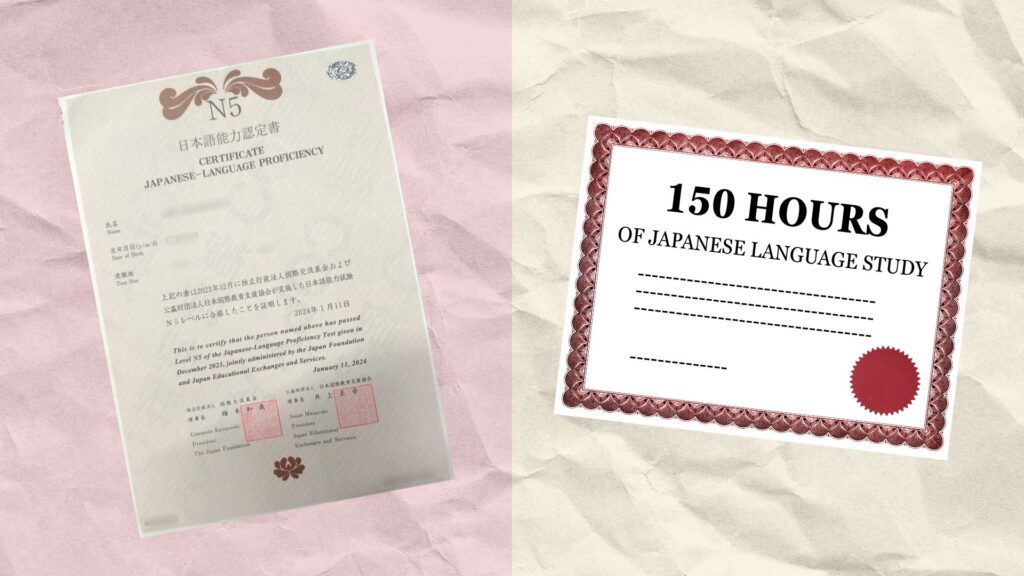
Applicants to Japanese language schools in Japan generally need to show proof of basic Japanese language study.
This may include:
- JLPT N5 certificate, or
- proof of approximately 150 hours of Japanese language study
This requirement is important for students who want to apply for a Japanese language school and COE.
If you do not yet have a JLPT N5 certificate or 150-hour Japanese study certificate, JLRC can help you prepare through its Japanese language courses.
Students who need to build their Japanese foundation before applying can check JLRC’s Japanese language courses.
This is especially helpful for applicants who are interested in studying in Japan but have little or no Japanese background yet.
Why Apply Through JLRC’s Study in Japan Program?
Applying to a Japanese language school in Japan is not only about submitting forms. Students need to understand school options, costs, requirements, deadlines, documents, and visa-related procedures.
JLRC’s Study in Japan Program supports applicants through the process.
JLRC can help with:
- eligibility assessment
- school selection
- introduction to trusted partner schools in Japan
- arrangement of interviews with partner school representatives
- guidance for application forms and required documents
- visa and COE-related preparation
- optional Japanese document translation
- optional JLPT N5 / basic Japanese course preparation
- communication with partner schools during the application process
Because JLRC has strong connections with carefully selected partner schools in Japan, applicants may receive smoother communication and more organized support during the application process.
JLRC can also communicate with partner schools if students face certain issues during their stay in Japan.
Admission Months and Early Planning
Japanese language schools in Japan usually have four admission periods:
To study particles effectively, remember:
- April
- July
- October
- January
However, students should not wait until the last minute.
The COE and student visa process can take a few months, and students also need time to prepare documents, financial proof, school requirements, and Japanese study certification.
JLRC accepts applicants on a first-come, first-served basis, and there is a limit on the number of applicants in order to maintain the quality of its support services.
Should You Study Japanese Before Going to Japan?
Yes. Even if you plan to study Japanese in Japan, it is better to start learning before departure.
Basic Japanese can help you with:
- school communication
- daily life
- transportation
- shopping
- city hall procedures
- part-time job preparation
- understanding school instructions
It can also help you meet the Japanese language study requirement for the application.
For many Filipino students, starting with JLRC in the Philippines before applying to Japan can make the transition smoother.
Students who want to learn more about JLRC’s Japanese education can visit the JLRC Japanese language school page.
Plan Your Study in Japan Budget Carefully
Studying Japanese in Japan can be a life-changing opportunity, but it requires careful preparation.
Before applying, students should understand:
- school fees
- living expenses
- accommodation costs
- visa-related preparation
- 150 hours Japanese study certificate or JLPT N5 requirement
- airfare and arrival expenses
- document preparation costs
- admission schedules
- emergency funds
The cost to study Japanese in Japan from the Philippines varies depending on the school and location. However, early planning can make the process clearer and less stressful.
JLRC’s Study in Japan Program helps Filipino learners understand their options, prepare documents, and apply to trusted Japanese language schools in Japan with professional guidance.
FAQ
How much does it cost to study Japanese in Japan from the Philippines?
For JLRC partner schools, the estimated first-year school-related cost is generally around ¥650,000 to ¥950,000, depending on the school. Students should also prepare for living expenses, accommodation, airfare, visa-related costs, and personal expenses.
Do I need a 150-hour Japanese study certificate to study in Japan?
Applicants to Japanese language schools in Japan generally need proof of basic Japanese study, such as JLPT N5 or approximately 150 hours of Japanese language study. Requirements may vary by school and application situation.
Those who need to fulfill this requirement can explore JLRC’s Japanese language courses.
What does JLRC’s Study in Japan Program support include?
JLRC supports applicants with eligibility assessment, school selection, partner school introduction, document preparation, COE and visa-related guidance, and smooth communication with partner schools in Japan.
When should I start preparing to study Japanese in Japan?
Students should prepare several months before the intended admission period. Japanese language schools usually have April, July, October, and January intakes, but document preparation and COE processing require time.




Copyright © 2026 JLRC Inc.
All Rights Reserved
For international students, you may visit our Learn Japanese Online page.
For inquiries, you may call us at (63)2-7358-0565 or (63)917-163-3371
Japanese Language Research Center
Unit 506 Cityland Shaw Tower, Shaw Blvd, Mandaluyong, 1552 Metro Manila, Philippines
For international students, you may visit our Learn Japanese Online page.
For inquiries, you may call us at (63)2-7358-0565 or (63)917-163-3371
Japanese Language Research Center
Unit 506 Cityland Shaw Tower, Shaw Blvd, Mandaluyong, 1552 Metro Manila, Philippines
Copyright © 2026 JLRC Inc.
All Rights Reserved