
JLRC Blogs
- Courses
- Study Japan
- Materials
- Community
- About
- FAQ's
- Careers
- Class Details
- Login


How to Learn Japanese Faster with Structured Lessons
JLRC - Content Team 2025/10/26
For many people who want to learn Japanese, one of the biggest challenges is not only motivation. It is also time.
Some learners are ready to begin, but they need to wait for the right class schedule. Others want to continue to the next level, but the next class may not open immediately. Busy professionals, students, and future Japan-bound learners may also find that their schedule changes before they can even start.
This waiting time can affect motivation and delay progress.
At JLRC, we believe that Japanese learning should begin when students are ready, not only when a fixed calendar allows. This is one reason JLRC developed the Start Today Modular Method (STMM) — a structured learning system designed to reduce unnecessary waiting time and help learners study more efficiently.
This article explains how structured Japanese lessons can help learners reduce wasted time, continue progressing, and make better use of every lesson.
Table of Contents
- Why Waiting Time Matters in Japanese Learning
- What Structured Japanese Lessons Should Provide
- What Is JLRC’s Start Today Modular Method?
- Less Waiting Time: Start When You Are Ready
- More Efficient Training: Learn with Clearer Structure
- Why Faster Progress Does Not Mean Lower Quality
- Who Can Benefit from Modular Japanese Lessons?
- How JLRC Supports Efficient Japanese Learning
- Start Learning Japanese with Better Structure
- FAQ
Why Waiting Time Matters in Japanese Learning
Many learners are motivated when they first decide to study Japanese.
They may want to:
- prepare for JLPT
- study in Japan
- work with Japanese companies
- communicate with Japanese people
- improve career opportunities
- continue from one Japanese level to the next
However, if students need to wait too long before joining a class, motivation can fade. Their work schedule may change. Their study plans may be delayed. Their JLPT preparation may also move further away.
This is especially true for continuing learners who want to study higher levels. At some levels, class demand may be lower, and students may need to wait for a new class cycle.
Less waiting time can help students start sooner and keep their learning momentum.
What Structured Japanese Lessons Should Provide
Learning Japanese faster does not mean rushing.
It does not mean skipping important grammar, memorizing random vocabulary, or moving to the next level before the foundation is ready.
Instead, efficient Japanese learning should mean:
- learning in a clear order
- reducing unnecessary delays
- using proper materials
- reviewing with purpose
- connecting grammar, vocabulary, kanji, reading, and listening
- progressing step by step toward the next goal
A structured Japanese course helps students understand what they are learning, why they are learning it, and how each lesson connects to the next stage.
Without structure, students may study many things but still feel unsure about their progress. With structure, each lesson becomes part of a larger learning path.
Students who want to compare learning paths can also check JLRC’s Japanese language courses.
What Is JLRC’s Start Today Modular Method?
The Start Today Modular Method, or STMM, is JLRC’s modular learning system.
Instead of waiting for a full class cycle to begin from the very first lesson of a level, the course is organized into modules. This allows qualified students to join at appropriate entry points and continue learning without unnecessary waiting.
The method is based on two main ideas:
- Less Waiting Time — students can start sooner when they are ready
- More Efficient Training — lessons are organized to help students study with clearer focus
In JLRC’s current system, STMM is applied to N4 through N1 classes, while N5 classes are opened more frequently depending on student demand.
This distinction is important. Beginners at N5 usually need a full foundation from the start. Continuing learners at N4 and higher, however, can benefit from a modular structure when the entry point is properly managed.
Less Waiting Time: Start When You Are Ready
In a traditional batch system, students often need to wait until a new class opens. If they miss the start date, they may need to wait for the next cycle.
For some learners, this delay may be short. For others, especially at higher levels, the waiting time can be longer.
The problem is not only inconvenience. Waiting can affect learning momentum.
When students wait too long:
- motivation may decrease
- study habits may stop
- JLPT preparation may be delayed
- work or personal schedules may change
- the next level may feel harder to restart
With JLRC’s modular approach, students can start at the beginning of a suitable module instead of waiting for a completely new batch.
The goal is not to rush learning. The goal is to avoid wasted waiting time.
More Efficient Training: Learn with Clearer Structure
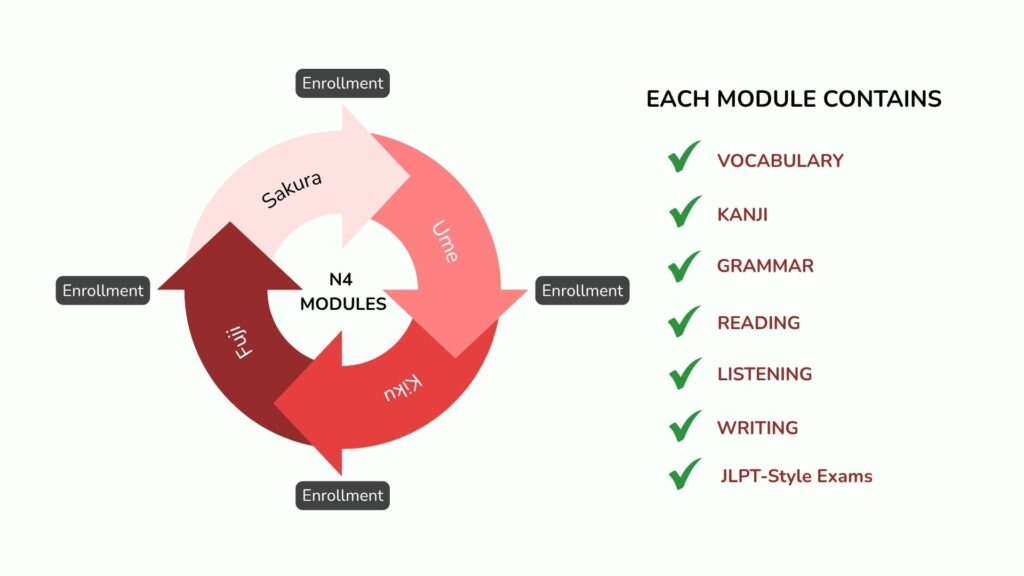
The second part of STMM is efficient training.
Each module is designed as a learning unit that connects important skills together. Rather than treating grammar, vocabulary, kanji, reading, and listening as completely separate areas, students learn how these elements work together.
A structured module may include:
- grammar points
- vocabulary connected to the lesson
- kanji or reading practice
- listening activities
- exercises for review
- examples that support real usage
This kind of structure helps students use their study time more effectively.
For many learners, the issue is not lack of effort. The issue is that their effort is not always organized. A good system helps students know what to study, how to review, and how each lesson supports the next level.
JLRC’s Japanese learning materials are also designed to support this kind of structured learning and review.
Why Faster Progress Does Not Mean Lower Quality
One common misunderstanding is that faster learning means cutting corners.
That is not the goal.
In Japanese learning, skipping important basics can create problems later. If students move too quickly without understanding grammar, particles, vocabulary, or reading skills, higher levels become more difficult.
Efficient progress should mean:
- fewer unnecessary delays
- clearer lesson organization
- better use of study time
- stronger review habits
- proper guidance from instructors
- steady movement toward the next level
In other words, faster progress should come from better structure, not from weaker learning.
Students who want to understand this concept more deeply can read about faster progress in Japanese learning.
Who Can Benefit from Modular Japanese Lessons?

The modular method is especially useful for continuing students.
After N5, learners often have different schedules, different strengths, and different study histories. Some students continue immediately. Others return after a break. Some may already know certain topics but need stronger review.
A modular system can help these learners continue more smoothly when the level and entry point are appropriate.
It can be especially helpful for:
- busy professionals
- continuing learners
- students preparing for N4, N3, N2, or N1
- learners returning after a break
- students who want to reduce waiting time
- learners with specific JLPT or career goals
This is why STMM is especially connected to N4 through N1 classes.
Students who want to understand the full level path can read more about JLPT courses from N5 to N1.
How JLRC Supports Efficient Japanese Learning
JLRC’s approach to Japanese learning is built around structure, continuity, and practical progress.
The Start Today Modular Method is one part of this approach. It helps continuing learners reduce waiting time while still following a clear course structure.
JLRC also supports learners through:
- trained instructors
- structured Japanese lessons
- original learning materials
- JLPT-based learning paths
- group class and 1-on-1 options
- online learning options
- support for students continuing to higher levels
JLRC is a Japanese language school in the Philippines that helps learners study Japanese with a clear path and practical purpose.
Start Learning Japanese with Better Structure
Learning Japanese takes effort, consistency, and time. But the way you study can make a major difference.
If your learning path is unclear, you may spend time without seeing steady progress. If your class schedule is delayed, you may lose momentum before you even begin.
Structured lessons can help students make better use of their time.
To learn Japanese more efficiently, remember:
- start when you are ready
- follow a clear learning path
- review with purpose
- use proper materials
- avoid random study
- continue step by step
- choose a course that supports your goal
JLRC’s Start Today Modular Method was created to help learners reduce unnecessary waiting time and continue studying with clearer direction.
FAQ
What is JLRC’s Start Today Modular Method?
JLRC’s Start Today Modular Method, or STMM, is a modular learning system designed to reduce unnecessary waiting time and help students continue Japanese learning through structured lessons.
Does STMM apply to all JLRC Japanese classes?
STMM is applied to N4 through N1 classes. N5 classes are opened more frequently depending on student demand because beginners usually need a full foundation from the start.
Does learning faster mean skipping lessons?
No. Faster progress should not mean skipping important lessons. It should mean reducing wasted time, following a clearer structure, and making better use of study hours.
Who can benefit from modular Japanese lessons?
Continuing learners, busy professionals, and students preparing for higher JLPT levels may benefit from modular Japanese lessons because they can reduce waiting time and continue progressing more smoothly.




Copyright © 2026 JLRC Inc.
All Rights Reserved
For international students, you may visit our Learn Japanese Online page.
For inquiries, you may call us at (63)2-7358-0565 or (63)917-163-3371
Japanese Language Research Center
Unit 506 Cityland Shaw Tower, Shaw Blvd, Mandaluyong, 1552 Metro Manila, Philippines
For international students, you may visit our Learn Japanese Online page.
For inquiries, you may call us at (63)2-7358-0565 or (63)917-163-3371
Japanese Language Research Center
Unit 506 Cityland Shaw Tower, Shaw Blvd, Mandaluyong, 1552 Metro Manila, Philippines
Copyright © 2026 JLRC Inc.
All Rights Reserved