JLRC Blogs
- Courses
- Study Japan
- Materials
- Community
- About
- FAQ's
- Careers
- Class Details
- Login


How to Introduce Yourself in Japanese: 20 Phrases for Beginners
JLRC - Content Team 2026/08/07

Introducing yourself is one of the first things many Japanese learners want to do.
Whether you are joining a Japanese class, meeting a Japanese friend, preparing for travel, or starting your JLPT N5 journey, simple self-introduction phrases can help you feel more confident.
In Japanese, self-introduction is called jikoshoukai.
A basic Japanese self-introduction does not need to be long. For beginners, the goal is to say your name, where you are from, what you do, and a simple closing phrase politely.
In this guide, you will learn 20 useful Japanese self-introduction phrases for beginners.
If you are new to Japanese, you may also read JLRC’s 25 Japanese Phrases for Beginners to Use in Class.
Table of Contents
- Basic Japanese Self-Introduction Structure
- 20 Japanese Self-Introduction Phrases for Beginners
- Simple Japanese Self-Introduction Example
- Tips for Introducing Yourself in Japanese
- Why Self-Introduction Is Important for Beginners
- Learn Japanese Step by Step with JLRC
- Start with Simple Japanese Phrases
- FAQ
Basic Japanese Self-Introduction Structure
A simple Japanese self-introduction usually follows this pattern:
- Greeting
- Name
- Country or background
- Job, school, or interest
- Closing phrase
For example:
Hajimemashite. Watashi wa Maria desu. Firipin kara kimashita. Yoroshiku onegaishimasu.
Meaning:
Nice to meet you. I am Maria. I am from the Philippines. I look forward to speaking with you.
This is simple, polite, and suitable for beginners.
20 Japanese Self-Introduction Phrases for Beginners
Below are 20 useful phrases you can use when introducing yourself in Japanese.
1. はじめまして。
Hajimemashite.
Nice to meet you.
This is one of the most common phrases used when meeting someone for the first time.
You can use it at the beginning of your self-introduction.
2. 私はマリアです。
Watashi wa Maria desu.
I am Maria.
Use this phrase to say your name.
You can replace “Maria” with your own name.
Example:
Watashi wa John desu.
I am John.
3. 名前はマリアです。
Namae wa Maria desu.
My name is Maria.
This is another way to introduce your name.
Both Watashi wa Maria desu and Namae wa Maria desu are beginner-friendly.
4. フィリピンから来ました。
Firipin kara kimashita.
I am from the Philippines.
This phrase is useful when you want to say where you are from.
Example:
Amerika kara kimashita.
I am from America.
Nihon kara kimashita.
I am from Japan.
5. フィリピン人です。
Firipin-jin desu.
I am Filipino.
Use this when you want to say your nationality.
Other examples:
Nihon-jin desu.
I am Japanese.
Amerika-jin desu.
I am American.
6. マニラに住んでいます。
Manira ni sunde imasu.
I live in Manila.
This phrase is useful when you want to say where you live.
Example:
Sebu ni sunde imasu.
I live in Cebu.
7. 学生です。
Gakusei desu.
I am a student.
This is a simple way to describe yourself.
You can also say:
Daigakusei desu.
I am a university student.
8. 会社員です。
Kaishain desu.
I am a company employee.
This is a common phrase for working adults.
It is simple and polite.
9. 先生です。
Sensei desu.
I am a teacher.
Use this if your job is teaching.
Eigo no sensei desu.
I am an English teacher.
10. 日本語を勉強しています。
Nihongo o benkyou shite imasu.
I am studying Japanese.
This is one of the most useful phrases for Japanese learners.
You can use it in class, online lessons, or when speaking with Japanese people.
If you are studying Japanese for the first time, you may also find JLRC’s Hiragana and Katakana Beginner Guide helpful.
11. JLPT N5を勉強しています。
JLPT N5 o benkyou shite imasu.
I am studying JLPT N5.
This phrase is useful if you are preparing for the beginner level of the Japanese Language Proficiency Test.
JLPT N5 is the first level many beginners take. It covers basic Japanese vocabulary, grammar, kanji, reading, and listening.
Students who want a structured beginner path can explore JLRC’s JLPT N5 Japanese language courses.
12. 日本語はまだ少しだけです。
Nihongo wa mada sukoshi dake desu.
My Japanese is still only a little.
This is useful when you are still a beginner.
It sounds humble and natural.
13. 趣味は音楽です。
Shumi wa ongaku desu.
My hobby is music.
Use this phrase to talk about your hobby.
You can replace ongaku with another hobby.
Examples:
Shumi wa eiga desu.
My hobby is movies.
Shumi wa ryokou desu.
My hobby is travel.
14. アニメが好きです。
Anime ga suki desu.
I like anime.
This is a useful and easy phrase for many learners.
You can also say:
Nihon no ongaku ga suki desu.
I like Japanese music.
Nihon no tabemono ga suki desu.
I like Japanese food.
15. 日本に行きたいです。
Nihon ni ikitai desu.
I want to go to Japan.
This phrase is helpful if your reason for learning Japanese is travel, study, or work in Japan.
If you are planning to study in Japan in the future, you may also read JLRC’s Study Japanese in Japan: Student Visa Guide.
16. 日本語をもっと上手になりたいです。
Nihongo o motto jouzu ni naritai desu.
I want to become better at Japanese.
This is a good phrase for learners who want to express their goal.
It is simple, positive, and useful in class.
17. よろしくお願いします。
Yoroshiku onegaishimasu.
Nice to meet you / I look forward to learning with you.
This phrase is very important in Japanese.
It does not have one perfect English translation. In self-introductions, it often means “Nice to meet you,” “I look forward to speaking with you,” or “I hope we can have a good relationship.”.
You can use it at the end of your introduction.
18. どうぞよろしくお願いします。
Douzo yoroshiku onegaishimasu.
It is a pleasure to meet you.
This is a slightly more polite version of yoroshiku onegaishimasu.
It is useful in class, work, or formal situations.
19. もう一度お願いします。
Mou ichido onegaishimasu.
One more time, please.
This is useful when you do not understand what someone said.
It is especially helpful in Japanese class.
You may also read JLRC’s Japanese Teacher Instructions Phrase Guide to understand common classroom phrases.
20. ゆっくりお願いします
Yukkuri onegaishimasu.
Slowly, please.
This is another useful classroom phrase.
If someone speaks too fast, you can politely ask them to speak more slowly.
Simple Japanese Self-Introduction Example
Here is a short self-introduction using some of the phrases above:
Hajimemashite.
Nice to meet you.
Watashi wa Maria desu.
I am Maria
Firipin kara kimashita.
I am from the Philippines.
Manira ni sunde imasu.
I live in Manila.
Nihongo o benkyou shite imasu
.
I am studying Japanese.
Yoroshiku onegaishimasu.
I look forward to speaking with you.
This introduction is short, polite, and easy for beginners to remember.
Tips for Introducing Yourself in Japanese
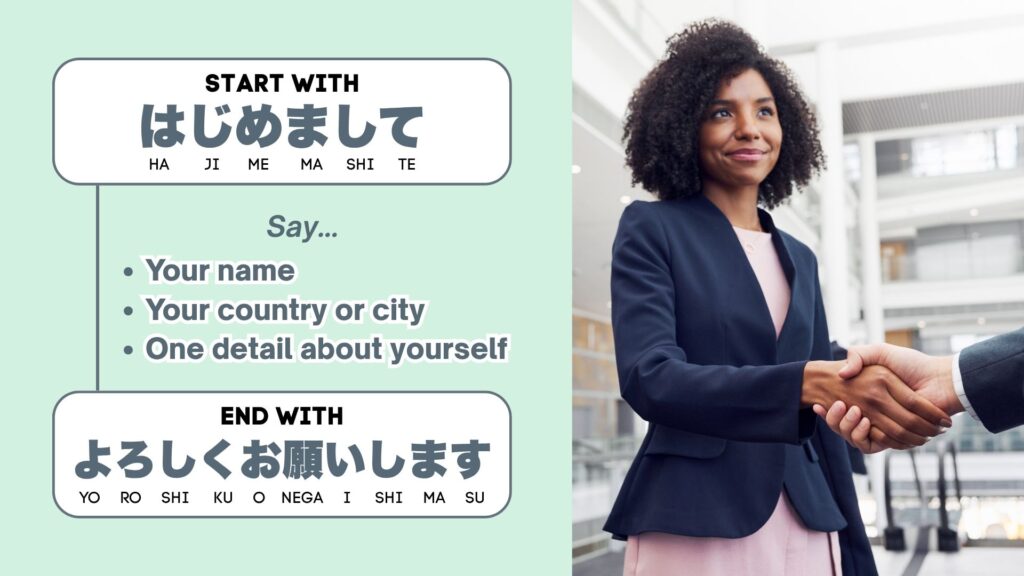
When introducing yourself in Japanese, keep it simple.
You do not need to make a long speech. A short and polite introduction is usually enough.
Here are some tips:
- Start with Hajimemashite
- Say your name clearly
- Add your country or city
- Add one simple detail about yourself
- End with Yoroshiku onegaishimasu
- Speak slowly and clearly
For beginners, accuracy and confidence are more important than using difficult sentences.
Why Self-Introduction Is Important for Beginners
Self-introduction is often one of the first speaking activities in Japanese class.
It helps learners practice:
- basic sentence patterns
- polite expressions
- pronunciation
- confidence in speaking
- simple communication
It also helps students understand how Japanese sentences work.
For example, many beginner phrases use desu, which is one of the first grammar points learners study in JLPT N5.
If you want to understand beginner grammar more clearly, you may also read JLRC’s JLPT N5 Grammar Guide.
Learn Japanese Step by Step with JLRC
Memorizing useful phrases is a good start, but beginners also need structure.
To communicate more confidently, students should learn:
- hiragana and katakana
- basic vocabulary
- simple grammar
- particles
- sentence patterns
- listening
- speaking practice
JLRC’s JLPT N5 course helps beginners build a foundation in Japanese step by step. Students learn basic Japanese grammar, vocabulary, reading, listening, and useful expressions in a structured way.
Students who want to begin their Japanese learning journey can explore JLRC’s JLPT N5 Japanese language course.
JLRC also welcomes international students who want to study Japanese online. You can also learn more about JLRC’s Japanese language education.
With structured lessons, beginners can make clearer progress with less wasted time.
Start with Simple Japanese Phrases
Learning how to introduce yourself in Japanese is a great first step.
You do not need to speak perfectly at the beginning. Start with simple phrases, practice regularly, and slowly build your confidence.
Once you can introduce yourself, you can begin learning more useful Japanese for class, travel, work, and JLPT preparation.
FAQ
How do you introduce yourself in Japanese?
A simple Japanese self-introduction can be: Hajimemashite. Watashi wa Maria desu. Firipin kara kimashita. Yoroshiku onegaishimasu. This means, “Nice to meet you. I am Maria. I am from the Philippines. I look forward to speaking with you.”
What does “Hajimemashite” mean?
Hajimemashite means “Nice to meet you.” It is usually used when meeting someone for the first time.
What does “Yoroshiku onegaishimasu” mean?
Yoroshiku onegaishimasu is a common Japanese phrase used at the end of a self-introduction. It can mean “Nice to meet you,” “I look forward to working with you,” or “Please treat me kindly,” depending on the situation.
Is self-introduction part of JLPT N5?
The JLPT N5 does not include a speaking test, but many self-introduction phrases use basic vocabulary and grammar that beginners study at N5 level.
Can JLRC help beginners learn Japanese from zero?
Yes. JLRC offers a structured JLPT N5 Japanese language course for beginners. Students can learn basic vocabulary, grammar, reading, listening, and useful classroom expressions step by step through JLRC’s course page: JLRC Japanese language courses.




Copyright © 2026 JLRC Inc.
All Rights Reserved
For international students, you may visit our Learn Japanese Online page.
For inquiries, you may call us at (63)2-7358-0565 or (63)917-163-3371
Japanese Language Research Center
Unit 506 Cityland Shaw Tower, Shaw Blvd, Mandaluyong, 1552 Metro Manila, Philippines
For international students, you may visit our Learn Japanese Online page.
For inquiries, you may call us at (63)2-7358-0565 or (63)917-163-3371
Japanese Language Research Center
Unit 506 Cityland Shaw Tower, Shaw Blvd, Mandaluyong, 1552 Metro Manila, Philippines
Copyright © 2026 JLRC Inc.
All Rights Reserved