
JLRC Blogs
- Courses
- Study Japan
- Materials
- Community
- About
- FAQ's
- Careers
- Class Details
- Login


20 Japanese Business Email Phrases: Essential Expressions for Work
JLRC - Content Team 2026/09/23

Writing a business email in Japanese can feel difficult, even for learners who already understand basic Japanese grammar.
This is because Japanese business emails often use polite expressions, formal sentence endings, and keigo. The message should sound respectful, clear, and professional.
For learners who want to use Japanese at work, learning common business email phrases is a practical step. These expressions can help you write simple emails to Japanese clients, managers, colleagues, teachers, or business partners.
In this guide, you will learn 20 Japanese business email phrases that are useful for workplace communication.
If you are still learning the basics of polite Japanese, you may also read JLRC’s Japanese Keigo for Work and Formal vs Informal Japanese.
Table of Contents
- Why Japanese Business Email Phrases Are Important
- Basic Structure of a Japanese Business Email
- Example: Simple Japanese Business Email
- Common Mistakes in Japanese Business Emails
- How to Study Japanese Business Email Phrases
- Why Structured Lessons Help with Business Japanese
- Learn Japanese Business Email Phrases with JLRC
- FAQ
Why Japanese Business Email Phrases Are Important
Japanese business communication is not only about correct grammar.
It is also about showing respect, choosing the right level of politeness, and making the message easy to understand.
In English, a simple email may begin with “Hello” and end with “Thank you.” In Japanese, business emails often use more formal expressions such as:
- お世話になっております
- 何卒よろしくお願いいたします
- ご確認のほどよろしくお願いいたします
- 申し訳ございません
- 恐れ入りますが
These phrases may sound long at first, but they are very common in Japanese workplace communication.
Learning them can help students understand real emails more easily and write more professional messages.
For practical workplace expressions, you may read JLRC’s 25 Japanese Phrases for Work.
Basic Structure of a Japanese Business Email
Before learning phrases, it is helpful to understand the basic structure of a Japanese business email.
A simple Japanese business email often follows this order:
- Recipient name or company name
- Greeting
- Self-introduction or company name
- Main message
- Request, confirmation, or explanation
- Closing expression
- Name and contact information
For beginners, the goal is not to write a perfect Japanese business email immediately.
The first goal is to understand common phrases and know where they are usually used.
1. お世話になっております。
Osewa ni natte orimasu.
Thank you for your continued support.
This is one of the most common opening phrases in Japanese business emails. It is often used after writing the recipient’s name.
Example:
田中様
お世話になっております。
Dear Mr./Ms. Tanaka,
Thank you for your continued support.
In many Japanese business emails, this phrase works like a professional greeting.
2. 初めてご連絡いたします。
Hajimete go-renraku itashimasu.
I am contacting you for the first time.
Use this when emailing someone for the first time. It sounds polite and professional.
Example:
初めてご連絡いたします。JLRCのサントスと申します。
I am contacting you for the first time. My name is Santos from JLRC.
This phrase is useful for first-time business communication.
3. 〇〇と申します。
〇〇 to moushimasu.
My name is 〇〇.
This is a polite way to introduce yourself.
Example:
JLRCのマリアと申します。
My name is Maria from JLRC.
In business emails, 申します sounds more formal than です.
4. ご連絡ありがとうございます。
Go-renraku arigatou gozaimasu.
Thank you for contacting us.
Use this when replying to someone’s message.
Example:
ご連絡ありがとうございます。
Thank you for contacting us.
This is simple, polite, and useful for customer or client emails.
5. メールを拝見いたしました。
Meeru o haiken itashimashita.
I have read your email.
This is a polite way to say that you have seen or read someone’s email. 拝見する is humble language used for “to look at” or “to read.”
Example:
メールを拝見いたしました。
I have read your email.
This phrase is useful when responding to a message or document.
6. ご確認をお願いいたします。
Go-kakunin o onegai itashimasu.
Please confirm. / Please check.
Use this when asking someone to check information.
Example:
添付ファイルをご確認お願いいたします。
Please check the attached file.
This is common in workplace emails.
7. ご確認のほどよろしくお願いいたします。
Go-kakunin no hodo yoroshiku onegai itashimasu.
Thank you for your confirmation. / Kindly check.
This is a more formal and softer way to ask for confirmation.
Example:
内容をご確認のほどよろしくお願いいたします。
Kindly check the contents.
This phrase is common in formal emails because it sounds respectful and indirect.
8. ご返信をお待ちしております。
Go-henshin o omachi shite orimasu.
I look forward to your reply.
Use this when waiting for a response.
Example:
ご返信をお待ちしております。
I look forward to your reply.
This is a polite closing phrase when you need a reply.
9. お手数をおかけいたしますが、よろしくお願いいたします。
Otesuu o okake itashimasu ga, yoroshiku onegai itashimasu.
We apologize for the trouble, but thank you for your cooperation.
This phrase is used when asking someone to do something that may require effort.
Example:
お手数をおかけいたしますが、よろしくお願いいたします。
We apologize for the trouble, but thank you for your cooperation.
It is very common in Japanese business communication.
10. 恐れ入りますが、〇〇をお願いいたします。
Osoreirimasu ga, 〇〇 o onegai itashimasu.
We are sorry to trouble you, but please 〇〇.
Use this when making a polite request.
Example:
恐れ入りますが、ご確認をお願いいたします。
We are sorry to trouble you, but please confirm.
This phrase helps make a request sound softer and more respectful.
11. 添付ファイルをご確認ください。
Tenpu fairu o go-kakunin kudasai.
Please check the attached file.
This is useful when sending documents.
Example:
添付ファイルをご確認ください。
Please check the attached file.
A more formal version is:
添付ファイルをご確認のほどよろしくお願いいたします。
Kindly check the attached file.
12. 〇〇についてご連絡いたしました。
〇〇 ni tsuite go-renraku itashimashita.
I am contacting you regarding 〇〇.
Use this when explaining the purpose of your email.
Example:
面接の日程についてご連絡いたしました。
I am contacting you regarding the interview schedule.
This phrase helps make the email purpose clear.
13. 〇〇について確認させていただきたく存じます。
〇〇 ni tsuite kakunin sasete itadakitaku zonjimasu.
I would like to confirm 〇〇.
This is a very polite way to say you want to confirm something.
Example:
お支払いについて確認させていただきたく存じます。
I would like to confirm the payment.
This phrase is useful in formal business emails.
14. 申し訳ございません。
Moushiwake gozaimasen.
We sincerely apologize.
This is a formal apology.
Example:
ご返信が遅くなり、申し訳ございません。
We sincerely apologize for the late reply.
It sounds more formal than すみません.
15. ご迷惑をおかけして申し訳ございません。
Go-meiwaku o okake shite moushiwake gozaimasen.
We sincerely apologize for the inconvenience.
Use this when your action or situation has caused trouble to the other person.
Example:
ご迷惑をおかけして申し訳ございません。
We sincerely apologize for the inconvenience.
This is common in customer service and business apology emails.
16. ご理解のほどよろしくお願いいたします。
Go-rikai no hodo yoroshiku onegai itashimasu.
Thank you for your understanding.
Use this when asking someone to understand a situation.
Example:
ご理解のほどよろしくお願いいたします。
Thank you for your understanding.
This phrase is often used when explaining changes, delays, or limitations.
17. ご検討のほどよろしくお願いいたします。
Go-kentou no hodo yoroshiku onegai itashimasu.
Thank you for your consideration.
Use this when asking someone to consider something.
Example:
ご検討のほどよろしくお願いいたします。
Thank you for your consideration.
This is useful for proposals, requests, or applications.
18. 何卒よろしくお願いいたします。
Nanitozo yoroshiku onegai itashimasu.
Thank you very much for your kind cooperation.
This is a formal closing expression.
Example:
何卒よろしくお願いいたします。
Thank you very much for your kind cooperation.
This phrase is more formal than よろしくお願いいたします.
19. 引き続きよろしくお願いいたします。
Hikitsuzuki yoroshiku onegai itashimasu.
Thank you for your continued support.
Use this when continuing communication or cooperation.
Example:
引き続きよろしくお願いいたします。
Thank you for your continued support.
This is useful for ongoing projects, work arrangements, or business relationships.
20. 以上、よろしくお願いいたします。
Ijou, yoroshiku onegai itashimasu.
That is all. Thank you.
This is a common closing phrase.
Example:
以上、よろしくお願いいたします。
That is all. Thank you.
It is simple, practical, and commonly used in business emails.
Example: Simple Japanese Business Email
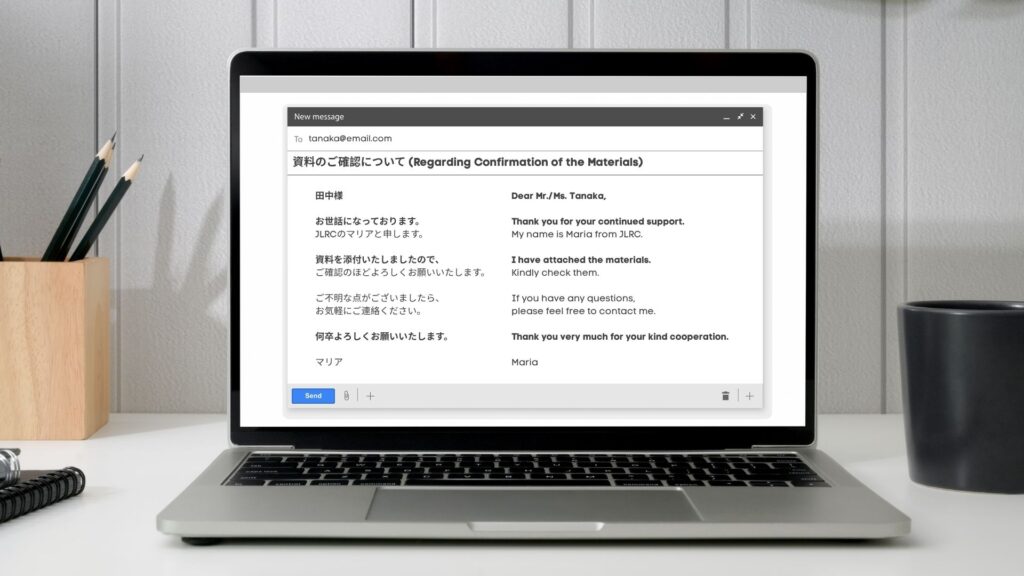
Here is a simple example using some of the phrases above.
件名:資料のご確認について
Subject: Regarding Confirmation of the Materials
田中様
お世話になっております。
JLRCのマリアと申します。
資料を添付いたしましたので、
ご確認のほどよろしくお願いいたします。
ご不明な点がございましたら、
お気軽にご連絡ください。
何卒よろしくお願いいたします。
マリア
English Translation
Dear Mr./Ms. Tanaka,
Thank you for your continued support.
My name is Maria from JLRC.
I have attached the materials.
Kindly check them.
If you have any questions,
please feel free to contact me.
Thank you very much for your kind cooperation.
Maria
Common Mistakes in Japanese Business Emails
Japanese business emails can be difficult because learners often translate directly from English.
Common mistakes include:
- using casual Japanese in formal emails
- using です / ます when stronger keigo is needed
- using sonkeigo and kenjogo incorrectly
- making requests too directly
- forgetting opening and closing expressions
- overusing machine translation without checking nuance
- writing long sentences that are hard to understand
For example, 見ました means “I saw it,” but in business emails, 拝見いたしました may sound more appropriate depending on the situation.
This is why learning business email phrases together with keigo is important.
How to Study Japanese Business Email Phrases
The best way to study business email phrases is not only to memorize them.
Learners should understand:
- when the phrase is used
- who the email is for
- how formal the situation is
- whether the phrase is for opening, request, apology, confirmation, or closing
- how the phrase sounds in real workplace communication
It is also helpful to practice writing short emails.
For example, students can practice emails for:
- requesting confirmation
- apologizing for a late reply
- sending a document
- asking about a schedule
- replying to an inquiry
- thanking someone for their response
Business Japanese becomes easier when learners study phrases by situation.
Why Structured Lessons Help with Business Japanese
Business Japanese is not only about vocabulary.
Learners need to understand politeness, keigo, sentence structure, tone, and workplace situations.
This can be difficult to master through random self-study.
JLRC helps learners build Japanese step by step through structured lessons, from beginner to advanced levels. Students can learn basic grammar, polite forms, JLPT preparation, and practical expressions used in work and communication.
Students who want to improve Japanese for work, JLPT, or career growth can explore JLRC’s Japanese language courses.
JLRC also provides structured Japanese language training for companies and organizations. Companies can learn more here: corporate Japanese language training.
You can also learn more about JLRC’s Japanese language education in the Philippines.
With structured lessons, learners can make clearer progress with less wasted time.
Learn Japanese Business Email Phrases with JLRC
Japanese business email phrases are useful for learners who want to use Japanese at work.
At first, expressions such as お世話になっております, ご確認のほどよろしくお願いいたします, and 何卒よろしくお願いいたします may feel long and difficult. But with practice, students can understand when and how to use them.
For learners who want to use Japanese at work, business email phrases can support clearer workplace communication, career development, and more professional interactions with Japanese companies, clients, managers, colleagues, or business partners.
If you are also preparing for Japanese job interviews, you may read JLRC’s Japanese Job Interview Questions and Phrases.
If you want to strengthen your Japanese for work, it is helpful to study not only phrases, but also grammar, keigo, listening, reading, and practical communication.
FAQ
What are common Japanese business email phrases?
Common Japanese business email phrases include お世話になっております, ご確認のほどよろしくお願いいたします, 申し訳ございません, 恐れ入りますが, and 何卒よろしくお願いいたします.
Is keigo necessary for Japanese business emails?
Yes. Keigo is very important in Japanese business emails because it helps show respect and professionalism. Learners should understand polite Japanese, sonkeigo, and kenjogo.
How do you start a Japanese business email?
A common way to start a Japanese business email is to write the recipient’s name, followed by お世話になっております. If it is your first time contacting the person, you can use 初めてご連絡いたします.
How do you end a Japanese business email?
Common closing phrases include よろしくお願いいたします, 何卒よろしくお願いいたします, and 引き続きよろしくお願いいたします.
Does JLRC teach Japanese for workplace communication?
Yes. JLRC offers structured Japanese language courses for learners who want to study Japanese for work, JLPT, or career growth. JLRC also provides Japanese language training for companies and organizations.




Copyright © 2026 JLRC Inc.
All Rights Reserved
For international students, you may visit our Learn Japanese Online page.
For inquiries, you may call us at (63)2-7358-0565 or (63)917-163-3371
Japanese Language Research Center
Unit 506 Cityland Shaw Tower, Shaw Blvd, Mandaluyong, 1552 Metro Manila, Philippines
For international students, you may visit our Learn Japanese Online page.
For inquiries, you may call us at (63)2-7358-0565 or (63)917-163-3371
Japanese Language Research Center
Unit 506 Cityland Shaw Tower, Shaw Blvd, Mandaluyong, 1552 Metro Manila, Philippines
Copyright © 2026 JLRC Inc.
All Rights Reserved