
JLRC Blogs
- Courses
- Study Japan
- Materials
- Community
- About
- FAQ's
- Careers
- Class Details
- Login


JLPT 2025 Global Statistics & Trends – Why More Learners Are Taking the Exam and How to Prepare
JLRC – Content Team
Updated 2025/08/08
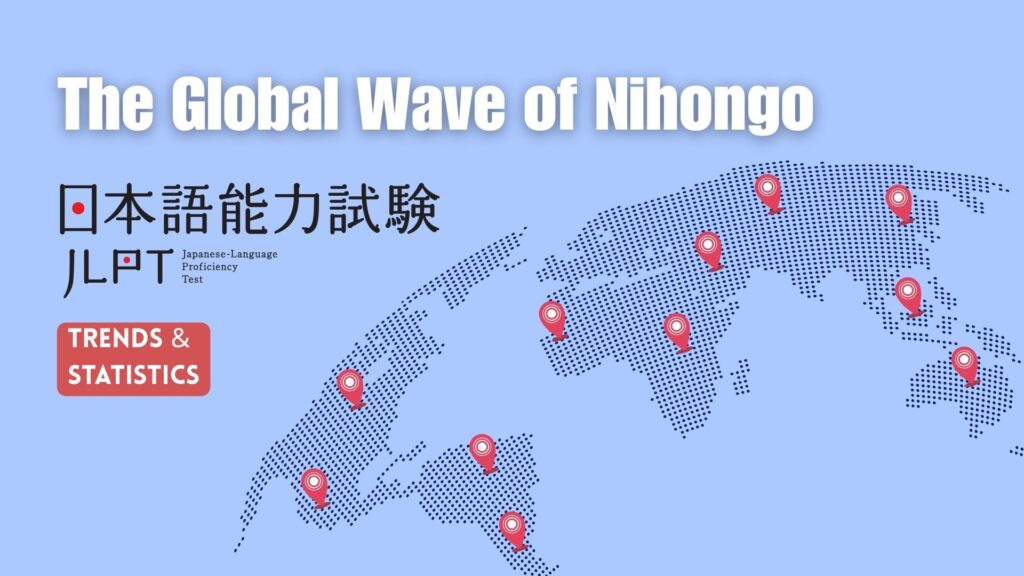
*This article summarizes the latest official JLPT statistics for 2025, including global participation, pass rates, regional trends, and difficulty levels, in one place for easy reference.
*JLPT 2025 recorded more than 1.64 million examinees worldwide, the highest annual total on record. In the December 2025 test, overall certification rates ranged from 50.2% for N5 to 29.8% for N1.
*These JLPT statistics help learners understand which level to take and how to prepare effectively.
If you're preparing for the JLPT, explore our online Japanese classes for international learners.
Table of Contents
- Introduction: Why the JLPT Matters More Than Ever
- The JLPT Boom: Record Numbers in 2025
- How Much Has the JLPT Grown Since the Pandemic?
- Where Are the Learners? A Global Distribution
- JLPT 2025 Statistics: Pass Rates by Level
- Why N2/N1 Are So Tough: The Hidden Weak Points
- Which JLPT Levels Attract the Most Learners?
- Spotlight: JLPT in the Philippines
- Regional Leaders: Who Drives the Numbers?
- A Growing Global Footprint
- What This Means for You as a Learner
- Conclusion: More Than Just Numbers
- Frequently Asked Questions About JLPT
Introduction: Why the JLPT Matters More Than Ever
Every year, hundreds of thousands of learners around the world sit for the Japanese Language Proficiency Test (JLPT). For many, it’s not just an exam—it’s a stepping stone to studying in Japan, landing jobs that require Nihongo proficiency, or proving their Japanese language skills.
But beyond personal goals, the JLPT itself is a fascinating mirror of global trends: where Japanese language is being learned, how many people are investing their time in it, and which regions are driving the growth.
With the latest official JLPT data from 2025, we can take a closer look at how this exam has become a truly worldwide phenomenon.
The JLPT Boom: Record Numbers in 2025
If you thought Japanese learning was a niche pursuit, think again.
According to the official JLPT statistics for 2025, the JLPT reached a new annual high with 1,940,852 applicants and 1,645,713 examinees worldwide. This was up from 1,470,989 examinees in 2024—an increase of approximately 11.9% in just one year.
The official JLPT statistics also identify 2025 as the year with the largest number of applicants ever recorded.
Clearly, interest in Japanese language learning and JLPT certification continues to expand worldwide.
For Japanese language schools like JLRC in the Philippines, this growth translates into a continuing need for structured Japanese language programs and JLPT preparation courses.
How Much Has the JLPT Grown Since the Pandemic?
One of the clearest trends in recent JLPT statistics is the rapid recovery and expansion of test participation following the pandemic.
In 2021, 684,907 people took the JLPT worldwide. By 2024, the number had reached 1,470,989, and in 2025 it rose further to 1,645,713 examinees.
That means the annual number of JLPT examinees has more than doubled compared with 2021.
| Year | JLPT Examinees Worldwide |
|---|---|
| 2021 | 684,907 |
| 2024 | 1,470,989 |
| 2025 | 1,645,713 |
The pandemic affected JLPT administration significantly—in 2020, for example, the July examination was cancelled worldwide. The strong increase since then therefore reflects both the restoration of international testing and continuing global demand for Japanese language proficiency.For learners, this also means it is increasingly important to plan both exam registration and preparation well in advance.
Where Are the Learners? A Global Distribution
So, where exactly are people taking the JLPT?
The December 2025 examination gives us a useful snapshot.
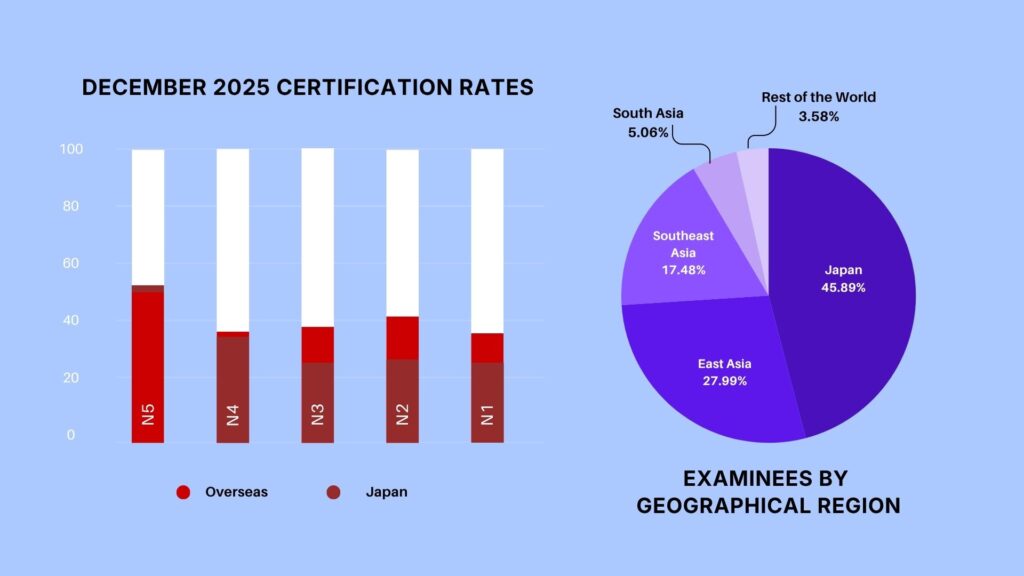
- Japan: 402,228 examinees (45.89%)
- East Asia: 245,313 (27.99%)
- Southeast Asia: 153,213 (17.48%)
- South Asia: 44,330 (5.06%)
- Other regions: 31,400 (3.58%)
In total, 876,484 people took the December 2025 JLPT worldwide.
Japan alone accounted for about 46% of examinees, while East and Southeast Asia together represented another very large share.
On the bubble-style world map above, you can see just how dominant Asia is in the JLPT landscape.
This highlights an important truth: Japanese is not studied only in Japan—it has become an important language skill across Asia.
JLPT 2025 Statistics: Pass Rates by Level
Of course, it’s not just about sitting the exam—it’s about passing.
The December 2025 statistics show some interesting differences between learners taking the test in Japan and those taking it overseas:
That means the annual number of JLPT examinees has more than doubled compared with 2021.
| Level | Overseas | Japan | Overall |
|---|---|---|---|
| N5 | 50.0% | 53.5% | 50.2% |
| N4 | 35.3% | 33.6% | 34.6% |
| N3 | 37.5% | 26.2% | 31.2% |
| N2 | 40.9% | 25.4% | 33.0% |
| N1 | 34.2% | 24.0% | 29.8% |
These are the data from official December 2025 JLPT statistics.
N5 had the highest overall certification rate at 50.2%, while N1 recorded 29.8%.
Interestingly, overseas certification rates were higher than Japan’s at N1 through N4 in December 2025. However, the official statistics do not explain why, so the difference should not automatically be attributed to motivation, nationality, or study behavior.
👉 Overall, the figures illustrate the challenge of progressing through the JLPT levels, particularly toward N2 and N1.
To improve your chances of passing, consider structured learning through our online Japanese classes.
Or explore our Japanese Language Courses (N5–N1).
Why N2/N1 Are So Tough: The Hidden Weak Points
Looking deeper, advanced JLPT levels present several challenges that become increasingly important as learners progress.
Reading Speed
At N2 and N1, learners must process longer and more complex texts within limited time.
Understanding individual grammar points and vocabulary is not enough. Candidates also need to identify arguments, relationships between ideas, and the writer’s intention quickly.
Kanji & Vocabulary Density
From N3 upward, learners encounter an increasingly wide range of vocabulary and kanji.
At N2 and N1, passages may contain more abstract expressions, formal vocabulary, compound words, and language that learners may not frequently encounter in everyday conversation.
👉 In short, progressing from beginner to advanced JLPT levels requires not only accumulating knowledge but also developing stronger reading, listening, and processing skills.
Which JLPT Levels Attract the Most Learners?
Another interesting way to understand the JLPT is to look at which levels attract the largest number of applicants worldwide.
Combining the July and December 2025 examinations gives the following picture:
| JLPT Level | 2025 Applicants Worldwide |
|---|---|
| N3 | 546,117 |
| N2 | 495,080 |
| N4 | 435,575 |
| N1 | 284,856 |
| N5 | 179,224 |
These totals are calculated from the official July and December 2025 JLPT statistics.
What stands out is that N3 attracted the largest number of applicants worldwide in 2025, followed by N2.
This shows that global JLPT participation is not driven only by beginners. A very large proportion of candidates are studying at intermediate and advanced levels and continuing their Japanese learning beyond N5 and N4.
The pattern differs by country, however. In some markets—including the Philippines—N4 and N5 account for a much larger share of applicants.
For learners, this is an encouraging sign: the JLPT pathway is not simply about taking one examination. Many students continue progressing from beginner Japanese toward N3, N2, and ultimately N1.
Spotlight: JLPT in the Philippines
The Philippines continues to have a substantial JLPT learner community in Southeast Asia.
Official 2025 statistics recorded 12,900 JLPT applications across the July and December examinations combined, with 10,714 people actually taking the test.
By level, the Philippines recorded:
| Level | 2025 Applicants |
|---|---|
| N5 | 3,637 |
| N4 | 5,726 |
| N3 | 2,079 |
| N2 | 1,002 |
| N1 | 179,224 |
| Total | 12,900 |
The figures are calculated from the official July and December test-site statistics. In July, the Philippines recorded 6,647 applicants and 5,336 examinees; in December, there were 6,253 applicants and 5,378 examinees.
The most striking feature is the strength of the beginner and lower-intermediate levels.
N4 alone accounted for more than 44% of all Philippine JLPT applications in 2025, while N4 and N5 combined accounted for more than 72%.
At the same time, more than 3,500 applications were recorded at N3 through N1, showing that a meaningful number of Filipino learners are continuing toward intermediate and advanced Japanese.
The Philippine testing network also extended beyond Manila. In July 2025, tests were recorded in Manila, Cebu, Davao, and Cagayan de Oro, while the December examination was conducted in Manila, Cebu, and Davao.
For Japanese language schools like JLRC, this data confirms the importance of offering a clear learning pathway from beginner Japanese through all JLPT levels.
Regional Leaders: Who Drives the Numbers?
Asia remains the center of global JLPT participation.
In December 2025 alone:
- East Asia: 308,389 applicants / 245,313 examinees
- Southeast Asia: 188,502 applicants / 153,213 examinees
- South Asia: 54,504 applicants / 44,330 examinees
Among the major JLPT markets were countries and regions such as China, Korea, Taiwan, Myanmar, Vietnam, Indonesia, India, and others.
Southeast Asia is particularly notable.
Myanmar recorded more than 85,000 applicants for the December 2025 examination, while Vietnam had more than 35,000 and Indonesia more than 34,000.
These numbers show just how deeply Japanese language learning has expanded throughout the region.
The Philippines remains part of this growing Southeast Asian JLPT ecosystem, supported by learners pursuing Japanese for education, employment, career development, and personal goals.
A Growing Global Footprint
Another striking trend is the JLPT’s broad international reach.
Across the full year, the 2025 JLPT was conducted across 92 countries and areas, according to the official JLPT annual statistics.
The test now connects Japanese learners across Asia, Europe, the Americas, Oceania, Africa, and other regions.
This growing global footprint shows that Japanese language learning is no longer limited to a relatively small number of countries.
It has become an international field of study connecting learners with education, careers, culture, travel, and opportunities involving Japan.
What This Means for You as a Learner
So, how should you use this data as a learner?
Book early.
In high-demand testing locations, available slots may be limited. Check registration periods well in advance.
Choose a realistic level.
If you are a beginner, N5 or N4 provides a structured starting point before progressing toward the intermediate levels.
Set a clear purpose.
Define why you’re taking the exam—career advancement, study in Japan, professional development, or personal achievement. A clear goal can help sustain motivation.
Prepare for more than vocabulary and grammar.
At higher levels, reading speed, listening comprehension, vocabulary range, and the ability to process complex Japanese become increasingly important.
Use a structured learning pathway.
JLRC offers Japanese language courses covering JLPT N5 through N1, allowing learners to progress systematically from beginner to advanced Japanese.
Explore our Japanese Language Courses (N5–N1).
👉 You can also explore the Japanese Learning Materials for JLPT used in JLRC courses.
Conclusion: More Than Just Numbers
The JLPT is not simply an exam—it represents a global community of learners studying Japanese for many different reasons.
The data shows us the scale, but behind every number is a learner pursuing a goal: studying in Japan, developing a career, communicating in Japanese, or simply achieving a personal milestone.
And the scale continues to grow.
With 1,645,713 examinees worldwide in 2025, the JLPT reached its highest annual participation level on record. The number of examinees was approximately 11.9% higher than in 2024 and more than twice the level recorded in 2021.
At JLRC, a trusted Japanese language school in the Philippines, we’ve trained over 16,500 students since 2001, and our mission remains the same: to deliver high value in Japanese language education with less time, less cost, and less effort.
Because in the end, the JLPT is not just about passing a test—it’s about opening doors.
Start your JLPT journey today with our Japanese Language Courses and receive full details on schedules, tuition, and enrollment.Frequently Asked Questions About JLPT
1. What is the pass rate for JLPT?
JLPT certification rates vary depending on the level and examination session. In December 2025, the overall certification rate was 50.2% for N5, 34.6% for N4, 31.2% for N3, 33.0% for N2, and 29.8% for N1.
2. Is JLPT N1 difficult?
Yes. N1 is the highest JLPT level and requires advanced vocabulary, kanji, grammar, reading, and listening comprehension. In December 2025, the worldwide N1 certification rate was 29.8%.
3. How long does it take to pass JLPT?
There is no fixed amount of time because progress depends on your starting level, study frequency, previous Japanese experience, and learning environment. A structured course can help learners progress systematically through each JLPT level.
4. Which JLPT level should I start with?
Complete beginners generally begin with N5. Learners who already have Japanese knowledge should evaluate their vocabulary, kanji, grammar, reading, and listening skills before selecting a level.
JLRC offers structured Japanese Language Courses from N5 to N1.
5. Is JLPT required to work in Japan?
Not for every job. Requirements depend on the employer, occupation, and visa or professional requirements. However, JLPT certification—particularly N2 or N1—is commonly used as evidence of Japanese language proficiency for certain employment and academic opportunities.
6. Can I pass JLPT without attending a language school?
Yes. Some learners successfully prepare independently. However, structured classes can provide a systematic curriculum, instructor guidance, regular study progress, and preparation across vocabulary, kanji, grammar, reading, and listening. vocabulary gaps.
JLRC provides online Japanese classes for international learners as well as courses for students in the Philippines.




Copyright © 2026 JLRC Inc.
All Rights Reserved
For international students, you may visit our Learn Japanese Online page.
For inquiries, you may call us at (63)2-7358-0565 or (63)917-163-3371
Japanese Language Research Center
Unit 506 Cityland Shaw Tower, Shaw Blvd, Mandaluyong, 1552 Metro Manila, Philippines
For international students, you may visit our Learn Japanese Online page.
For inquiries, you may call us at (63)2-7358-0565 or (63)917-163-3371
Japanese Language Research Center
Unit 506 Cityland Shaw Tower, Shaw Blvd, Mandaluyong, 1552 Metro Manila, Philippines
Copyright © 2026 JLRC Inc.
All Rights Reserved