


JLPT Certificate Philippines: Salary, Jobs & Career Opportunities for Filipinos

JLRC - Content Team 2025/08/23 Last updated: 2026/04/08

A JLPT certificate in the Philippines can increase salary by 30–70%, open job opportunities in BPO, IT, and Japanese companies, and support study or work in Japan.

Introduction:

A JLPT certificate in the Philippines can increase salary by 30–70%, open job opportunities in BPO, IT, and Japanese companies, and support study or work in Japan.

The Japanese Language Proficiency Test (JLPT) has become one of the most valuable certifications for Filipinos seeking to enhance their careers both locally and abroad. More than just an exam, the JLPT certificate proves your ability to use Japanese in real-world contexts whether in customer service, IT, healthcare, or even advanced academic studies in Japan.

But many learners still wonder:

“How exactly can my JLPT certificate help me in the Philippines and beyond?”

As one of the largest Japanese language schools / Nihongo training centers in the Philippines since 2001, JLRC (Japanese Language Research Center) has guided over 16,000 learners in mastering Nihongo. With our long-standing expertise, let us show you how you can transform your JLPT certificate into real opportunities for your career and future.

If you're planning to earn a JLPT certificate, explore our Japanese Language Courses in the Philippines.

Table of Contents

JLPT Career Guide
  1. Strengthen Your Resume for Japanese Companies in the Philippines
  2. Career Growth in BPO and Shared Service Centers
  3. Opportunities in IT, Engineering, and Specialized Fields
  4. Internship, Technical Intern Training, and SSW Programs
  5. Study in Japan with JLRC’s SIJP (Study in Japan Program)
  6. JLRC’s Certificate of Completion – A Widely Recognized Qualification
  7. Why JLRC is Your Best Partner for JLPT and Career Growth
  8. Final Thoughts

1. Strengthen Your Resume for Japanese Companies in the Philippines

Japanese companies play a major role in the Philippine economy, operating in Metro Manila, Cebu, Clark, Davao, and other hubs. These companies highly value employees who can communicate in Japanese language, bridging local teams with Japanese management and clients.

A JLPT certificate on your resume:

  • Serves as international proof of proficiency.
  • Instantly gives you an advantage in competitive hiring pools
  • Qualifies you for bilingual roles in BPO, IT, manufacturing, trading, and customer service

👉 For example, many BPO firms require JLPT N3 or higher for Japanese account handling. Some even offer salary premiums or special allowances for JLPT-certified staff.

2. Career Growth in BPO and Shared Service Centers

The BPO industry is one of the Philippines’ most dynamic sectors, and Japanese accounts are in constant demand. Bilingual professionals are required to:

  • Answer calls and chats from Japanese clients
  • Translate contracts, manuals, and reports
  • Coordinate between Japanese managers and Filipino staff

JLPT N3 passers often qualify for higher-level roles such as Quality Analysts, Team Leaders, or Trainers.

JLPT N4 passers may start in entry-level support roles but can quickly climb the ladder with continuous improvement.

👉 Structured JLPT preparation can significantly improve your chances of qualifying for higher-paying roles. Learn more about our JLPT-focused Japanese courses.

Salary Insight:
✅ Real impact: Employees with JLPT certification often earn 30–70% higher salaries compared to their non-certified peers in the same industry, while exact figures vary by company and industry.

3. Opportunities in IT, Engineering, and Specialized Fields

The demand for JLPT-certified professionals is not limited to call centers.

When evaluating a school’s program, check if it includes:

  • IT outsourcing: Japanese firms seek bilingual developers and engineers who can troubleshoot and communicate directly with their Japanese counterparts. JLPT N3–N2 is often required.
  • Engineering and manufacturing: Companies in electronics, automotive, and heavy industry hire engineers who can read Japanese technical documentation or liaise with Japanese auditors.
  • Healthcare and nursing: Under the Japan-Philippines Economic Partnership Agreement (JPEPA), Filipino nurses and caregivers need JLPT certification (N4–N2) to continue employment in Japan.

In these industries, JLPT is not just an advantage. It is often a requirement.

4. Internship, Technical Intern Training, and SSW Programs

JLPT also plays a vital role in migration and training pathways to Japan.

  • Technical Intern Training Program (TITP): Accepts Filipinos for practical training in industries such as agriculture, construction, food processing, caregiving, and hospitality. JLPT N5 or N4 may be sufficient for entry, depending on the employer and sector.
  • Specified Skilled Worker (SSW): Introduced to address Japan’s labor shortages in 14 industries (including nursing care, food service, construction, aviation). Here, N4 is generally the benchmark, though in some industries N5 passers are considered.
  • Internships and on-the-job training: Universities and companies often use JLPT as proof of readiness for study-abroad programs or training exchange.

👉 This means that even JLPT N5 can be a gateway to Japan, while higher levels expand your career and earning potential.

5. Study in Japan with JLRC’s SIJP (Study in Japan Program)

JLRC not only prepares you for JLPT but also connects you with our partner Japanese schools in Japan through its SIJP (Study in Japan Program).

With SIJP, students can:

  • Secure admission to partner schools in Japan
  • Get assistance with student visa documentation, admission guidance, and orientation
  • Transition from studying in the Philippines to pursuing long-term education and careers in Japan

For Filipinos aspiring to study or work in Japan, SIJP is a proven bridge built by JLRC’s strong network of trusted institutions.

👉 Learn more about JLRC’s Study in Japan Program (SIJP) and how it can help you start your journey in Japan.
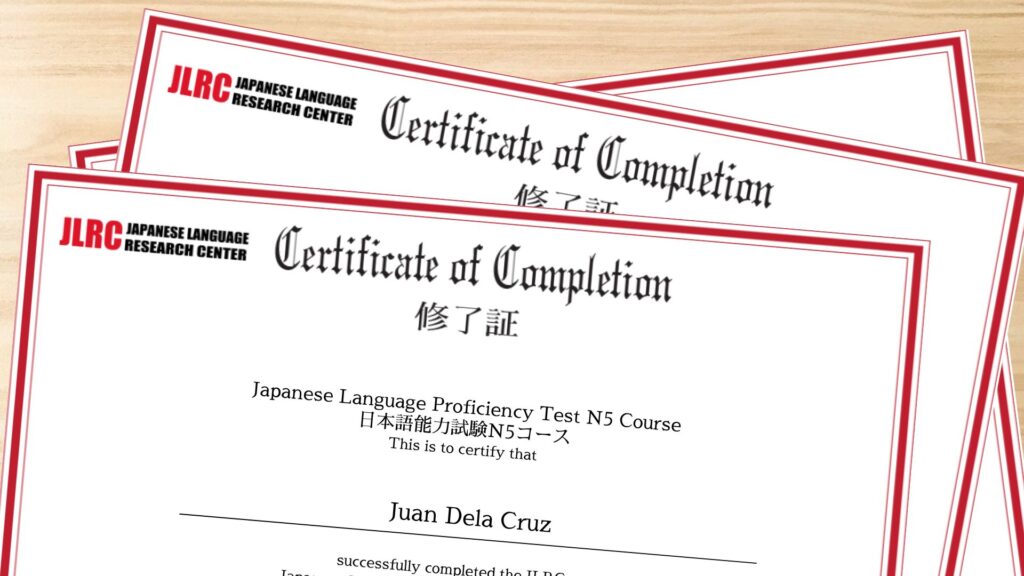
6. JLRC’s Certificate of Completion – A Widely Recognized Qualification

Apart from JLPT, JLRC also issues its own Certificate of Completion to students who fulfill its JLPT classes requirements, including attendance and passing marks in quizzes and mock exams.

This certificate is:

  • Recognized by BPO providers, institutions, and Japanese companies in the Philippines
  • Acknowledged by Japanese schools and employers as proof of formal Japanese language training
  • Accepted by Japan Immigration for certain visa processes

This means you can leverage JLRC’s Nihongo class / JLPT course certificate for both local job applications and Japan-related opportunities even as you continue working toward higher JLPT levels.

JLPT certificate Philippines

Why JLRC is Your Best Partner for JLPT and Career Growth

At JLRC, we combine over two decades of Nihongo teaching experience with innovative Japanese language training methods to ensure success.

  • Over 16,000 graduates since 2001
  • Original JLPT-focused materials are designed to help learners achieve maximum results with less time and effort.
  • Proven track record with thousands of successful JLPT passers
  • Comprehensive support: JLPT prep, Certificates of Completion, SIJP programs, and long-term guidance

👉 Learn more about the materials used in our courses: Japanese learning materials.

Final Thoughts

Your JLPT certificate is not just a test result—it is a powerful career asset in the Philippines and a gateway to opportunities in Japan. From higher salaries and better job roles to study abroad and international career paths, JLPT certification can significantly shape your future.

At JLRC, we go beyond exam preparation. With over two decades of experience and more than 16,000 successful learners, we provide structured Japanese language training designed to help you achieve results with less time, less cost, and less effort.

Whether your goal is career advancement, working in Japan, or simply mastering Nihongo, the right guidance and learning approach can make all the difference.

👉 Start your Japanese learning journey today with our Nihongo classes in the Philippines and receive full details on schedules, fees, and enrollment.

Your skills, career growth, and future opportunities begin with the right step.

**Source: Based on industry data and JLPT trends in the Philippines and Japan.**

Frequently Asked Questions

1. Is JLPT worth it in the Philippines?

Yes, a JLPT certificate is highly valuable in the Philippines. It improves your chances of getting hired in Japanese companies, BPOs, and IT firms, and serves as recognized proof of your language ability. It can also open opportunities for study and work in Japan, making it a practical investment for long-term career growth.

2. How much salary increase can JLPT bring?

JLPT-certified professionals often earn around 30–70% higher salaries, especially in BPO and IT roles. Higher levels such as N2 or N1 can lead to better positions, language allowances, and more career opportunities, depending on the company and industry.

3. What JLPT level is required for jobs?

For entry-level roles, N4 or N3 may be sufficient. However, most companies prefer N2 or higher for professional positions. N3 is often considered the minimum for workplace communication, while N2 is the standard for more advanced roles.

4. Can I work in Japan with JLPT?

Yes, JLPT is often required for working in Japan, especially under programs like SSW and JPEPA. While lower levels may be accepted for some roles, N3 or higher is generally preferred for long-term employment and career stability.

5. Is N5 enough to get a job?

N5 can help you start, but it is usually not enough for most jobs. Many employers require at least N4 or N3, as these levels show better communication skills and readiness for workplace tasks.

6. Can I pass JLPT without attending a language school?

It is possible to pass N5 or N4 through self-study, though many learners face challenges at higher levels such as N3, N2, and N1. Structured programs can help improve efficiency, reduce study time, and address common issues like reading speed and vocabulary gaps.

👉 For learners worldwide, you can explore our online Japanese learning programs.

JLRC Japanese Language School logo
Community
Other Services

For international students, you may visit our Learn Japanese Online page.

For inquiries, you may call us at (63)2-7358-0565 or (63)917-163-3371

Japanese Language Research Center

Unit 506 Cityland Shaw Tower, Shaw Blvd, Mandaluyong, 1552 Metro Manila, Philippines

JLRC

For international students, you may visit our Learn Japanese Online page.

For inquiries, you may call us at (63)2-7358-0565 or (63)917-163-3371

Japanese Language Research Center

Unit 506 Cityland Shaw Tower, Shaw Blvd, Mandaluyong, 1552 Metro Manila, Philippines

Copyright © 2026 JLRC Inc.
All Rights Reserved