
JLRC Blogs
- Courses
- Study Japan
- Materials
- Community
- About
- FAQ's
- Careers
- Class Details
- Login


JLPT N4 Study Guide: How to Move Up After N5
JLRC - Content Team 2026/06/02

Completing JLPT N5 is an important first step in Japanese learning.
At N5 level, learners build the foundation of Japanese: hiragana, katakana, basic kanji, simple grammar, essential vocabulary, short reading passages, and basic listening skills.
But after N5, many students ask the same question:
“What should I study next for JLPT N4?”
JLPT N4 is still a beginner-level exam, but it is clearly one step above N5. Sentences become longer, vocabulary becomes wider, and reading and listening tasks require more confidence.
This guide explains what changes from N5 to N4, what you should study, common challenges learners face, and how structured lessons can help you move forward more efficiently.
Table of Contents
- What Is JLPT N4?
- JLPT N5 vs N4: What Changes?
- What You Should Review Before Starting N4
- What to Study for JLPT N4
- Common Challenges When Moving from N5 to N4
- How Long Does It Take to Prepare for JLPT N4 After N5?
- Why Structured Lessons Help N4 Learners
- How JLRC Supports Students Moving from N5 to N4
- Should You Take a JLPT N4 Course?
- Start Your JLPT N4 Learning Path
- FAQ
What Is JLPT N4?
JLPT N4 is the second beginner level of the Japanese-Language Proficiency Test.
It is designed for learners who already understand basic Japanese and are ready to handle more practical daily expressions.
At N4 level, students are expected to understand basic Japanese used in everyday situations. This includes simple conversations, short written passages, and common grammar patterns.
Compared with N5, N4 requires learners to:
- understand longer sentences
- recognize more vocabulary
- read longer simple passages
- listen to slightly more natural conversations
- use more grammar patterns
- understand daily-life Japanese more confidently
In simple terms, N5 gives you the foundation, while N4 helps you use that foundation more actively.
JLPT N5 vs N4: What Changes?
The move from N5 to N4 is not just about learning more words. It is about using Japanese with more flexibility.
In the Philippines, some Japanese bilingual roles may offer higher salary potential than ordinary entry-level positions. This is often because companies need people who can communicate across languages, support Japanese clients, or work with Japanese-speaking teams.
Japanese skills may become more valuable when combined with fields such as:
| Area | JLPT N5 | JLPT N4 |
|---|---|---|
| Grammar | Basic sentence patterns | More connected and practical expressions |
| Vocabulary | Essential daily words | Wider daily-life vocabulary |
| Kanji | Introductory kanji | More common beginner kanji |
| Reading | Very short passages | Longer simple passages |
| Listening | Slow and basic conversations | More natural daily conversations |
| Study focus | Foundation building | Expanding usage and confidence |
Many students feel that N4 is the level where Japanese starts to become more “real.” You begin to understand more daily expressions and connect ideas more naturally.
However, this also means you need stronger review habits. If your N5 foundation is weak, N4 can feel much harder than expected.
What You Should Review Before Starting N4
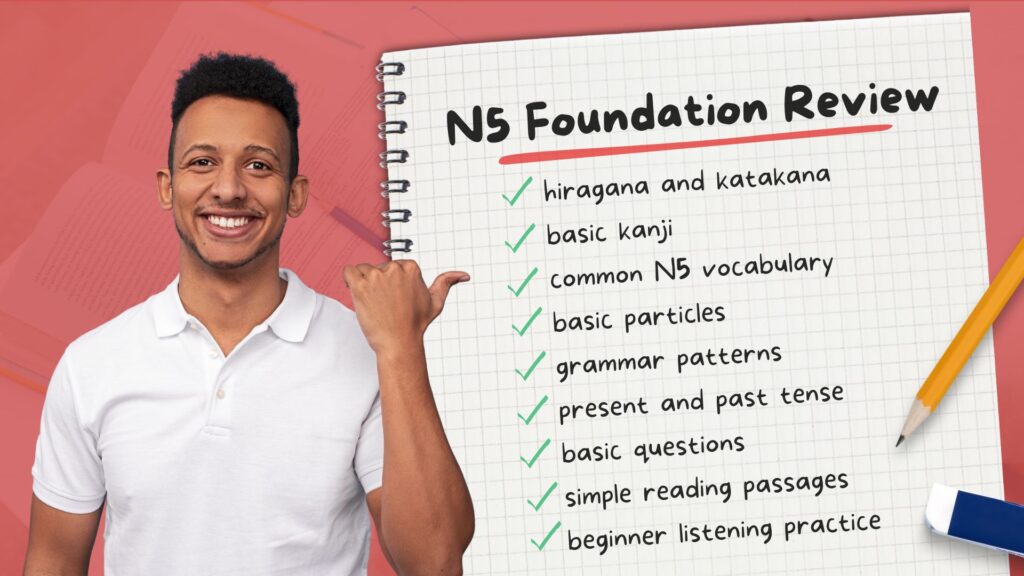
Before moving fully into N4 study, it is important to check your N5 foundation.
You should be comfortable with:
- hiragana and katakana
- basic kanji
- common N5 vocabulary
- basic particles such as は, が, を, に, で
- noun, adjective, and verb sentence patterns
- present and past tense
- basic questions
- simple reading passages
- beginner listening practice
If these areas still feel unclear, you do not need to feel discouraged. Many learners need review before moving forward.
A good N4 study plan should include both N5 review and new N4 learning. Skipping review may save time in the short term, but it often causes confusion later.
What to Study for JLPT N4
To prepare for JLPT N4, students should study grammar, vocabulary, kanji, reading, and listening together.
1. N4 Grammar
N4 grammar expands your ability to express ideas.
You will study patterns that help you talk about:
- reasons
- conditions
- experiences
- obligations
- comparisons
- intentions
- changes
- advice
- actions happening at the same time
N4 grammar is important because it helps you move beyond very simple sentences.
2. N4 Vocabulary
N4 vocabulary includes more words used in daily life.
You may need to learn words related to school, work, health, transportation, shopping, family, hobbies, weather, daily routines, feelings, and opinions.
The challenge is not only memorizing more words. You also need to understand how words appear in sentences, questions, and reading passages.
3. N4 Kanji
N4 kanji increases the amount of Japanese you can read.
At this level, students should continue building kanji recognition step by step. You do not need to master everything immediately, but you should review regularly.
Kanji becomes easier when you study it together with vocabulary, not as isolated symbols.
4. Reading and Listening Practice
N4 reading passages are longer than N5 passages. Students need to understand the main idea, follow sentence connections, and recognize grammar patterns in context.
N4 listening is still basic, but it may feel faster and more natural than N5. Students should practice short conversations, daily situations, classroom expressions, and common spoken grammar patterns.
Short, regular practice is better than rare long study sessions.
Common Challenges When Moving from N5 to N4

Many students find N4 challenging not because it is impossible, but because it requires stronger study habits.
Common challenges include:
- forgetting N5 grammar
- confusing particles
- feeling overwhelmed by new vocabulary
- struggling with longer reading passages
- finding listening practice too fast
- studying grammar but not using it actively
- trying to memorize without review
One common mistake is treating N4 as a completely separate level. In reality, N4 builds directly on N5.
If N5 is weak, N4 becomes heavy. If N5 is reviewed well, N4 becomes much easier to manage.
The key is not to rush from N5 to N4. The key is to move forward with structure.
How Long Does It Take to Prepare for JLPT N4 After N5?
The time needed to prepare for JLPT N4 depends on your current level, study schedule, review habits, and learning method.
Your preparation time may depend on:
- how strong your N5 foundation is
- how often you attend class
- how much you review after lessons
- how much vocabulary and kanji you remember
- whether you practice listening regularly
- whether you study with a clear plan
Faster progress does not mean rushing. It means reducing wasted time by learning in the right order, reviewing properly, and receiving guidance when needed.
Why Structured Lessons Help N4 Learners
JLPT N4 requires more organization than N5.
At N5, many students can still survive by memorizing basic words and grammar patterns. At N4, this becomes harder. You need to connect what you learn and use it in reading, listening, and communication.
Structured lessons help because they provide:
- clear lesson order
- level-based progression
- grammar explained in context
- vocabulary connected to each topic
- regular review
- listening and reading practice
- teacher correction
- materials matched to the level
This is where JLRC’s learning approach becomes useful.
JLRC develops Japanese learning materials that support step-by-step study from beginner to higher levels. These materials are designed to help learners review, practice, and connect each lesson to their next level of progress.
For N4 learners, having the right structure can reduce confusion and help them continue toward N3 and higher levels.
How JLRC Supports Students Moving from N5 to N4
JLRC supports Japanese learners through structured courses, trained instructors, original materials, and level-based learning paths.
For students moving from N5 to N4, the goal is not simply to study more. The goal is to strengthen the foundation and expand Japanese ability in a clear order.
JLRC’s N4 learning support focuses on:
- reviewing important N5 foundations
- introducing N4 grammar step by step
- building vocabulary and kanji gradually
- improving reading and listening skills
- helping students continue toward N3, N2, and N1
- providing group class and 1-on-1 options depending on student needs
JLRC is a Japanese language school in the Philippines that supports learners from beginner to higher JLPT levels through structured Japanese language education.
Students who want to understand the full JLPT path can read JLRC’s guide on JLPT courses from N5 to N1.
Should You Take a JLPT N4 Course?
You can study for JLPT N4 on your own, especially if you are disciplined and have good materials.
However, a structured course can help if you:
- are not sure what to study next
- need review of N5 foundations
- struggle with grammar explanations
- need listening and reading practice
- want teacher correction
- study better with a regular schedule
- plan to continue to N3 or higher
A course can help students avoid random study and stay on track.
This is especially useful for learners who want to progress efficiently instead of repeating the same basics without clear direction.
If you are looking for a clear path from N5 to higher JLPT levels, you can explore JLRC’s Japanese language courses.
For students outside the Philippines, JLRC also offers options to learn Japanese online from anywhere.
Start Your JLPT N4 Learning Path
JLPT N4 is an important step after N5.
It helps learners expand their Japanese from basic sentence patterns to more practical daily communication. It also prepares students for N3, where Japanese becomes more useful for work, study, and real-life situations.
To prepare for N4 effectively, remember:
- review your N5 foundation
- study N4 grammar in context
- increase vocabulary gradually
- review kanji regularly
- practice reading short passages
- listen to Japanese often
- follow a clear learning path
- avoid random study
With the right structure, N4 becomes a manageable and meaningful next step.
FAQ
What is JLPT N4?
JLPT N4 is the second beginner level of the Japanese-Language Proficiency Test. It tests basic Japanese used in everyday situations, including grammar, vocabulary, kanji, reading, and listening.
Is JLPT N4 much harder than N5?
N4 is harder than N5 because it includes more grammar, vocabulary, kanji, reading, and listening. However, it becomes manageable if your N5 foundation is strong.
What should I study after JLPT N5?
After JLPT N5, students should review N5 grammar and vocabulary, then begin studying N4 grammar, vocabulary, kanji, reading, and listening step by step.
Do I need JLPT to use Japanese at work?
Not always. Some jobs focus on practical communication, while others require JLPT certification. It depends on the company, position, and responsibilities.
Can I study JLPT N4 online?
Yes. JLPT N4 can be studied online if the course is structured, interactive, and includes teacher guidance, materials, review, reading, and listening practice.
Should I take a JLPT N4 course?
A JLPT N4 course can help if you need structure, teacher explanations, review support, and a clear path from N5 to N4 and higher levels.




Copyright © 2026 JLRC Inc.
All Rights Reserved
For international students, you may visit our Learn Japanese Online page.
For inquiries, you may call us at (63)2-7358-0565 or (63)917-163-3371
Japanese Language Research Center
Unit 506 Cityland Shaw Tower, Shaw Blvd, Mandaluyong, 1552 Metro Manila, Philippines
For international students, you may visit our Learn Japanese Online page.
For inquiries, you may call us at (63)2-7358-0565 or (63)917-163-3371
Japanese Language Research Center
Unit 506 Cityland Shaw Tower, Shaw Blvd, Mandaluyong, 1552 Metro Manila, Philippines
Copyright © 2026 JLRC Inc.
All Rights Reserved