
JLRC Blogs
- Courses
- Study Japan
- Materials
- Community
- About
- FAQ's
- Careers
- Class Details
- Login


JLPT N5 Self-Study Guide: Can You Pass on Your Own?
JLRC - Content Team 2026/04/15

If you are thinking about taking JLPT N5, you may be asking yourself: “Can I study for this on my own?”
The honest answer is yes, many learners do. But self-study is not just about buying a textbook or downloading an app. In real life, it means planning your study, deciding what to focus on, reviewing regularly, and staying motivated even when your schedule changes or your energy drops.
For some learners, that feels manageable. For others, it becomes harder than expected. A busy working adult may have the motivation to study, but not always the mental energy to decide what to learn after a long day. Someone with more flexible time may find self-study easier to sustain. In other words, self-study is not only about ability. It is also about your daily routine, your energy, and how you learn best.
So before deciding whether self-study is the right path, it helps to look at the reality of your life, not just the level of the exam.
If you want a complete overview of what you need to pass, read our guide on how to pass JLPT N5. If you want a more practical weekly schedule, you can also see our JLPT N5 study plan.
In this article, we will focus on who self-study works for, what to study, what to avoid, and when a structured course may actually save time and effort.
Table of Contents
- Can You Pass JLPT N5 by Self-Study?
- Who Self-Study Usually Works Well For
- When Self-Study Becomes Much Harder
- What to Study for JLPT N5 by Self-Study
- A Realistic Way to Organize Self-Study
- Common JLPT N5 Self-Study Mistakes
- When a Structured Course May Be the Better Choice
- Frequently Asked Questions About JLPT N5 Self-Study
- Start Your JLPT N5 Journey with JLRC
Can You Pass JLPT N5 by Self-Study?
Yes, many beginners can.
N5 is the beginner level. It is intended for learners who have just started studying Japanese and want to understand the basics of the language.
JLPT N5 is the most basic level of the JLPT, so it is possible to prepare for it through self-study. If you use the right materials, follow a realistic routine, and review consistently, self-study can be an effective way to build a beginner-level foundation in Japanese.
However, the real question is not simply whether self-study is possible. The more important question is whether self-study fits your life right now.
Some learners have enough time, mental space, and routine to manage their own progress well. Others may be serious about learning Japanese, but still struggle because their schedule is unstable, their energy is low after work, or they feel overwhelmed trying to organize everything alone.
That is why self-study works well for some people and becomes frustrating for others.
Who Self-Study Usually Works Well For
Self-study often works best for learners whose daily lives give them enough flexibility to learn without constant pressure.
For example, someone who is not currently working, is between jobs, is on a school break, or simply has a stable daily routine may find self-study easier to manage. When you have more control over your time, it becomes easier to review regularly, keep momentum, and follow a routine without feeling rushed.
It can also work well for students who already know how to study independently. A learner who is used to reviewing lessons, preparing for exams, or organizing schoolwork often adapts more easily to beginner Japanese.
Self-study may also suit learners who genuinely prefer moving at their own pace. Some people like to repeat lessons quietly, pause when needed, and study without the pressure of a class schedule.
In general, self-study tends to work more smoothly when you have:
- Enough time to study without rushing
- A stable weekly routine
- Enough mental energy to plan and review
- Patience for repetition and trial and error
- A habit of learning independently
When these conditions are present, self-study can be a very reasonable starting point.
When Self-Study Becomes Much Harder

This is the part many articles do not explain clearly enough.
Self-study becomes much harder when your daily life is already mentally full.
For example, many busy professionals truly want to learn Japanese. The problem is not lack of motivation. The problem is that after a full day of work, they are often too tired to decide what to study, choose materials, review properly, and stay consistent week after week.
The same can happen to people with family responsibilities. If you are helping at home, caring for children, or balancing many household tasks, even if you technically have some free time, that time may not feel mentally free.
Shift workers and people with changing schedules can also struggle with self-study. It is hard to build momentum when your available study time keeps moving around.
Even highly motivated learners can get stuck if they keep asking themselves:
- What should I study today?
- Am I reviewing the right things?
- Should I focus on grammar, vocabulary, or listening?
- Am I using the right materials?
- Why do I feel busy but not really progressing?
That kind of decision fatigue is real. For many beginners, it is one of the biggest hidden difficulties of self-study.
What to Study for JLPT N5 by Self-Study
For many beginners, three months is a realistic timeline for preparing for JLPT N5 if you study consistently. The exact pace depends on your background and schedule, but a 3-month plan is often enough to build a solid foundation in grammar, vocabulary, kanji, reading, and listening.
Grammar
Grammar helps everything else make sense. Without it, vocabulary stays disconnected and reading becomes harder.
For self-study, grammar should stay practical. Many beginners lose time trying to understand every explanation in depth. At N5, it is usually more effective to learn basic patterns and see how they work in simple sentences.
Vocabulary
Vocabulary is essential, but long word lists often feel productive only for a short time. A more realistic method is to study vocabulary in smaller groups, review it often, and connect it to everyday topics like time, food, family, daily routines, and places.
Kanji
Kanji often feels intimidating at first, but it becomes more manageable when learned little by little. For most N5 learners, it is easier to study kanji together with words they are already learning.
Reading and Listening
Many self-study learners postpone reading and listening because they feel difficult. That is understandable, but it often creates more trouble later. Even short reading practice and simple listening exposure help build familiarity and confidence over time.
If you are looking for useful Japanese learning materials, it helps to choose resources that are easy to follow consistently and broad enough to support grammar, vocabulary, reading, and listening in a balanced way.
A Realistic Way to Organize Self-Study
One of the biggest reasons self-study fails is that the plan does not match real life.
For example, a learner may decide to study two hours every night after work. It sounds impressive, but in reality, that plan often becomes exhausting after just a few days. Once fatigue builds up, motivation drops, and the routine becomes hard to maintain.
A more realistic study routine should fit your actual schedule, not your ideal one.
For example:
- If you work full-time, a shorter weekday routine may work better than an ambitious daily target.
- If your mornings are calmer than your evenings, studying before the day gets busy may be easier than studying late at night.
- If your schedule changes often, weekly goals may work better than fixed daily goals.
- If you are mentally tired after work, use that time for lighter review or listening rather than difficult grammar study.
A sustainable routine is usually more effective than a perfect one.
If you want a more detailed schedule for organizing your week and month, read our JLPT N5 study plan. That guide goes deeper into timing and study structure. This article is more about whether self-study fits your life and how to make it realistic.
Common JLPT N5 Self-Study Mistakes
Many beginner mistakes are not academic. They are practical.
-
Creating a plan for your ideal self
Some learners build a routine based on the version of themselves that is always energetic, motivated, and free. Real life rarely works that way.
-
Studying only when motivation is high
Motivation helps, but it changes from day to day. Self-study works better when it becomes part of a routine instead of a daily decision.
-
Switching materials too often
A beginner may spend more time searching for the perfect app, textbook, or YouTube channel than actually studying.
-
Avoiding uncomfortable skills
It is easy to keep reviewing what feels familiar. That often means too much vocabulary and not enough listening or reading.
-
Treating self-study as easy because it is flexible
Self-study may feel more flexible, but flexibility also means you must make more decisions yourself. That becomes tiring over time.
-
Waiting too long before changing approach
Some learners stay stuck for months because they keep repeating the same routine even when it is clearly not working.
This is one reason many learners eventually explore structured Japanese language courses after trying to manage everything alone.
When a Structured Course May Be the Better Choice
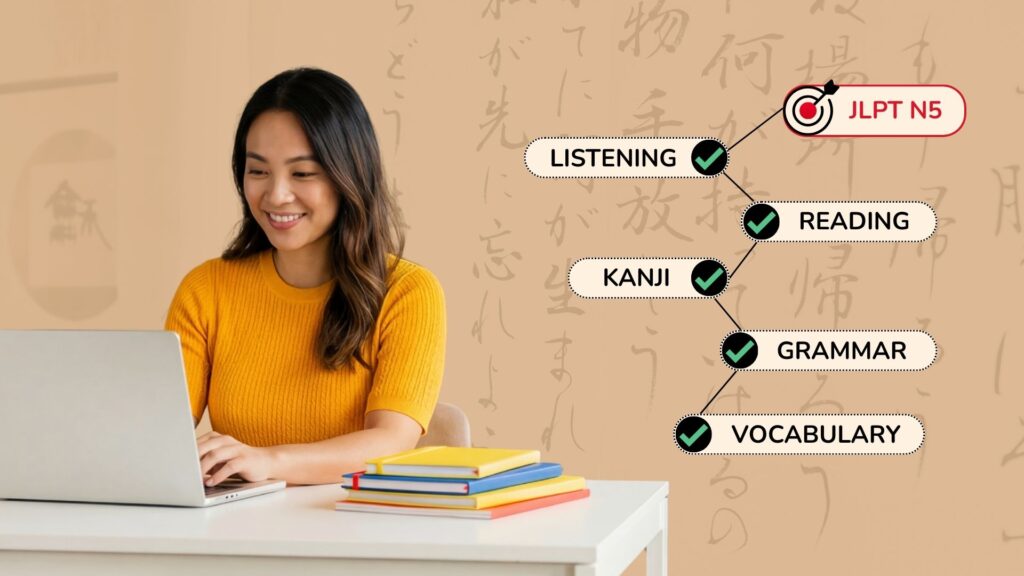
A structured course is not only for learners who cannot self-study. In many cases, it is for learners who could self-study, but do not want to carry the full burden of planning everything alone.
For example, a busy professional may have enough discipline to study, but not enough mental energy to build a complete learning system after work. A parent or caregiver may want flexibility, but also need a clearer path because time is limited and cannot be wasted on trial and error. A complete beginner may simply want reassurance that they are studying in the right order.
In these cases, a structured course can save time and reduce mental load.
It can be especially helpful when you want:
- A clearer study path
- Less time spent planning
- Better balance across skills
- More efficient progress
- Less confusion about what to study next
For learners who want that kind of support, JLRC offers structured Japanese language courses designed to help beginners progress step by step.
JLRC is also a trusted Japanese language school in the Philippines that has taught over 16,000 learners since 2001 and welcomes international students in its online classes. Recognized as the Japanese language school with the largest number of students in the Philippines, JLRC supports learners through a more organized path designed for less time, less cost, and less effort.
If your long-term goal includes studying in Japan, you may also want to explore JLRC’s Study in Japan program for future academic plans.
And if you are looking for flexible online options from abroad, you can also visit JLRC’s learn Japanese online (International Students) page.
Frequently Asked Questions About JLPT N5 Self-Study
1. Can a complete beginner pass JLPT N5 by self-study?
Yes, many complete beginners can. But success depends a lot on whether they can follow a realistic routine and keep studying consistently over time.
2. Is self-study cheaper but harder?
Often, yes. Self-study usually costs less money, but it can require more planning, more decision-making, and more mental effort
3. Is self-study a good option for busy professionals?
It can be, but it is often harder than people expect. Busy professionals may have the motivation to study but not always the time or energy to organize and maintain an effective routine by themselves
4. Who is self-study usually best for?
Self-study is often a good fit for learners who have more flexible time, stronger independent study habits, and enough mental space to manage their own progress.
Start Your JLPT N5 Journey with JLRC
If you want to prepare for JLPT N5 more efficiently, self-study can be a good place to begin, but structured learning may be the more realistic option when time, energy, and consistency are limited.
JLRC’s Japanese language courses help learners build a strong foundation through structured lessons, guided practice, and a clear learning path designed for less time, less cost, and less effort.
If you want a complete overview of what to study, read our guide on how to pass JLPT N5. If you want a more practical weekly schedule, you can also explore our JLPT N5 study plan




Copyright © 2026 JLRC Inc.
All Rights Reserved
For international students, you may visit our Learn Japanese Online page.
For inquiries, you may call us at (63)2-7358-0565 or (63)917-163-3371
Japanese Language Research Center
Unit 506 Cityland Shaw Tower, Shaw Blvd, Mandaluyong, 1552 Metro Manila, Philippines
For international students, you may visit our Learn Japanese Online page.
For inquiries, you may call us at (63)2-7358-0565 or (63)917-163-3371
Japanese Language Research Center
Unit 506 Cityland Shaw Tower, Shaw Blvd, Mandaluyong, 1552 Metro Manila, Philippines
Copyright © 2026 JLRC Inc.
All Rights Reserved