
JLRC Blogs
- Courses
- Study Japan
- Materials
- Community
- About
- FAQ's
- Careers
- Class Details
- Login


JLPT N5 Study Plan: A Practical 3-Month Schedule for Beginners | JLRC
JLRC - Content Team 2026/04/29

If you are preparing for JLPT N5, one of the best things you can do is follow a clear study plan.
Many beginners do not fail because they lack motivation. They struggle because they do not know what to study first, how much time to spend on each skill, or how to balance grammar, vocabulary, kanji, reading, and listening from week to week
That is why having a practical schedule matters.
A good JLPT N5 study plan helps you study with more direction, avoid wasted time, and make steady progress over time. Instead of studying randomly, you can build your skills step by step and prepare for the exam more efficiently.
If you want a complete overview of what you need to pass, read our guide on how to pass JLPT N5. In this article, we will focus specifically on how to organize your study and follow a realistic 3-month plan.
Table of Contents
- Why a JLPT N5 Study Plan Matters
- How Long Should You Study for JLPT N5?
- How Many Minutes or Hours Should You Study Each Day?
- How to Balance Grammar, Vocabulary, Kanji, Reading, and Listening
- A Practical 3-Month JLPT N5 Study Plan
- A Simple Weekly JLPT N5 Study Routine
- Common Mistakes in a JLPT N5 Study Plan
- How to Stay Consistent with Your JLPT N5 Study Plan
- When Structured Learning Can Help
- Frequently Asked Questions About JLPT N5 Study Plans
- Start Your JLPT N5 Study with JLRC
Why a JLPT N5 Study Plan Matters
A lot of beginners start with a textbook, an app, or a few online videos. That can work at first, but many learners eventually feel stuck because their study lacks structure.
Without a plan, it is easy to:
- Spend too much time on one skill and ignore another
- Memorize vocabulary without enough review
- Delay listening practice
- Study grammar without applying it
- Use too many materials at once
- Lose momentum after a few weeks
A study plan solves these problems by giving you a clear structure. It helps you decide what to study each day, how to balance different skills, and how to build confidence little by little.
For beginners, this often makes the difference between studying hard and studying effectively.
How Long Should You Study for JLPT N5?
For many beginners, three months is a practical timeline for JLPT N5 if study is consistent.
Of course, the exact timeline depends on your background, pace, and available study time. Some learners may need longer, while others may move faster. But a 3-month schedule works well because it gives you enough time to build the basics, review regularly, and get comfortable with the exam format.
The key is not just how many months you study, but how well your time is organized.
How Many Minutes or Hours Should You Study Each Day?
A common question is How much should I study each day for JLPT N5?
For many beginners, 60 to 90 minutes a day is a realistic and effective target. If you are very busy, even 45 minutes a day can still produce good progress when your study is focused and consistent.
A simple daily balance might look like this:
- 20–25 minutes of grammar and example sentences
- 15–20 minutes of vocabulary review
- 10–15 minutes of kanji practice
- 10–15 minutes of listening or reading
- 5–10 minutes of review
You do not need to study for many hours every day. What matters more is following a routine you can actually maintain
How to Balance Grammar, Vocabulary, Kanji, Reading, and Listening
One of the biggest beginner mistakes is spending too much time on only one area.
A practical JLPT N5 study plan should include all of the following:
Grammar
Grammar gives structure to everything else. It helps you understand how words connect and how Japanese sentences work.
Vocabulary
Vocabulary is essential, but it should not be studied in isolation. It is easier to remember words when you see them in context.
Kanji
At N5, kanji should be learned gradually and together with vocabulary whenever possible.
Reading
Reading helps you apply grammar and vocabulary in real sentences and short passages.
Listening
Listening should start early, even if it feels difficult. Beginners improve faster when listening becomes part of their weekly routine
The best approach is balance. You do not need to study every skill equally every day, but over the course of a week, all five should be included.
If you are looking for helpful Japanese learning materials to support this process, it is best to choose resources that match your level and make regular study easier to maintain.
A Practical 3-Month JLPT N5 Study Plan
Below is a simple and realistic 3-month structure for beginners.
Month 1: Build the Foundation
The first month is about creating a base you can build on.
Main focus
- Learn hiragana
- Learn katakana
- Start basic vocabulary
- Study essential beginner grammar
- Begin simple kanji
- Start light listening practice
Study goal
Your goal in Month 1 is not speed. It is familiarity. You want the basics to stop feeling unfamiliar and start feeling usable
Suggested weekly pattern
- 5 days a week: grammar, vocabulary, and kana review
- 2 to 3 days a week: light kanji practice
- 3 to 4 days a week: short listening practice
- 1 day a week: full review of what you studied
Month 1 should feel steady, not overwhelming.
Month 2: Expand and Combine Skills
The second month is where you begin using what you have learned more actively.
Main focus
- Add more grammar
- Expand vocabulary steadily
- Continue kanji study
- Start reading short passages
- Increase listening practice
- Begin basic JLPT-style questions
Study goal
The purpose of Month 2 is to connect isolated knowledge. Grammar, vocabulary, and kanji should start working together through reading, listening, and simple test-style practice.
Suggested weekly pattern
- 4 to 5 days a week: grammar and vocabulary
- 3 to 4 days a week: kanji review
- 3 days a week: short reading practice
- 3 to 5 days a week: listening practice
- 1 day a week: review and simple quiz or test questions
This is often the stage when weak areas become easier to notice. That is a good sign. It means you can adjust before the exam gets closer.
Month 3: Review and Exam Preparation
The final month should be more focused on review and application than on learning large amounts of new material
Main focus
- Review key grammar
- Strengthen vocabulary recall
- Review kanji in context
- Improve reading confidence
- Practice listening more actively
- Get used to the exam format
Study goal
Month 3 is about becoming comfortable and prepared. You should spend more time checking weak points, reviewing mistakes, and practicing under more realistic conditions.
Suggested weekly pattern
- 3 to 4 days a week: grammar and vocabulary review
- 2 to 3 days a week: kanji review
- 3 days a week: reading practice
- 4 to 5 days a week: listening practice
- 1 day a week: timed practice or mock-test work
The goal is not perfection. It is consistency, familiarity, and test readiness.
A Simple Weekly JLPT N5 Study Routine
If you want a practical weekly structure, here is a beginner-friendly example.
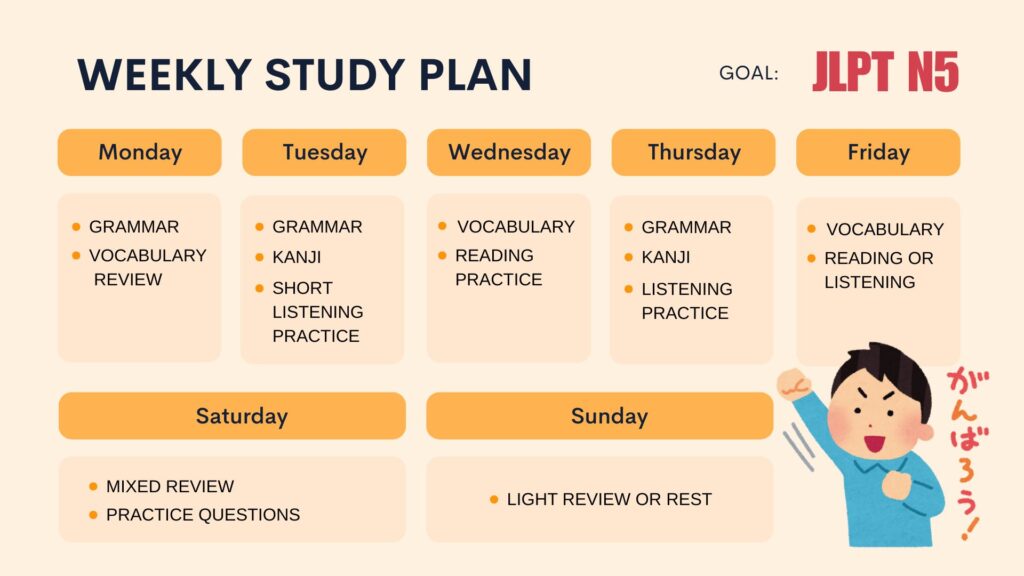
Monday
- Grammar
- Vocabulary review
Tuesday
- Grammar
- Kanji
- Short listening practice
Wednesday
- Vocabulary
- Reading practice
Thursday
- Grammar
- Kanji
- Listening practice
Friday
- Vocabulary
- Reading or listening
Saturday
- Mixed review
- Practice questions
Sunday
- Light review or rest
This kind of routine works because it keeps study regular without making every day feel too heavy
If you need a more complete explanation of what skills you should master overall, see our guide on how to pass JLPT N5.
Common Mistakes in a JLPT N5 Study Plan
Even a good plan can become ineffective if your study habits are weak.
Here are some common mistakes:
-
Studying too much at the beginning
Some learners study very hard in the first week, then burn out. A sustainable routine is better than an intense one you cannot maintain
-
Ignoring review
Without review, new material disappears quickly. Review should be built into every week.
-
Avoiding listening
Listening should not be saved for the final month. It should be part of the plan from the start
-
Using too many resources
A small number of reliable materials is usually better than constantly switching between tools.
-
Focusing only on grammar and vocabulary
Reading and listening are also essential. Your plan should reflect that.
-
Studying without a weekly structure
A month-long goal is helpful, but weekly organization is what makes progress realistic.
How to Stay Consistent with Your JLPT N5 Study Plan
Consistency is one of the biggest factors in passing JLPT N5.
A few simple ways to stay on track are:
- Study at the same time each day if possible
- Keep sessions realistic
- Review every week
- Track your weak areas
- Avoid changing materials too often

The best study plan is the one you can follow for weeks, not just for a few days.
When Structured Learning Can Help
Some learners can organize everything on their own, but many beginners find it easier to stay consistent when their study path is already structured.
If you want a more guided and efficient approach, JLRC offers structured Japanese language courses that help learners study step by step with clearer direction.
JLRC is also a trusted Japanese language school in the Philippines that has taught over 16,000 learners since 2001 and welcomes international students in its online classes.
If you are an overseas learner looking for flexible options, you can also explore JLRC’s learn Japanese online page for students worldwide.
Frequently Asked Questions About JLPT N5
1. Is 3 months enough for JLPT N5?
For many beginners, yes. Three months is a realistic timeline when study is steady and organized.
2. How many hours should I study for JLPT N5 each week?
Many learners do well with around 7 to 10 hours a week, depending on their pace and starting level.
3. Should I study grammar and vocabulary every day?
For most beginners, yes. Daily contact with grammar and vocabulary helps build retention and routine.
4. What is the best way to organize JLPT N5 study?
A balanced plan that includes grammar, vocabulary, kanji, reading, listening, and weekly review is usually the most effective
Start Your JLPT N5 Journey with JLRC
If you want to follow your JLPT N5 study plan in a more efficient and organized way, structured learning can make a big difference.
JLRC’s Japanese language courses help learners study through a clearer path with structured lessons, guided practice, and a practical learning flow designed for less time, less cost, and less effort.
Our online group classes offer flexible scheduling options to match different lifestyles. The JLPT N5 course (100 hours) can typically be completed in approximately 2.5 months (3 sessions per week), 4 months (2 sessions per week), or 6.5 months (1 session per week).
For learners who prefer a more personalized approach,




Copyright © 2026 JLRC Inc.
All Rights Reserved
For international students, you may visit our Learn Japanese Online page.
For inquiries, you may call us at (63)2-7358-0565 or (63)917-163-3371
Japanese Language Research Center
Unit 506 Cityland Shaw Tower, Shaw Blvd, Mandaluyong, 1552 Metro Manila, Philippines
For international students, you may visit our Learn Japanese Online page.
For inquiries, you may call us at (63)2-7358-0565 or (63)917-163-3371
Japanese Language Research Center
Unit 506 Cityland Shaw Tower, Shaw Blvd, Mandaluyong, 1552 Metro Manila, Philippines
Copyright © 2026 JLRC Inc.
All Rights Reserved