

JLPT 2024 Global Statistics & Trends – Why More Learners Are Taking the Exam and How to Prepare
JLRC – Content Team
2025/11/29
Table of Contents
- Introduction: Why the JLPT Matters More Than Ever
- The JLPT Boom: Record Numbers in 2024
- Where Are the Learners? A Global Distribution
- Pass Rates: Where Dreams Meet Reality
- Why N2/N1 Are So Tough: The Hidden Weak Points
- Spotlight: JLPT in the Philippines
- Regional Leaders: Who Drives the Numbers?
- A Growing Global Footprint
- What This Means for You as a Learner
- Conclusion: More Than Just Numbers
Introduction: Why the JLPT Matters More Than Ever
Every year, hundreds of thousands of learners around the world sit for the Japanese Language Proficiency Test (JLPT). For many, it’s not just an exam—it’s a stepping stone to studying in Japan, landing jobs that require Nihongo proficiency, or proving their skills for immigration and scholarships.
But beyond personal goals, the JLPT itself is a fascinating mirror of global trends: where Japanese language is being learned, how many people are investing their time in it, and which regions are driving the boom. With the latest official JLPT data from 2024, we can take a closer look at how this exam has become a worldwide phenomenon.
The JLPT Boom: Record Numbers in 2024
If you thought Japanese learning was a niche pursuit, think again. In 2024, the JLPT reached an all-time high with 1.72 million applicants and 1.47 million examinees worldwide. To put that into perspective, that’s larger than the population of some countries.
Just three years ago, in 2021, examinees numbered under 700,000. The growth since then—despite the global pandemic—has been explosive. Clearly, the demand for Nihongo classes and certification is surging across the globe.
For Japanese language schools like JLRC in the Philippines, this surge translates into a growing need for structured Japanese language programs and JLPT prep courses.
Where Are the Learners? A Global Distribution
So, where exactly are people taking the JLPT? The December 2024 sitting gives us a clear snapshot.
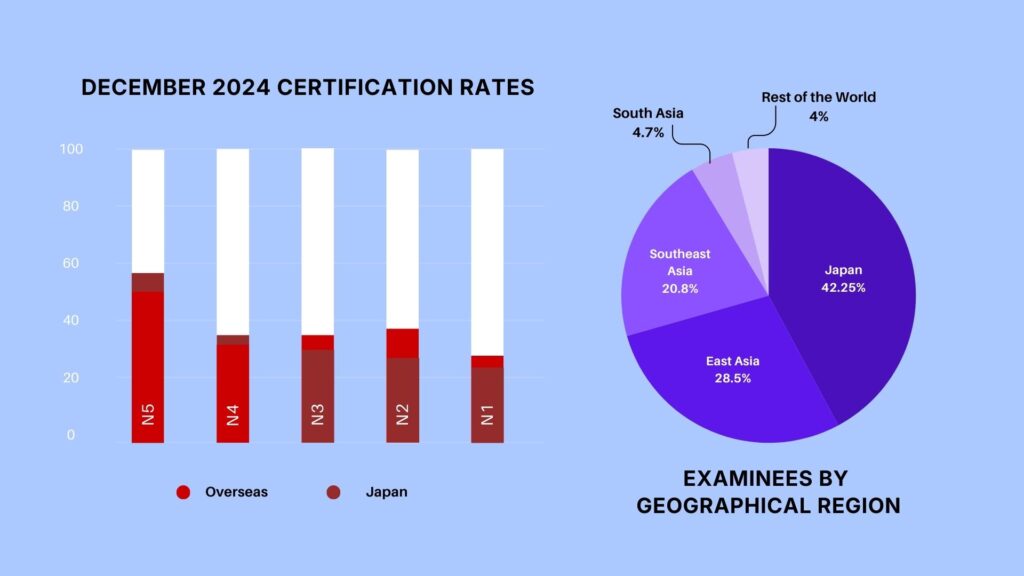
- Japan: 333,983 examinees (42.25%).
- East Asia (China, Korea, etc.): 225,061 (28.5%).
- Southeast Asia (Myanmar, Vietnam, Philippines, etc.): 164,419 (20.8%).
- South Asia (India, Nepal, Sri Lanka, etc.): 36,887 (4.7%).
- Rest of the world (Europe, Americas, Africa, Oceania): less than 4% combined.
In other words, over 9 out of 10 JLPT examinees are in Asia.
On the bubble-style world map above, you can see just how dominant Asia is in this landscape. Japan remains the core, but East and Southeast Asia together nearly match Japan in test-taker numbers.
This highlights an important truth: the Japanese language is not just studied in Japan—it’s truly a regional skill across Asia.
Pass Rates: Where Dreams Meet Reality
Of course, it’s not just about sitting the exam—it’s about passing. And here’s where the data gets even more interesting.
- N5: 48.8% overseas / 59.6% in Japan
- N4: 35% overseas / 36.3% in Japan.
- N3: 38% overseas / 32.5% in Japan.
- N2: 38.7% overseas / 26.4% in Japan.
- N1: 31.7% overseas / 24.3% in Japan.
Notice the trend? The higher you go, the tougher it gets. While nearly half of N5 examinees overseas earn certification, only 1 in 4 succeed at N1 in Japan.
What’s surprising is that overseas pass rates are consistently higher than Japan’s. Why? Experts suggest that overseas learners are often more “goal-driven”—they prepare with a clear purpose such as job requirements or study abroad programs.
Why N2/N1 Are So Tough: The Hidden Weak Points
Looking deeper, the falling pass rates reveal where learners struggle most:
-
Reading Speed
At N2 and N1, the reading section demands rapid comprehension of long texts: newspaper editorials, academic passages, and business-like documents. Many learners fail not because they don’t understand Japanese, but because they cannot finish on time. -
Kanji & Vocabulary Density
At N2 and N1, the reading section demands rapid comprehension of long texts: newspaper editorials, academic passages, and business-like documents. Many learners fail not because they don’t understand Japanese, but because they cannot finish on time.
👉 In short, N5/N4 test “basic knowledge,” while N2/N1 test “academic and professional literacy.” That’s why the data shows a cliff-drop in certification rates at the upper levels.
Spotlight: JLPT in the Philippines
The Philippines has become one of Southeast Asia’s strongest JLPT markets. Data from 2021–2024 shows how each level has grown:
- N5 & N4 dominate: In Dec 2024, N5 had 6,550 applicants and N4 had 5,092. A strong beginner base continues to fuel interest in Nihongo.
- N3 & N2 surge: Both levels quadrupled in just 3 years. Mid-level learners are clearly on the rise.
- N1 grows steadily: From just 200 applicants in 2021 to 1,153 in 2024, proving a growing advanced learner community.
Interpretation: The Philippines shows a classic “language pyramid”—a wide beginner base, a fast-expanding intermediate group, and a steadily growing advanced tier. This reflects both student demand (study abroad in Japan) and professional needs (work opportunities requiring JLPT certification).
For Japanese language schools like JLRC, this data confirms why offering flexible Nihongo classes in the Philippines with clear JLPT pathways is essential.
Regional Leaders: Who Drives the Numbers?
The biggest players in December 2024 were:
- China, Myanmar, and Korea in East Asia.
- Vietnam and the Philippines in Southeast Asia.
- India and Nepal in South Asia.
Each of these countries now hosts large and growing test populations. The Philippines, for example, continues to see rising interest, driven by students aiming for study programs in Japan and professionals seeking career advantages.
A Growing Global Footprint
Another striking trend: the JLPT is reaching new corners of the world. In December 2024, the test was administered in 81 countries and 247 cities.
For the first time, Senegal (Dakar) joined the test map, along with Middlebury (USA) and Florianópolis (Brazil) as new cities. This shows how Japanese language study is no longer confined to Asia but increasingly embraced worldwide.
What This Means for You as a Learner
So, how should you use this data as a learner?
- Book early. In high-demand regions like Japan, China, or Southeast Asia, test slots fill quickly.
- Set realistic level. Start with N5 or N4 for momentum. Jumping straight to N3 or N2 may lead to frustration.
- Set clear purpose. Define why you’re taking the exam—career advancement, study abroad, visa requirements, or personal achievement—so your motivation remains strong even when learning gets tough.
- Use data to plan prep. Know that reading speed and kanji vocabulary are common weak points, especially at N2/N1.
- Leverage structured programs. Nihongo institutions such as JLRC (Philippines) offer Japanese language courses with flexible schedules, original study materials, and bilingual support, helping learners progress from N5 all the way to N1.
Conclusion: More Than Just Numbers
The JLPT is not simply an exam—it’s a global movement of learners who share a passion for Nihongo. The data shows us the scale, but behind every number is a story: of students chasing dreams in Japan, of professionals unlocking new career paths, of cultures connecting across borders.
And with the JLPT growing year after year, now is the perfect time to start or continue your Japanese language journey.
At JLRC, we’ve trained over 16,000 students since 2001, and our mission remains the same: to deliver the highest value in our Japanese language courses, with less time, less cost, and less effort.
Because in the end, the JLPT is not just about passing a test—it’s about opening doors.
For inquiries, you may call us at (63)2-7358-0565 or (63)917-163-3371
Japanese Language Research Center
Unit 506 Cityland Shaw Tower, Shaw Blvd, Mandaluyong, 1552 Metro Manila, Philippines
For inquiries, you may call us at (63)2-7358-0565 or (63)917-163-3371
Japanese Language Research Center
Unit 506 Cityland Shaw Tower, Shaw Blvd, Mandaluyong, 1552 Metro Manila, Philippines
Copyright © 2024 JLRC Inc.
All Rights Reserved