
JLRC Blogs
- Courses
- Study Japan
- Materials
- Community
- About
- FAQ's
- Careers
- Class Details
- Login


JLPT N5 Grammar Guide: Japanese Grammar vs English for Beginners
JLRC - Content Team 2026/07/18

For many beginners, Japanese grammar feels very different from English.
Even simple sentences can feel confusing at first because Japanese does not follow the same word order as English. Japanese also uses particles, places verbs at the end, and often removes the subject when the meaning is clear.
This is why JLPT N5 grammar is an important foundation.
JLPT N5 grammar is not only about memorizing patterns. It is about understanding how Japanese sentences work.
In this guide, we will explain basic N5 grammar by comparing Japanese and English. This can help beginners understand why Japanese feels different and how to study it more effectively.
If you are preparing for the full beginner level, you may also read JLRC’s How to Pass JLPT N5 guide.
Table of Contents
- Why Japanese Grammar Feels Different from English
- Particles: A Big Challenge for Beginners
- Japanese Often Drops the Subject
- Polite Form and Plain Form
- Common Grammar Mistakes Beginners Make
- How to Study N5 Grammar Without Getting Confused
- Why Structured Lessons Help Beginners
- Start Building Your N5 Grammar Foundation
- FAQ
Why Japanese Grammar Feels Different from English
English and Japanese organize sentences in different ways.
In English, the usual order is:
Subject + Verb + Object
For example:
I eat sushi.
In Japanese, the basic order is closer to:
Subject + Object + Verb
For example:
I sushi eat.
This does not mean you should translate Japanese word by word. However, this simple comparison helps beginners understand why Japanese sentences feel different from English.
| English | Japanese-style order |
|---|---|
| I eat sushi. | I sushi eat. |
| I study Japanese. | I Japanese study. |
| I go to school. | I school to go. |
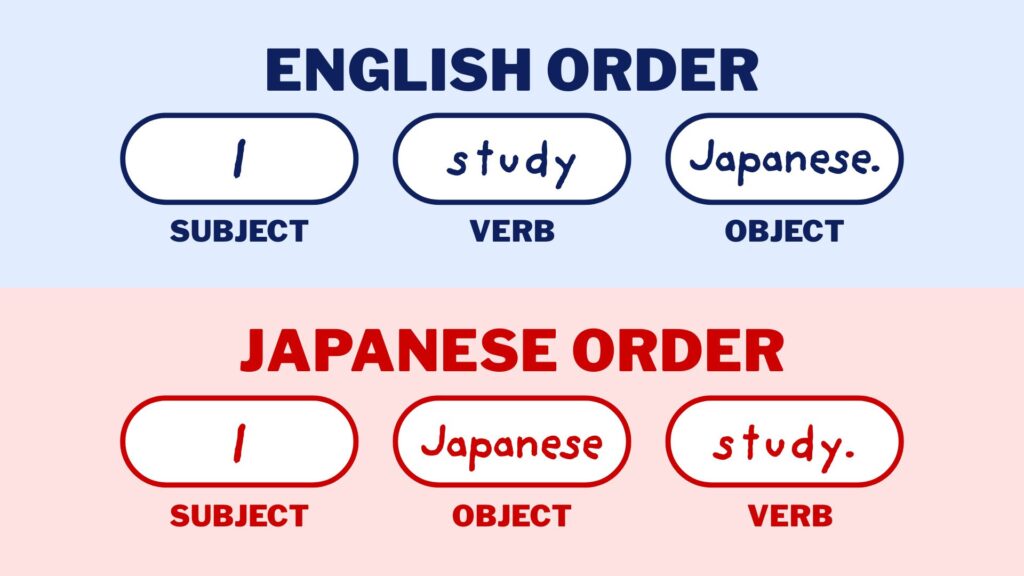
In English, the verb usually comes early. In Japanese, the verb usually comes at the end.
At N5 level, becoming comfortable with this verb-final structure is important because many basic grammar patterns are built around verb forms, such as present, past, negative, and polite expressions.
For English speakers and learners who study in English, this can feel strange at first. But once you understand the basic structure, Japanese grammar becomes easier to follow.
Particles: A Big Challenge for Beginners
One of the biggest differences between Japanese and English is the use of particles.
Particles are short words that show the function of a word in a sentence.
For example, particles can show:
- the topic
- the subject
- the object
- direction
- location
- time
- method or means
In English, word order often shows meaning. In Japanese, particles help show meaning.
This is why beginners often struggle with particles such as は, が, を, に, and で.
For example, in Japanese, the particle can show who is doing the action, what is being done, or where the action happens.
If you remove or misuse particles, the sentence may become unclear or unnatural.
Particles are small, but they are very important in Japanese grammar.
Japanese Often Drops the Subject
In English, we usually say the subject clearly.
For example:
I am a student.
I study Japanese.
I like sushi.
In Japanese, the subject is often removed when it is already clear from the context.
This can confuse beginners because they may wonder:
“Who is doing the action?”
But in Japanese, if the speaker and listener already understand the situation, the subject does not always need to be repeated.
This is one reason why direct translation from English to Japanese can sound unnatural.
At N5 level, learners should begin to understand that Japanese often depends on context.
Polite Form and Plain Form
N5 learners usually study polite Japanese first.
For example, beginners often learn sentences ending in です or ます.
This is helpful because polite forms are common in class, basic conversation, and beginner materials.
However, learners also need to understand that Japanese has different levels of politeness.
At N5 level, students begin to see:
- polite form
- simple negative form
- past form
- basic plain forms
- question forms
For beginners, it is not necessary to master every style immediately. But it is important to understand that Japanese changes depending on politeness, situation, and relationship .
This is another reason why structured lessons are useful.
Common Grammar Mistakes Beginners Make

Many beginners make similar mistakes when learning N5 grammar.
Mistake 1: Using English word order
English word order does not always work in Japanese. Beginners need to get used to the verb coming at the end.
Mistake 2: Ignoring particles
Particles may look small, but they carry important meaning. Skipping them can make a sentence unclear.
Mistake 3: Translating word by word
Japanese and English do not match perfectly. Word-by-word translation can create unnatural sentences.
Mistake 4: Forgetting to review
N5 grammar is the foundation for N4, N3, and higher levels. If the foundation is weak, later levels become harder.
For learners who want a study schedule, JLRC also has a JLPT N5 Study Plan.
How to Study N5 Grammar Without Getting Confused
N5 grammar becomes easier when learners study it step by step.
Here are some practical tips.
1. Learn sentence structure first
Before memorizing many patterns, understand the basic Japanese sentence order.
2. Study particles by function
Do not only memorize particle translations. Learn what each particle does in a sentence.
3. Practice with short sentences
Short sentences help beginners understand grammar clearly before moving to longer sentences.
4. Review grammar with listening and reading
Grammar should not stay only on paper. Try to recognize patterns in listening and reading practice.
5. Do not rush
A strong N5 foundation helps you continue to N4, N3, and higher levels with less confusion.
Why Structured Lessons Help Beginners
N5 grammar may look simple, but beginners often need clear explanation.
This is especially true when comparing Japanese and English. The two languages organize sentences differently, so learners need guidance to understand grammar naturally.
Structured lessons help beginners:
- understand sentence order
- learn particles step by step
- practice verbs correctly
- review grammar regularly
- connect grammar with reading and listening
- avoid random study
- build confidence for the next level
JLRC develops Japanese learning materials designed to support structured Japanese study from beginner to higher JLPT levels.
With the right structure, beginners can make clearer progress with less wasted time.
For learners looking for a structured beginner program, JLRC is a Japanese language school in the Philippines that supports students from basic Japanese to higher JLPT levels since 2001.
Students who want to start or continue their Japanese learning journey can explore JLRC’s Japanese language courses from beginner (N5) to higher JLPT levels (N1).
Start Building Your N5 Grammar Foundation
JLPT N5 grammar is the foundation of Japanese learning.
At first, Japanese may feel very different from English because of sentence order, particles, verb placement, subject omission, and politeness.
But these differences become easier to understand when you study step by step.
To build a strong N5 grammar foundation, remember:
- Japanese word order is different from English
- particles show the function of words
- verbs usually come at the end
- subjects are often omitted
- polite forms are important for beginners
- grammar should be studied in context
If you are still learning the writing system, you may also read JLRC’s guide on How to Master Hiragana and Katakana Faster.
For learners outside the Philippines or those who want a flexible online option, JLRC also offers a way to learn Japanese online from anywhere.
The goal is not only to memorize grammar rules, but to understand how Japanese sentences work.
FAQ
Is JLPT N5 grammar difficult for beginners?
JLPT N5 grammar can feel difficult at first because Japanese sentence order, particles, and verb placement are different from English. However, it becomes easier when studied step by step.
How is Japanese grammar different from English?
English usually follows subject-verb-object order, while Japanese often places the verb at the end. Japanese also uses particles to show the function of words in a sentence.
What grammar should I study for JLPT N5?
JLPT N5 learners should study basic sentence patterns, particles, verbs, polite forms, negative forms, past tense, questions, and simple expressions.




Copyright © 2026 JLRC Inc.
All Rights Reserved
For international students, you may visit our Learn Japanese Online page.
For inquiries, you may call us at (63)2-7358-0565 or (63)917-163-3371
Japanese Language Research Center
Unit 506 Cityland Shaw Tower, Shaw Blvd, Mandaluyong, 1552 Metro Manila, Philippines
For international students, you may visit our Learn Japanese Online page.
For inquiries, you may call us at (63)2-7358-0565 or (63)917-163-3371
Japanese Language Research Center
Unit 506 Cityland Shaw Tower, Shaw Blvd, Mandaluyong, 1552 Metro Manila, Philippines
Copyright © 2026 JLRC Inc.
All Rights Reserved