
JLRC Blogs
- Courses
- Study Japan
- Materials
- Community
- About
- FAQ's
- Careers
- Class Details
- Login


25 Japanese Phrases for Work: Useful Nihongo for the Workplace
JLRC - Content Team 2026/08/14

Learning Japanese for work does not always begin with difficult grammar.
For many beginners, the first step is learning simple workplace phrases that can be used in greetings, meetings, emails, instructions, and daily communication.
If you work with Japanese clients, managers, colleagues, or business partners, even basic Japanese phrases can help you show respect and build smoother communication.
In this guide, you will learn 25 useful Japanese phrases for work. These phrases are beginner-friendly, but they are also practical for workplace situations.
If you are learning Japanese for career growth, you may also read JLRC’s Japanese for Work in the Philippines.
Why Japanese Workplace Phrases Are Important
Japanese workplace communication often uses polite and respectful expressions.
Even if you are still a beginner, learning common workplace phrases can help you:
- greet people politely
- join meetings more confidently
- ask for help
- confirm instructions
- apologize properly
- show appreciation
- communicate more professionally
Of course, memorizing phrases alone is not enough to become fluent. However, useful phrases can give beginners a practical starting point.
For learners who want a stronger foundation, structured lessons can help connect phrases with grammar, vocabulary, listening, and speaking practice.
Students who want to begin learning Japanese step by step can explore JLRC’s Japanese language courses.
1. おはようございます。
Ohayou gozaimasu.
Good morning.
This is a polite morning greeting.
In Japanese workplaces, greetings are important because they show respect and help create a positive atmosphere.
Use this when you arrive at work in the morning.
2. お疲れ様です。
Otsukaresama desu.
Thank you for your hard work. / Hello.
This is one of the most useful workplace phrases in Japanese.
It can be used when greeting coworkers, ending a meeting, or acknowledging someone’s effort.
There is no perfect English translation, but in the workplace it often means something like “Thank you for your hard work” or “Good work.”
3. よろしくお願いします。
Yoroshiku onegaishimasu.
I look forward to working with you.
This phrase is very common in Japanese communication.
In the workplace, it can be used when starting a project, meeting someone, making a request, or beginning cooperation.
It does not have one perfect English translation, but it often expresses respect, cooperation, and goodwill.
4. ありがとうございます。
Arigatou gozaimasu.
Thank you very much.
This is the polite way to say thank you.
In the workplace, it is better to use arigatou gozaimasu instead of the casual arigatou.
5. すみません。
Sumimasen.
Excuse me. / I’m sorry.
This phrase can be used in several ways.
You can use it when you want to get someone’s attention, apologize lightly, or ask for help.
For example, you may say sumimasen before asking a question.
6. 申し訳ありません。
Moushiwake arimasen.
I sincerely apologize.
This is a more formal apology than sumimasen.
It is useful in workplace or customer-related situations where a stronger apology is needed.
Beginners do not need to use it often at first, but it is helpful to recognize the phrase.
7. 少々お待ちください。
Shoushou omachi kudasai.
Please wait a moment.
It is useful in offices, customer service, online meetings, and phone conversations.
8. もう一度お願いします。
Mou ichido onegaishimasu. One more time, please.
Use this when you want someone to repeat something.
This is very useful for beginners who are still getting used to Japanese listening.
Japanese Teacher Instructions Phrase Guide helpful for understanding common classroom and instruction phrases.
9. ゆっくりお願いします。
Yukkuri onegaishimasu. Slowly, please.
If someone speaks too quickly, you can use this phrase politely.
It is simple but very useful in meetings, training, or Japanese class.
10. わかりました。
Wakarimashita.
I understand. / Understood.
This phrase is used when you understand an instruction or explanation.
In workplace communication, it can show that you have received the message.
11. 承知しました。
Shouchi shimashita.
This is more formal than wakarimashita.
It is often used in business situations, emails, and polite workplace communication.
For beginners, it is useful to recognize this phrase even if you first become more comfortable using wakarimashita
12. 確認します。
Kakunin shimasu.
I will check. / I will confirm.
This is useful when you need to verify information before answering.
For example, if a coworker asks a question and you are not sure, you can say:
Kakunin shimasu.
I will check.
13. 確認しました。
Kakunin shimashita.
I have checked. / I have confirmed.
Use this after checking information.
This phrase is especially useful in workplace updates, emails, or reports.
14. もう一度確認します。
Mou ichido kakunin shimasu.
I will check again.
This phrase is useful when you want to make sure the information is correct.
It shows carefulness and professionalism.
15. 質問があります。
Shitsumon ga arimasu.
I have a question.
Use this when you want to ask a question in a meeting, class, or workplace discussion.
It is simple and polite.
16. 相談があります。
Soudan ga arimasu.
I would like to consult with you. / I need to discuss something.
This phrase is useful when you need advice or want to discuss a matter.
It is often used before talking about a concern, issue, schedule, decision, or work-related matter.
17. お願いがあります。
Onegai ga arimasu.
I have a request.
Use this when you want to ask someone for help or make a request politely.
It is softer and more polite than directly asking someone to do something.
18. 手伝っていただけますか
Tetsudatte itadakemasu ka.
Could you help me?
This is a polite way to ask for help.
It is useful in the workplace because it sounds respectful.
A simpler version is:
Tetsudatte itadakemasu ka.
Can you help me?
However, tetsudatte itadakemasu ka is more polite.
19. メールを送りました。
Meeru o okurimashita.
I sent the email.
This is useful for workplace updates.
You can also say:
Shiryou o okurimashita.
I sent the materials.
File o okurimashita.
I sent the file.
20. 資料を確認してください。
Shiryou o kakunin shite kudasai.
Please check the materials.
This phrase is useful when asking someone to review documents, files, or meeting materials.
For a more polite tone, you may say:
Shiryou o go-kakunin kudasai.
Please kindly check the materials.
21. 会議は何時ですか。
Kaigi wa nanji desu ka.
What time is the meeting?
This is a simple question that is useful in workplace situations.
You can replace kaigi with another event.
Example:
Mensetsu wa nanji desu ka.
What time is the interview?
22. 会議に参加します。
Kaigi ni sanka shimasu.
I will attend the meeting.
Use this when confirming that you will join a meeting.
This can be useful for office communication and online meetings.
23. 少し遅れます。
Sukoshi okuremasu.
I will be a little late.
This is useful when you need to inform someone politely that you will be late.
If you want to apologize, you can say:
Sumimasen, sukoshi okuremasu.
I’m sorry, I will be a little late.
24. 先に失礼します。
Osaki ni shitsurei shimasu.
Excuse me for leaving before you.
This phrase is commonly used when leaving the workplace before others.
It is a polite expression that shows consideration.
25. お先に失礼します。
Osaki ni shitsurei shimasu.
Excuse me for leaving before you.
This is a more natural and common version of the previous phrase.
When leaving work, employees often say:
Osaki ni shitsurei shimasu.
Coworkers may reply:
Otsukaresama desu.
Simple Japanese Workplace Conversation Example
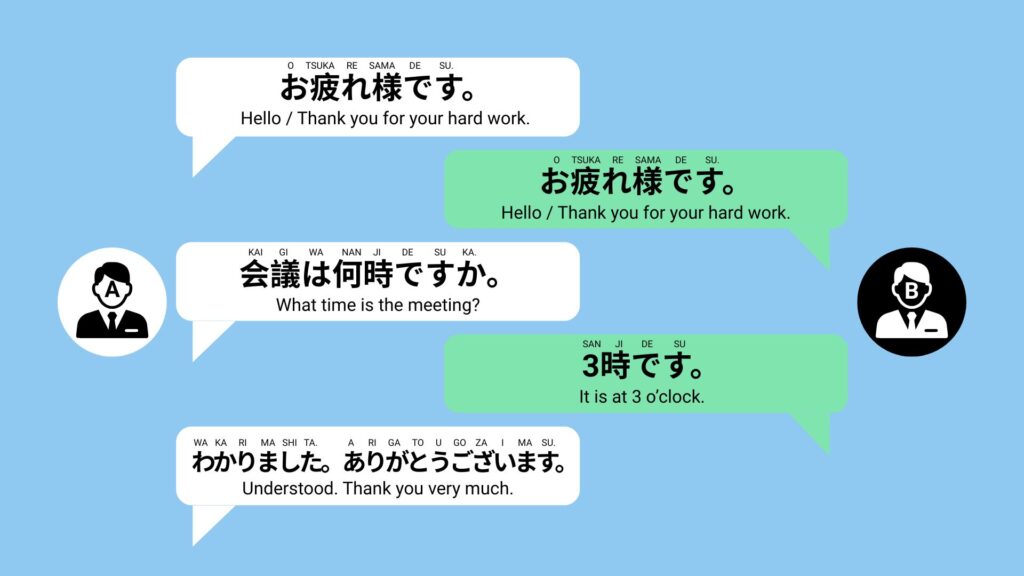
Here is a short example using some of the phrases above.
A: お疲れ様です。
Otsukaresama desu.
Hello / Thank you for your hard work.
B: お疲れ様です。
Otsukaresama desu.
Hello / Thank you for your hard work.
A: 会議は何時ですか
Kaigi wa nanji desu ka.
What time is the meeting?
B: 3時です。
San-ji desu.
It is at 3 o’clock.
A: わかりました。ありがとうございます。
Wakarimashita. Arigatou gozaimasu.
Understood. Thank you very much.
This kind of short conversation is simple, but it helps beginners practice polite workplace communication.
Tips for Using Japanese at Work
When using Japanese in the workplace, politeness is important.
You do not need to use very difficult Japanese at the beginning. It is better to use simple phrases correctly and respectfully.
Here are some helpful tips:
- Use polite forms such as desu and masu
- Avoid overly casual phrases at work
- Listen carefully to how Japanese speakers use workplace expressions
- Practice greetings every day
- Learn phrases together with grammar and context
- Ask for repetition if you do not understand
Workplace Japanese is not only about vocabulary. It is also about tone, timing, and respect.
Is Japanese for Work Connected to JLPT?
Yes. Many workplace phrases are not exactly the same as JLPT questions, but the foundation is connected.
For example, JLPT study helps learners build:
- vocabulary
- grammar
- reading comprehension
- listening comprehension
- sentence patterns
- polite expressions
JLPT N5 and N4 help learners build a basic foundation. JLPT N3 and N2 are especially useful for learners who want to understand more workplace-related Japanese.
If you are studying Japanese for career growth, you may also read JLRC’s JLPT Certificate in the Philippines: Career Benefits and Opportunities and JLPT N2 and Career Opportunities.
Learn Workplace Japanese with Structure
Memorizing useful workplace phrases is a good start.
However, if you want to use Japanese more confidently at work, you need more than phrases. You need to understand grammar, sentence patterns, listening, and how polite Japanese works in real situations.
JLRC offers structured Japanese language courses to help learners build Japanese step by step from beginner to advanced levels. Students can study vocabulary, grammar, reading, listening, and practical expressions through guided lessons.
For learners who want to improve Japanese for work, JLRC’s Japanese language courses can help build a stronger foundation.
JLRC also provides Japanese language training for companies and organizations in the Philippines. Companies that need Japanese training for employees can learn more here: Japanese Language Training for Companies.
You can also learn more about JLRC’s Japanese language education in the Philippines here: Japanese language education in the Philippines.
With structured lessons, learners can make clearer progress with less wasted time.
Start with Useful Japanese for the Workplace
Japanese workplace phrases can help beginners communicate more politely and confidently.
Start with simple expressions such as ohayou gozaimasu, otsukaresama desu, yoroshiku onegaishimasu, wakarimashita, and kakunin shimasu.
As you continue studying, you can build stronger Japanese communication skills for work, career growth, JLPT preparation, and professional situations.
FAQ
What are useful Japanese phrases for work?
Useful Japanese phrases for work include ohayou gozaimasu, otsukaresama desu, yoroshiku onegaishimasu, wakarimashita, kakunin shimasu, and shoushou omachi kudasai.
What does otsukaresama desu mean?
Otsukaresama desu is a common Japanese workplace phrase. It can mean “Thank you for your hard work,” “Good work,” or even a workplace greeting, depending on the situation.
What does yoroshiku onegaishimasu mean at work?
At work, yoroshiku onegaishimasu often means “I look forward to working with you” or expresses cooperation, respect, and goodwill.
Is Japanese workplace language difficult for beginners?
It can feel difficult at first because Japanese workplace communication uses polite expressions. However, beginners can start with simple phrases and gradually learn more formal Japanese.
Is JLPT useful for workplace Japanese?
Yes. JLPT study helps learners build vocabulary, grammar, reading, listening, and sentence patterns. Higher levels such as N3 and N2 can be especially useful for understanding more workplace-related Japanese.
Does JLRC offer Japanese lessons for work?
Yes. JLRC offers structured Japanese language courses for learners who want to study Japanese for work, JLPT preparation, or career growth. JLRC also provides online Japanese language training for companies and organizations in the Philippines and abroad.




Copyright © 2026 JLRC Inc.
All Rights Reserved
For international students, you may visit our Learn Japanese Online page.
For inquiries, you may call us at (63)2-7358-0565 or (63)917-163-3371
Japanese Language Research Center
Unit 506 Cityland Shaw Tower, Shaw Blvd, Mandaluyong, 1552 Metro Manila, Philippines
For international students, you may visit our Learn Japanese Online page.
For inquiries, you may call us at (63)2-7358-0565 or (63)917-163-3371
Japanese Language Research Center
Unit 506 Cityland Shaw Tower, Shaw Blvd, Mandaluyong, 1552 Metro Manila, Philippines
Copyright © 2026 JLRC Inc.
All Rights Reserved