
JLRC Blogs
- Courses
- Study Japan
- Materials
- Community
- About
- FAQ's
- Careers
- Class Details
- Login

How to Say Thank You in Japanese: Arigatou and Other Expressions
JLRC - Content Team 2026/10/17

How do you say thank you in Japanese?
The most familiar answer is ありがとう (arigatou). You may also have heard ありがとうございます (arigatou gozaimasu), a more polite expression commonly used in Japan.
But Japanese has many ways to express gratitude, and choosing the right phrase depends on the situation, the relationship between speakers, and the level of politeness.
A simple arigatou may be perfect for a close friend, while a customer, teacher, or business partner may require a more respectful expression.
In this guide, you will learn how to say thank you in Japanese, including everyday, polite, and formal expressions, with practical examples and explanations.
Whether you are learning Japanese for travel, work, or personal interest, understanding these differences will help you communicate more naturally.
Table of Contents
- What Does Arigatou Mean in Japanese?
- The Original Meaning of Arigatou: Something Rare and Precious
- Arigatou vs Arigatou Gozaimasu: What's the Difference?
- 15 Japanese Ways to Say Thank You
- Which Japanese Thank You Expression Should You Use?
- How to Say Thank You in Japanese at Work
- Why Japanese People Sometimes Say Sumimasen Instead of Arigatou
- Common Mistakes When Saying Thank You in Japanese
- Learn Everyday Japanese Expressions with JLRC
- Start with Arigatou, Then Build Your Japanese
- FAQ
What Does Arigatou Mean in Japanese?
ありがとう (arigatou) means “thank you.”
It is one of the most common Japanese expressions of gratitude.
You can use it when someone helps you, gives you something, or does something kind for you.
For example:
ありがとう。
Arigatou.
Thank you.
This expression is natural among friends, family members, and people with whom you have a close relationship.
However, Japanese politeness depends on context. When speaking to teachers, customers, unfamiliar adults, or people in formal situations, ありがとうございます (arigatou gozaimasu) is usually more appropriate.
This distinction is an important part of Japanese communication.
If you want to understand how politeness changes Japanese expressions, you may also read JLRC's Formal vs Informal Japanese.
The Original Meaning of Arigatou: Something Rare and Precious
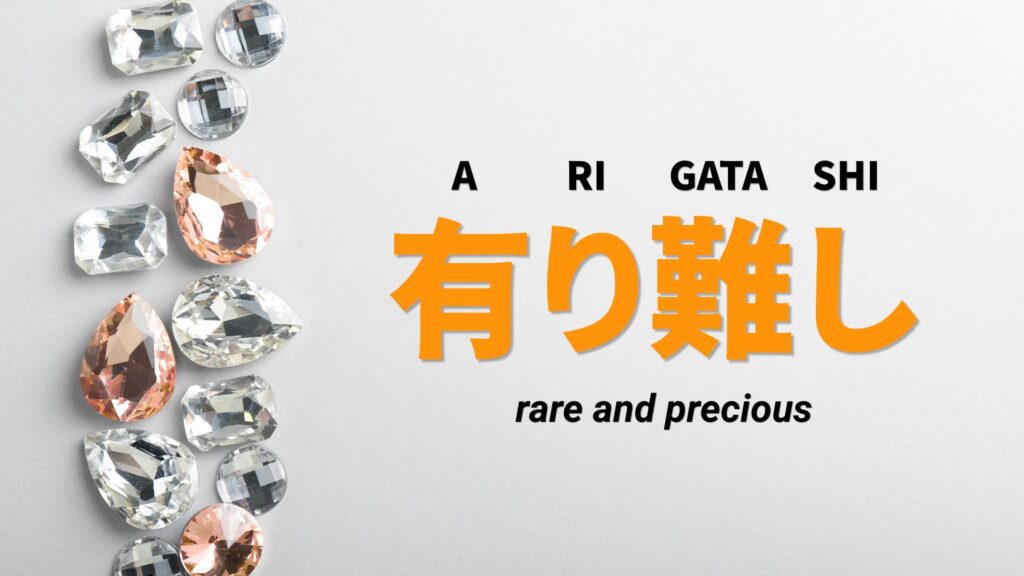
The Japanese word ありがとう (arigatou) comes from the classical Japanese expression 有り難し (arigatashi).
It combines two ideas:
- 有る (aru) — to exist
- 難い (gatai) — difficult
Its original meaning was “difficult to exist” or “rare and precious.”
Over time, this sense of something rare and valuable developed into an expression of gratitude.
In this way, arigatou carries a beautiful underlying idea: recognizing someone's kindness as something valuable rather than taking it for granted.
Understanding this origin adds a deeper meaning to one of the most familiar expressions in Japanese.
Arigatou vs Arigatou Gozaimasu: What's the Difference?
Both expressions mean "thank you," but they differ in politeness.
| Japanese | Romaji | English | Typical Use |
|---|---|---|---|
| ありがとう | Arigatou | Thank you | Casual |
| ありがとうございます | Arigatou gozaimasu | Thank you very much | Polite |
| ありがとうございました | Arigatou gozaimashita | Thank you | Polite, often after completed actions |
Arigatou is casual and commonly used with people you know well.
Arigatou gozaimasu is more polite and appropriate for everyday interactions with people outside your close circle.
Arigatou gozaimashita is often used when thanking someone for something that has already been completed.
For example:
手伝ってくれてありがとう。
Tetsudatte kurete arigatou.
Thank you for helping me.
ご協力ありがとうございます。
Go-kyouryoku arigatou gozaimasu.
Thank you for your cooperation.
昨日はありがとうございました。
Kinou wa arigatou gozaimashita.
Thank you for yesterday.
The difference between gozaimasu and gozaimashita is not simply that one is present tense and the other is past tense. In actual communication, the choice also depends on whether the situation or interaction is ongoing or has been completed.
15 Japanese Ways to Say Thank You
Japanese offers many expressions of gratitude, from simple everyday phrases to formal business language.
Here are 15 useful expressions and when to use them.
1. ありがとう — Arigatou
Meaning: Thank you.
Politeness: Casual
This is the basic expression of gratitude in Japanese.
Use it with friends, family members, or people you know well.
Example:
プレゼントをありがとう。
Purezento o arigatou.
Thank you for the present.
2. ありがとうございます — Arigatou Gozaimasu
Meaning: Thank you very much.
Politeness: Polite
This is one of the safest expressions for everyday Japanese communication.
It is commonly used with teachers, store staff, colleagues, and people you do not know well.
Example:
親切にしてくださってありがとうございます。
Shinsetsu ni shite kudasatte arigatou gozaimasu.
Thank you for being so kind.
3. ありがとうございました — Arigatou Gozaimashita
Meaning: Thank you very much.
Politeness: Polite
This expression is often used after a service, event, lesson, or helpful action has been completed.
Example:
今日はありがとうございました。
Kyou wa arigatou gozaimashita.
Thank you for today.
It is commonly heard at the end of meetings, classes, and appointments.
4. どうも — Doumo
Meaning: Thanks.
Politeness: Casual or context-dependent
Doumo is a short expression that can be used to acknowledge a favor or thank someone briefly.
Example:
Someone hands you something.
どうも。
Doumo.
Thanks.
Although convenient, doumo by itself may sound too brief in formal situations.
5. どうもありがとう — Doumo Arigatou
Meaning: Thank you very much.
Politeness: Casual
Adding doumo strengthens the feeling of gratitude.
Example:
助けてくれて、どうもありがとう。
Tasukete kurete, doumo arigatou.
Thank you very much for helping me.
This is natural when expressing sincere thanks to someone close to you.
6. どうもありがとうございます — Doumo Arigatou Gozaimasu
Meaning: Thank you very much.
Politeness: Polite
This expression combines stronger gratitude with polite language.
Example:
ご親切にどうもありがとうございます。
Go-shinsetsu ni doumo arigatou gozaimasu.
Thank you very much for your kindness.
It works well in situations where you want to express appreciation respectfully.
7. 本当にありがとうございます — Hontou ni Arigatou Gozaimasu
Meaning: Thank you so much. / I truly appreciate it.
Politeness: Polite and sincere
Hontou ni means "truly" or "really."
It emphasizes genuine appreciation.
Example:
ご支援いただき、本当にありがとうございます。
Go-shien itadaki, hontou ni arigatou gozaimasu.
Thank you so much for your support.
8. いつもありがとうございます — Itsumo Arigatou Gozaimasu
Meaning: Thank you for everything you always do.
Politeness: Polite
Itsumo means "always."
Use this to thank someone for continuing support, help, or kindness.
Example:
いつもありがとうございます。
Itsumo arigatou gozaimasu.
Thank you for your continued kindness and support.
This expression is useful for teachers, colleagues, and people who regularly help you.
9. 助かりました — Tasukarimashita
Meaning: That was a great help. / You really helped me.
Politeness: Polite
This phrase expresses gratitude by emphasizing how helpful someone's action was.
Example:
手伝っていただいて、助かりました。
Tetsudatte itadaite, tasukarimashita.
Your help was greatly appreciated.
It is especially useful when someone helps you solve a problem.
10. お世話になりました — Osewa ni Narimashita
Meaning: Thank you for everything you have done for me.
Politeness: Polite
This expression is often used when acknowledging someone's support over a period of time.
For example, students may say it to a teacher at the end of a course, or employees may use it when leaving a workplace.
Example:
今まで大変お世話になりました。
Ima made taihen osewa ni narimashita.
Thank you very much for all your support.
There is no single perfect English translation because the expression reflects an ongoing relationship of assistance, guidance, or care.
11. 感謝しています — Kansha Shite Imasu
Meaning: I am grateful. / I appreciate it.
Politeness: Polite
Kansha means gratitude or appreciation.
This expression emphasizes the feeling of being grateful.
Example:
皆さんのご協力に感謝しています。
Minasan no go-kyouryoku ni kansha shite imasu.
I am grateful for everyone's cooperation.
It is suitable for personal messages, speeches, and many professional situations.
12. 心から感謝しています — Kokoro Kara Kansha Shite Imasu
Meaning: I am deeply grateful. / I sincerely appreciate it.
Politeness: Polite and heartfelt
Kokoro kara means "from the heart."
It is used when expressing deeper appreciation.
Example:
皆さんの温かい支援に心から感謝しています。
Minasan no atatakai shien ni kokoro kara kansha shite imasu.
I am sincerely grateful for everyone's warm support.
13. 感謝申し上げます — Kansha Moushiagemasu
Meaning: I would like to express my sincere gratitude.
Politeness: Very formal
This is a formal expression commonly used in speeches, official communications, business correspondence, and written acknowledgments.
Example:
皆様のご支援に深く感謝申し上げます。
Minasama no go-shien ni fukaku kansha moushiagemasu.
We would like to express our deepest gratitude for your support.
This expression is generally unnecessary in casual conversation.
14. ご協力ありがとうございます — Go-kyouryoku Arigatou Gozaimasu
Meaning: Thank you for your cooperation.
Politeness: Polite
This expression is common in workplaces, schools, customer service, and public notices.
Example:
アンケートへのご協力ありがとうございます。
Ankeeto e no go-kyouryoku arigatou gozaimasu.
Thank you for your cooperation with the survey.
15. お気遣いありがとうございます — O-kizukai Arigatou Gozaimasu
Meaning: Thank you for your thoughtfulness.
Politeness: Polite
Use this when someone shows concern, consideration, or kindness toward you.
Example:
お気遣いありがとうございます。
O-kizukai arigatou gozaimasu.
Thank you for your thoughtfulness.
It is particularly useful when someone shows personal or professional consideration.
Which Japanese Thank You Expression Should You Use?

The correct expression depends on your relationship with the other person and the situation.
| Situation | Recommended Expression |
|---|---|
| Thanking a close friend | ありがとう |
| Thanking a teacher | ありがとうございます |
| Thanking someone after a lesson | ありがとうございました |
| Expressing strong appreciation | 本当にありがとうございます |
| Thanking someone for helpful assistance | 助かりました |
| Thanking someone for continued support | いつもありがとうございます |
| Thanking a colleague for cooperation | ご協力ありがとうございます |
| Expressing formal gratitude | 感謝申し上げます |
For beginners, the most important distinction is between casual and polite Japanese.
As your Japanese improves, you can gradually learn more formal and situation-specific expressions.
For additional everyday expressions, JLRC's 25 Japanese Phrases for Beginners offers a useful starting point.
How to Say Thank You in Japanese at Work
In Japanese workplaces, expressing gratitude is an important part of maintaining professional relationships.
Business communication often requires more than using arigatou gozaimasu.
For example:
お忙しいところ、ありがとうございます。
O-isogashii tokoro, arigatou gozaimasu.
Thank you for taking the time despite your busy schedule.
迅速なご対応、ありがとうございます。
Jinsoku na go-taiou, arigatou gozaimasu.
Thank you for your prompt response.
ご確認いただき、ありがとうございます。
Go-kakunin itadaki, arigatou gozaimasu.
Thank you for checking.
このたびは誠にありがとうございました。
Kono tabi wa makoto ni arigatou gozaimashita.
Thank you very much on this occasion.
These expressions are useful in business emails, meetings, customer service, and professional communication.
Japanese workplace language also involves keigo, or respectful and humble expressions. Learning keigo helps students understand why Japanese expressions change depending on the speaker, listener, and situation.
For more detailed explanations, read JLRC's Japanese Keigo for Work: Sonkeigo, Kenjogo and Teineigo Explained.
If you want examples specifically for written communication, JLRC's 20 Japanese Business Email Phrases for Work is also helpful.
Why Japanese People Sometimes Say Sumimasen Instead of Arigatou
One interesting aspect of Japanese communication is that people sometimes use すみません (sumimasen) to express gratitude.
Although sumimasen commonly means "excuse me" or "I'm sorry," it can also acknowledge that someone has gone out of their way to help you.
For example:
Someone picks up something you dropped.
あっ、すみません。
Ah, sumimasen.
Oh, thank you. / Sorry to trouble you.
In this situation, the speaker is not necessarily apologizing for a serious mistake. The expression acknowledges the effort or inconvenience involved in helping.
You can also combine it with gratitude:
すみません、ありがとうございます。
Sumimasen, arigatou gozaimasu.
Oh, thank you very much.
This is one example of why Japanese expressions cannot always be translated word for word into English.
Understanding the cultural meaning behind expressions is part of learning natural Japanese.
Common Mistakes When Saying Thank You in Japanese
Japanese learners sometimes make mistakes because they assume that every English expression of gratitude has a direct Japanese equivalent.
Here are three common problems.
1. Using Casual Japanese in Formal Situations
Arigatou is natural among friends, but arigatou gozaimasu is usually safer when speaking to unfamiliar adults, teachers, customers, or business contacts.
2. Translating English Expressions Too Literally
Expressions such as "I appreciate it," "Thanks for your time," and "Thank you for your support" do not always translate into Japanese using the same sentence structure.
For example, osewa ni narimashita expresses appreciation for support or care received over time, rather than simply saying "thank you."
3. Memorizing Phrases Without Understanding Context
A learner may remember several expressions but still feel unsure about when to use them.
That is why vocabulary, grammar, politeness, and real conversation practice should be studied together.
Learn Everyday Japanese Expressions with JLRC
Learning how to say thank you is a small but important step toward understanding Japanese communication.
At JLRC, Japanese learning is designed to progress systematically from beginner to advanced levels.
Rather than memorizing isolated expressions, students build an understanding of how vocabulary, grammar, sentence patterns, pronunciation, and politeness work together.
For beginners, this starts with practical Japanese expressions and a strong foundation in basic grammar and communication.
Learners who want to develop that foundation can explore JLRC's Japanese language courses for beginners.
You can also learn more about JLRC's educational approach here Japanese language school in the Philippines.
With structured lessons, learners can move beyond memorizing phrases and develop a clearer understanding of how Japanese is actually used.
Start with Arigatou, Then Build Your Japanese
Arigatou is one of the first Japanese words many people learn.
But understanding how to express gratitude in different situations teaches something more important: Japanese communication depends not only on what you say, but also on whom you are speaking to and why.
Start with simple expressions such as arigatou and arigatou gozaimasu. Then gradually learn how politeness, relationships, and context influence Japanese communication.
These small steps can help you build confidence as you continue learning Japanese.
FAQ
What is the difference between arigatou and arigatou gozaimasu?
Arigatou is casual, while arigatou gozaimasu is polite. The polite form is usually more appropriate when speaking to teachers, unfamiliar adults, customers, or people in formal situations.
What does arigatou gozaimashita mean?
Arigatou gozaimashita (ありがとうございました) is a polite way to express thanks, commonly used after an event, service, lesson, or helpful action has been completed.
How do you say thank you very much in Japanese?
Common expressions include doumo arigatou, doumo arigatou gozaimasu, and hontou ni arigatou gozaimasu. The most suitable choice depends on the situation and required politeness.
Can sumimasen mean thank you?
Yes. Sumimasen can express gratitude when someone has helped you, particularly when you want to acknowledge the trouble or effort involved. Its meaning depends on the context.
Is arigatou enough when traveling in Japan?
Arigatou will often be understood, but arigatou gozaimasu is generally a safer and more polite choice when interacting with unfamiliar people.





Copyright © 2026 JLRC Inc.
All Rights Reserved
For international students, you may visit our Learn Japanese Online page.
For inquiries, you may call us at (63)2-7358-0565 or (63)917-163-3371
Japanese Language Research Center
Unit 506 Cityland Shaw Tower, Shaw Blvd, Mandaluyong, 1552 Metro Manila, Philippines
For international students, you may visit our Learn Japanese Online page.
For inquiries, you may call us at (63)2-7358-0565 or (63)917-163-3371
Japanese Language Research Center
Unit 506 Cityland Shaw Tower, Shaw Blvd, Mandaluyong, 1552 Metro Manila, Philippines
Copyright © 2026 JLRC Inc.
All Rights Reserved