JLRC Blogs
- Courses
- Study Japan
- Materials
- Community
- About
- FAQ's
- Careers
- Class Details
- Login


How Much Does a Japanese Language Course Cost in the Philippines?
JLRC - Content Team 2026/09/11
The cost of a Japanese language course in the Philippines can vary depending on the school, JLPT level, class format, total class hours, materials, and support included.
For beginner Japanese courses, students may find different price ranges depending on whether the course is a short introductory program, a full JLPT N5 course, a group class, or a private tutorial. In many cases, however, the real question is not only:
“How much is the tuition?”
A better question is:
“How much will it cost me to reach my target Japanese level?”
This is especially important for beginners who want to reach JLPT N5. A course may look affordable at first, but students should also check;
how many guided learning hours are included, whether textbooks or workbooks are included, whether the course is actually designed to reach the target level, and whether there is a clear path to continue after completion.
As one practical example, JLRC’s JLPT N5 group course is designed as a structured 100-hour beginner program with all necessary learning materials and support included, such as JLRC’s original physical and digital materials, supplementary resources, and mock exams to help students build a strong N5 foundation.
This means students should compare not only the visible tuition fee, but also the total guided learning time, materials, course structure, teacher support, and the value of reaching the N5 foundation more efficiently.
In other words, the best Japanese language course is not always the cheapest one. It is the course that gives students the best balance of tuition, time, quality, support, and progress toward their target level.
In this guide, we will explain how to understand Japanese language course costs in the Philippines and how to compare schools based on total value, not just the visible price.
If you are still comparing schools, you may also read JLRC’s Best Japanese Language Schools in the Philippines.
Table of Contents
- Japanese Language Course Cost: Why Tuition Is Only One Part
- What Affects the Cost of a Japanese Language Course?
- Cost to Reach Your Target Level Matters More Than Tuition
- Example: What to Check in a JLPT N5 Course
- Materials Can Affect the Real Cost
- Schedule and Time Cost Are Also Part of the Investment
- Cheap Course vs Good Value Course
- ROI: What Do You Gain from a Japanese Language Course?
- How JLRC Helps Students Get Better Value from Japanese Study
- Focus on Total Value, Not Just Tuition
- FAQ
Japanese Language Course Cost: Why Tuition Is Only One Part
When students ask about Japanese course cost, they often look first at the tuition fee.
That is natural.
However, tuition alone does not show the full value of a course.
A Japanese language course may have different inclusions, such as:
- total class hours
- textbooks and workbooks
- digital materials
- review support
- JLPT preparation
- teacher guidance
- certificate of completion
- class flexibility
- retake policy
- online access
- payment terms
This means that two courses with similar tuition fees may offer very different value.
A course with more structure, better materials, and clearer progression may save time and reduce wasted effort. On the other hand, a course that looks cheap at first may become more expensive if students need to repeat levels, buy separate materials, or study longer without clear progress.
This is why students should compare total value, not just the tuition fee.
What Affects the Cost of a Japanese Language Course?
Japanese language course fees in the Philippines can vary depending on several factors.
The most common factors are:
| Factor | Why It Matters |
|---|---|
| JLPT level | Higher levels usually require more advanced instruction |
| Total class hours | More hours may increase cost but may also provide more guided practice |
| Class type | Group classes are usually more affordable than private tutorials |
| Materials | Some courses include textbooks, workbooks, or digital materials |
| Instructor quality | Experienced teachers and structured training add value |
| Curriculum | A clear JLPT-based curriculum helps students progress more systematically |
| Schedule | Faster or more intensive schedules may affect cost and convenience |
| Retake or review support | This can reduce future cost if students need more practice |
For beginners, the most important point is not simply choosing the lowest tuition. The better question is:
Which course gives me the best chance to reach my target level efficiently?
Cost to Reach Your Target Level Matters More Than Tuition
A common mistake is comparing only the price of one course.
For example, if a student wants to reach JLPT N5, the student should ask:
- How many hours are included?
- Are materials included?
- Is the course actually designed for N5?
- Will I need another course before reaching N5?
- Is there a structured learning path after N5?
- Is there support if I struggle?
- How long will it take to complete the level?
This is the idea of cost to reach target level.
A course may look affordable, but if it does not provide enough structure or level coverage, the student may need to spend more time and money later.
This is especially important in Japanese because the language has several learning areas that must work together:
- hiragana and katakana
- kanji
- vocabulary
- grammar
- particles
- reading
- listening
- speaking confidence
- JLPT-style comprehension
For beginners, JLPT N5 is not only a test level. It is the foundation for continuing to N4, N3, N2, and N1.
Example: What to Check in a JLPT N5 Course
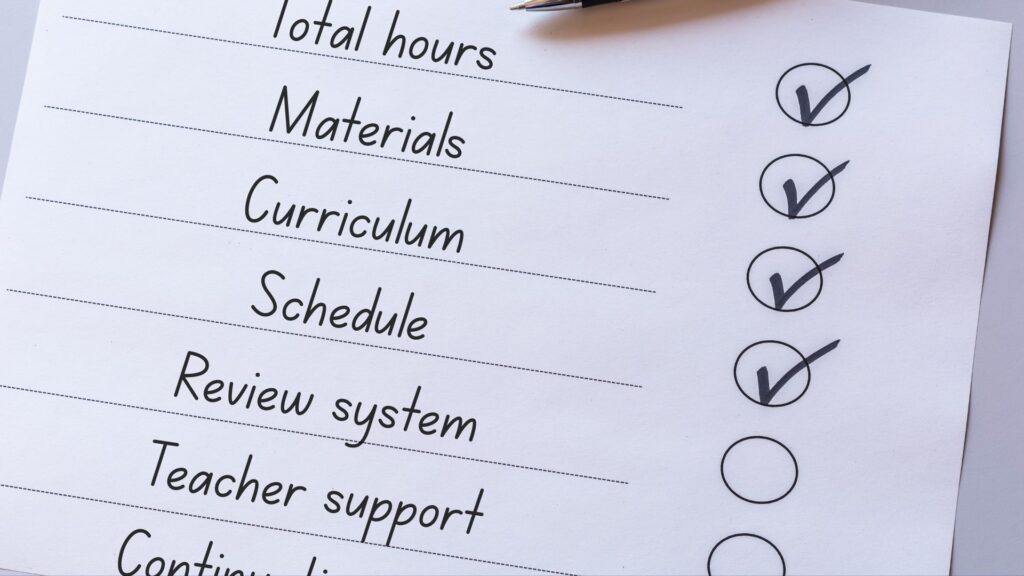
JLPT N5 is often the first major goal for beginners.
When comparing N5 course fees, students should not only ask, “How much is the tuition?”
They should also check what the course includes.
| What to Check | Why It Matters |
|---|---|
| Total hours | Shows how much guided learning time is included |
| Materials | Textbooks and workbooks may affect total cost (physical or degital?) |
| Curriculum | The course should cover N5-level vocabulary, grammar, reading, and listening |
| Schedule | A clear schedule helps students complete the level |
| Review system | Regular review helps students remember what they study |
| Teacher support | Beginners often need explanations, correction, and guidance |
| Continuation path | Students should know how to move from N5 to N4 and higher |
JLRC’s JLPT N5 course is designed as a structured beginner course. Students can learn the foundation of Japanese step by step, including basic vocabulary, grammar, reading, listening, and JLPT-oriented preparation.
You can learn more about JLRC’s beginner course here: JLPT N5 Japanese language course.
If you want to review how to prepare for N5, you may also read JLRC’s How to Pass JLPT N5.
Materials Can Affect the Real Cost
Japanese learning materials are another important part of the total cost.
Some schools include textbooks or workbooks in the course fee. Others may require students to buy materials separately. Some courses may use digital materials, while others may provide printed books.
Students should ask:
- Are textbooks included?
- Are workbooks included?
- Are digital materials available?
- Do I need to buy extra books?
- Are the materials aligned with the course?
- Can I use the materials for review?
Materials matter because Japanese cannot be learned only by listening to class explanations. Students need to review vocabulary, grammar, kanji, reading, and exercises outside class.
JLRC develops structured Japanese learning materials to support systematic study and clearer progress. You can learn more here: Japanese learning materials.
When materials are well connected to the course, students can study more efficiently and avoid wasting time searching for random resources.
Schedule and Time Cost Are Also Part of the Investment
Cost is not only money.
Time is also part of the investment.
A course that takes too long may delay a student’s progress. A course that moves too fast without enough support may cause students to feel lost. The best option depends on the learner’s goal, schedule, and study habits.
Students should consider:
- How many months will the course take?
- How many sessions are held per week?
- Can I study consistently with this schedule?
- Will I lose momentum if the course is too slow?
- Is there flexibility if my schedule changes?
This is where total value becomes important.
A good course should help students make steady progress without unnecessary delay. This connects with JLRC’s learning philosophy: helping students study Japanese with less wasted time, less wasted cost, and less wasted effort through structured lessons.
Cheap Course vs Good Value Course
A low tuition fee can be attractive.
However, the cheapest option is not always the best value.
A good value course should help students move toward their target level with a clear structure.
For example, a course may offer better value if it includes:
- enough guided hours
- clear level coverage
- organized materials
- experienced instructors
- JLPT-oriented lessons
- review support
- a continuation path
- flexible learning options
- realistic preparation for the target level
A cheaper course may become more expensive in the long run if students need to repeat lessons, buy extra materials, or restart their study because the foundation was not strong enough.
This does not mean students should always choose the most expensive course. It means students should compare value for progress.
The best course is the one that matches your goal, your schedule, and your target level.
ROI: What Do You Gain from a Japanese Language Course?
Return on investment, or ROI, is not only for business. It also applies to education.
When students pay for a Japanese language course, they are investing in skills that may support:
- JLPT certification
- career growth
- work with Japanese companies
- communication with Japanese clients or managers
- travel to Japan
- study in Japan
- future employment opportunities
- personal confidence and self-development
The value of a Japanese course is not only the class itself. It is the progress that the course helps you build.
How JLRC Helps Students Get Better Value from Japanese Study
JLRC focuses on structured Japanese education designed to help students make clearer progress.
Instead of studying random topics, students follow an organized path from beginner to higher levels. JLRC offers Japanese courses from JLPT N5 to N1, allowing learners to continue step by step as their goals grow.
JLRC’s approach is built around helping students reduce wasted time, wasted cost, and wasted effort through structured lessons, original learning materials, trained instructors, and level-based progression.
Students can study for JLPT, work, career growth, travel, future study in Japan, or personal development.
JLRC also offers flexible options, including group classes and 1-on-1 lessons, depending on the student’s needs.
For full class schedules, tuition fees, payment terms, and enrollment procedures, students may request details through JLRC’s Japanese language courses page.
JLRC has supported many learners through structured Japanese language education in the Philippines. You can learn more about JLRC’s overall school background and learning approach here: Japanese language school in the Philippines.
Focus on Total Value, Not Just Tuition
When choosing a Japanese language course in the Philippines, do not look only at the tuition fee.
Look at the full picture:
- What level will you reach?
- How many hours are included?
- Are materials included?
- How good is the structure?
- Can you continue to the next level?
- Does the schedule fit your life?
- Is the course aligned with your goal?
- Will it help you avoid wasted time and repeated study?
The best Japanese course is not always the cheapest course. It is the course that gives you the best chance to reach your target level with the right support.
If your goal is JLPT N5, N4, N3, N2, N1, career growth, or practical Japanese communication, structured learning can help you move forward more efficiently.
FAQ
How much does a Japanese language course cost in the Philippines?
The cost of a Japanese language course in the Philippines depends on the school, JLPT level, total hours, class format, materials, schedule, and support included. Students should compare total value, not only tuition fee.
What should I compare when checking Japanese course fees?
Compare tuition, total class hours, materials, course level, schedule, teacher quality, review support, retake policy, and whether the course helps you reach your target JLPT level.
Is the cheapest Japanese course always the best option?
Not always. A cheaper course may look attractive, but it may not offer enough hours, structure, materials, or support. The better question is how much it costs to reach your target level properly.
Is JLPT N5 a good starting point for beginners?
Yes. JLPT N5 is a good starting point because it helps beginners build basic vocabulary, grammar, kanji, reading, and listening. Students can learn more through JLRC’s JLPT N5 Japanese language course.
Are materials included in Japanese course fees?
It depends on the school. Some Japanese courses include textbooks, workbooks, or digital materials, while others require separate purchases. Students should always check what is included before enrolling.




Copyright © 2026 JLRC Inc.
All Rights Reserved
For international students, you may visit our Learn Japanese Online page.
For inquiries, you may call us at (63)2-7358-0565 or (63)917-163-3371
Japanese Language Research Center
Unit 506 Cityland Shaw Tower, Shaw Blvd, Mandaluyong, 1552 Metro Manila, Philippines
For international students, you may visit our Learn Japanese Online page.
For inquiries, you may call us at (63)2-7358-0565 or (63)917-163-3371
Japanese Language Research Center
Unit 506 Cityland Shaw Tower, Shaw Blvd, Mandaluyong, 1552 Metro Manila, Philippines
Copyright © 2026 JLRC Inc.
All Rights Reserved