
JLRC Blogs
- Courses
- Study Japan
- Materials
- Community
- About
- FAQ's
- Careers
- Class Details
- Login


Japanese Particles for Beginners: Why は, が, を, に, and で Are Confusing
JLRC - Content Team 2026/07/24
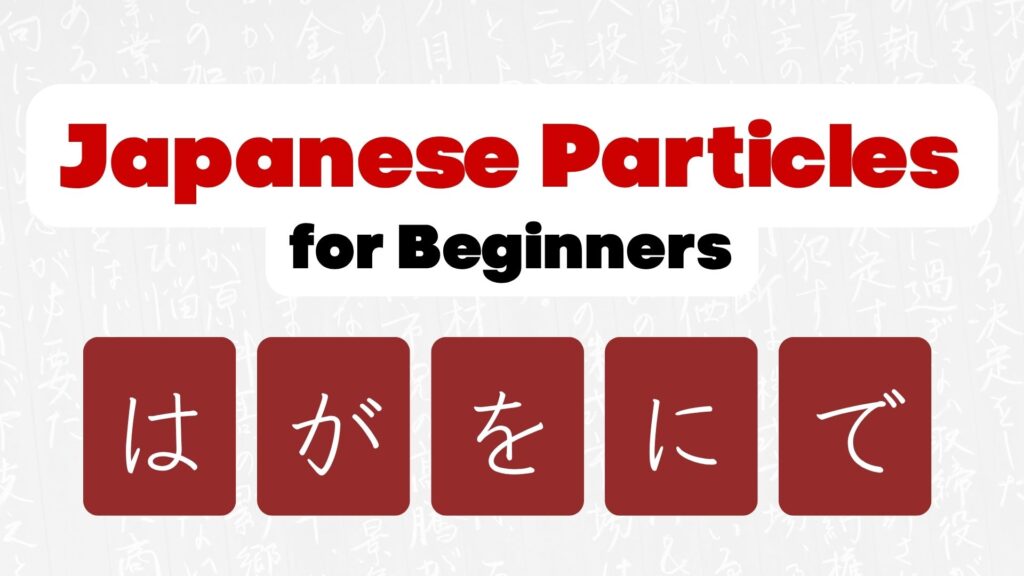
Japanese particles are small, but they are very important.
For many beginners, particles are one of the most confusing parts of Japanese grammar. Words such as は, が, を, に, and で may look short and simple, but they can change the meaning and structure of a sentence.
In English, word order often shows who does the action and what receives the action. In Japanese, particles help show the role of each word in the sentence.
This is why Japanese particles are not just small words. They are part of the sentence structure.
If you are still learning how Japanese grammar is different from English, you may first read JLRC’s JLPT N5 Grammar Guide.
Table of Contents
- Why Japanese Particles Feel Difficult
- What Do Japanese Particles Do?
- は: The Topic Marker
- が: The Subject Marker
- を: The Object Marker
- に: Direction, Time, and Target
- で: Place or Method of Action
- Common Mistakes Beginners Make with Particles
- How to Study Japanese Particles More Effectively
- Why Structured Lessons Help Beginners Understand Particles
- Build a Strong Foundation with Japanese Particles
- FAQ
Why Japanese Particles Feel Difficult
Japanese particles can feel difficult because English does not use them in the same way.
For example, in English, the order of words often tells us the meaning.
“I eat sushi.”
In Japanese, the sentence structure is different, and particles help show the function of each word.
Beginners may struggle because particles do not always have one simple English translation.
The same particle can have different uses depending on the sentence.
This is why memorizing particles as single English words is not enough.
Learners need to understand what each particle does in a sentence.
What Do Japanese Particles Do?
Particles show the relationship between words.
They can show:
- the topic of the sentence
- the subject
- the object
- direction
- location
- time
- method or means
- connection between ideas
At beginner level, students usually meet particles such as は, が, を, に, で, へ, と, も, の.
However, trying to master all particles at once can be confusing.
For beginners, it is better to focus first on the most common particles and understand their basic function.
は: The Topic Marker
The particle は is often used to show the topic of the sentence.
It tells the listener what the sentence is mainly about.
For example, if you are talking about “I,” “today,” or “Japanese class,” は can mark that topic.
Beginners often confuse は with が because both can appear near the subject or topic of a sentence.
A simple way to think about は is:
は introduces the topic or focus of the conversation.
However, は is not always the same as the English word “is” or “am.” This is a common beginner mistake.
が: The Subject Marker
The particle が often marks the subject or the thing being identified.
It can be used when introducing new information or emphasizing who or what is doing something.
Beginners often find が difficult because it sometimes looks similar to は in English translation.
A simple way to think about が is:
が points to the subject or the specific thing being talked about.
At beginner level, students do not need to master every difference between は and が immediately. But they should understand that the two particles do not always mean the same thing.
を: The Object Marker
The particle を marks the object of an action.
It helps show what receives the action of the verb.
For example, in a sentence like “I eat sushi,” sushi is the thing being eaten. In Japanese, を helps show that role.
A simple way to think about を is
を marks what the action is done to.
This is one of the most important beginner particles because many basic sentences use verbs and objects.
に: Direction, Time, and Target
The particle に has several common uses.
It can show direction, time, destination, or target
For example, に can be used when talking about:
- going to a place
- arriving at a place
- doing something at a specific time
- giving something to someone
- the target of an action
This is why に can be confusing for beginners.
A simple way to think about に is:
に often points to a destination, time, or target.
Instead of memorizing one English meaning, learners should study に through example sentences and situations.
で: Place or Method of Action
The particle で is often used to show where an action happens or how something is done.
For example, で can be used for:
- the place where an action occurs
- a tool or method
- transportation
- means of doing something
A simple way to think about で is:
で often shows the setting or method of an action.
Beginners often confuse に and で because both can be connected to places. But they are not the same.
In simple terms, に often points to a destination or target, while で often shows where an action happens.
Common Mistakes Beginners Make with Particles
Many beginners make similar mistakes when studying particles.
Mistake 1: Translating particles directly into English
Particles do not always have one exact English translation. It is better to understand their function.
Mistake 2: Skipping particles
Particles may be short, but removing them can make a sentence unclear or unnatural.
Mistake 3: Confusing は and が
This is one of the most common beginner problems. Learners should study them gradually through context.
Mistake 4: Confusing に and で
Both can connect to places, but they are used differently depending on meaning and action.
Mistake 5: Memorizing rules without examples
Particles become easier to understand when learners see them in real sentences.
How to Study Japanese Particles More Effectively

Particles are easier to learn when studied step by step.
Here are useful tips.
Learn particles by function
Do not only memorize English translations. Ask what the particle does in the sentence.
Study short example sentences
Short sentences help beginners clearly see how particles work.
Compare similar particles
Compare は and が, or に and で, but do not try to master every difference at once.
Read and listen regularly
Particles appear constantly in real Japanese. Reading and listening help learners recognize them naturally.
Review mistakes carefully
When you make a mistake, ask why that particle was needed.
For learners who want a clear beginner plan, JLRC also has a JLPT N5 Study Plan.
Why Structured Lessons Help Beginners Understand Particles
Japanese particles can be difficult to master through random study
Because particles depend on sentence structure and context, learners often need clear explanations, repeated practice, and examples.
Structured lessons help beginners:
- understand basic sentence structure
- learn particles step by step
- compare similar particles clearly
- practice with short sentences
- connect grammar with reading and listening
- avoid common beginner mistakes
- build a stronger foundation for N5 and higher levels
JLRC uses original Japanese learning materials to help students understand grammar, particles, vocabulary, and sentence patterns in a step-by-step way.
To learn more about JLRC’s teaching style, you can visit the JLRC Japanese language school page and see how its approach has been developed through more than 25 years of teaching students from basic Japanese to higher JLPT levels.
With the right structure, beginners can make clearer progress with less wasted time. Students who want to study Japanese in a structured class can also explore JLRC’s Japanese language courses.
Build a Strong Foundation with Japanese Particles
Japanese particles may feel confusing at first, but they become easier when learners understand their function.
To study particles effectively, remember:
- particles show the role of words in a sentence
- は and が are not always the same
- を marks the object of an action
- に often points to time, destination, or target
- で often shows place, method, or means
- particles should be studied in context
- structured practice helps beginners avoid confusion
By learning particles through clear examples and sentence patterns, beginners can build a stronger foundation for Japanese reading, listening, and communication.
JLRC also offers online Japanese lessons for international students, helping learners outside the Philippines study Japanese with structured support.
FAQ
What are Japanese particles?
Japanese particles are short words that show the role of other words in a sentence. They can mark the topic, subject, object, direction, place, time, or method.
Why are Japanese particles difficult for beginners?
Japanese particles are difficult because they do not always have exact English translations. Their meaning depends on sentence structure and context.
What is the difference between は and が?
In simple terms, は is often used to show what the sentence is mainly about, while が is often used to point out who or what is doing something. Beginners do not need to master the full difference immediately, but they should learn は and が through many example sentences.
What is the difference between に and で?
に often points to a time, destination, or target, while で often shows where an action happens or how something is done.
How can I study Japanese particles effectively?
Study particles by function, use short example sentences, compare similar particles, and review mistakes carefully. Structured lessons can also help beginners understand particles more clearly.




Copyright © 2026 JLRC Inc.
All Rights Reserved
For international students, you may visit our Learn Japanese Online page.
For inquiries, you may call us at (63)2-7358-0565 or (63)917-163-3371
Japanese Language Research Center
Unit 506 Cityland Shaw Tower, Shaw Blvd, Mandaluyong, 1552 Metro Manila, Philippines
For international students, you may visit our Learn Japanese Online page.
For inquiries, you may call us at (63)2-7358-0565 or (63)917-163-3371
Japanese Language Research Center
Unit 506 Cityland Shaw Tower, Shaw Blvd, Mandaluyong, 1552 Metro Manila, Philippines
Copyright © 2026 JLRC Inc.
All Rights Reserved