
JLRC Blogs
- Courses
- Study Japan
- Materials
- Community
- About
- FAQ's
- Careers
- Class Details
- Login


What JLPT Level Do You Need for Japanese Jobs in the Philippines?
JLRC - Content Team 2026/09/18

If you are learning Japanese for your career, one of the most important questions is:
What JLPT level do I actually need to get a Japanese-speaking job in the Philippines?
The short answer is that there is no single JLPT level required for every job.
Some entry-level Japanese-speaking positions may consider applicants around JLPT N3, especially when the role involves customer support or when the candidate already has relevant work experience.
However, JLPT N2 is often the level at which significantly more professional opportunities begin to open, particularly for Japanese bilingual, service desk, corporate support, translation, and other roles requiring regular Japanese communication.
For positions involving advanced interpretation, translation, management, or highly specialized communication, employers may prefer JLPT N1 or N2.
So rather than asking only, “What JLPT certificate do I need?”, it is better to ask:
What level of Japanese does the job actually require?
This guide explains how JLPT N5 through N1 relate to career opportunities in the Philippines and how to choose the right target level for your goals.
Table of Contents
- Why Japanese Language Skills Can Be Valuable in the Philippines
- What Do the JLPT Levels Actually Mean?
- Is JLPT N5 Enough for a Japanese-Speaking Job?
- What About JLPT N4?
- JLPT N3: Where Career Opportunities Start Becoming More Realistic
- JLPT N2: The Strong Career Target for Many Professionals
- JLPT N1: When Advanced Japanese Becomes a Major Professional Asset
- JLPT N3 vs N2 for Jobs: What Is the Real Difference?
- Does JLPT Certification Guarantee That You Can Speak Japanese at Work?
- Your Professional Skills Matter as Much as Your JLPT Level
- JLRC's Approach to Career-Focused Japanese Learning
- Final Answer: What JLPT Level Do You Need for a Japanese Job in the Philippines?
Why Japanese Language Skills Can Be Valuable in the Philippines
The Philippines is home to many Japanese companies, multinational corporations, BPO operations, IT companies, manufacturing firms, shared-service centers, and organizations that work with Japanese customers and business partners.
As a result, Japanese ability can complement many different professional backgrounds, including:
- Customer service
- IT and technical support
- Accounting and finance
- Human resources
- Administration
- Manufacturing
- Engineering
- Sales and purchasing
- Translation and interpretation
- Bilingual business support
Current Philippine job listings illustrate this range. For example, recent Japanese bilingual positions have advertised requirements ranging from N3 to N2, while some service desk and interpreting positions prefer N1 or N2.
The important point is that Japanese proficiency becomes more valuable when it is combined with another professional skill.
Japanese + IT, Japanese + accounting, Japanese + customer service, or Japanese + engineering can create a much stronger career profile than language ability alone.
If you are interested in how Japanese can support your career, see Japanese for Work in the Philippines: How Nihongo Skills Can Support Your Career.
What Do the JLPT Levels Actually Mean?
The Japanese-Language Proficiency Test has five levels:
N5 → N4 → N3 → N2 → N1
N5 is the introductory level, while N1 is the most advanced.
According to the official JLPT description, N4 and N5 primarily measure understanding of basic Japanese typically learned in the classroom.
N3 serves as a bridge between the basic and more advanced levels.
N2 measures the ability to understand Japanese used in everyday situations and, to some degree, in a wider range of circumstances, while N1 measures understanding of Japanese used in a broad variety of situations.
For employment purposes, this distinction matters.
A company that simply needs basic communication ability may accept a lower level.
A company that expects you to:
- read Japanese emails,
- understand meetings,
- communicate with Japanese customers,
- write reports,
- solve problems in Japanese, or
- interpret between Japanese and English,
will generally expect a much higher level.
Is JLPT N5 Enough for a Japanese-Speaking Job?
In most cases, JLPT N5 alone is not enough for a job where Japanese is a major working language.
N5 demonstrates that you understand basic Japanese, including elementary grammar, vocabulary, Kanji, reading, and simple listening.
That is an important first milestone, but professional communication normally requires significantly more.
However, N5 can still be valuable if you are:
- beginning a Japanese-related career path,
- already working for a Japanese company,
- adding Japanese to another strong technical skill,
- preparing to progress toward N4, N3, or N2.
There are exceptions. Some technical positions may place much greater weight on professional experience than on language level.
One Philippine software-development listing, for example, accepted Japanese proficiency across a wide N5–N1 range for certain technical specialties, provided applicants also had relevant professional experience.
The lesson is important:
JLPT level is only one part of your employability.
If you are starting from zero, JLPT N5 should usually be viewed as the beginning of your career pathway rather than the final destination.
Learn more about JLRC’s JLPT N5 Course.
What About JLPT N4?
JLPT N4 represents a stronger foundation in basic Japanese.
At this level, you can understand more grammar, vocabulary, Kanji, everyday expressions, and simple conversations than at N5.
However, N4 is still generally a foundation level rather than a professional working level.
It may be useful for:
- basic workplace interaction,
- simple communication with Japanese colleagues,
- companies that provide additional language training,
- roles where Japanese is an advantage rather than a core requirement.
For learners focused specifically on building a Japanese bilingual career, N4 is usually best viewed as an important step toward N3 and eventually N2.
JLPT N3: Where Career Opportunities Start Becoming More Realistic
For many learners, N3 is the first level at which Japanese begins to become meaningfully useful in the Philippine job market.
The official JLPT describes N3 as the ability to understand Japanese used in everyday situations to a certain degree. It also serves as the bridge between basic N4/N5 Japanese and advanced N2/N1 Japanese.
This is significant for employment.
At N3, you may begin to qualify for selected positions such as:
- Japanese customer service
- BPO support
- Junior bilingual roles
- Certain administrative positions
- Technical roles where Japanese supplements another skill
For example, a TELUS Digital Japanese bilingual listing required at least JLPT N3-level Japanese, while an Accenture listing indicated N3–N2 as a preferred range for a Japanese bilingual role.
Another Accenture listing showed an important distinction: N2/N1-level candidates could be considered without relevant domain experience, while N3-level candidates could qualify when combined with experience in areas such as customer service, help desk, translation, technical writing, or troubleshooting.
This illustrates an important career principle:

At N3, your Japanese may begin opening doors—but your professional experience still matters greatly.
For a deeper discussion, see JLPT N3 and Career Growth in the Philippines.
If N3 is your next target, you can also review the JLPT N3 Study Guide: How to Move Up After N4.
JLPT N2: The Strong Career Target for Many Professionals
For many Filipino professionals learning Japanese for employment, N2 is one of the most valuable career targets.
Why?
Because at N2, Japanese ability has progressed beyond everyday basic communication toward understanding Japanese used in a wider range of real-life situations.
According to the JLPT's official description, N2 learners can understand clearly written materials on a variety of topics and follow coherent conversations and news spoken at nearly natural speed in everyday and broader situations.
That level is much closer to what many employers need from bilingual employees.
Current Philippine job listings show N2 appearing in roles such as:
- Japanese bilingual support
- Service desk
- Customer support
- IT support
- Corporate operations
- Translation and interpretation
For example, Fujitsu has advertised Japanese bilingual service desk positions requiring N1–N2 level, preferably with JLPT certification.
Another Japanese bilingual role advertised by Accenture was open from native level to N2, with N1 certification preferred.
A Japanese interpreter position for the manufacturing sector also listed JLPT N1 or N2 among its qualifications, together with relevant interpreting experience.
This is why N2 can represent a major career milestone.
It does not guarantee a job, but it can significantly increase the number and type of Japanese-related roles for which you may be considered.
For more information, read JLPT N2 and Career Opportunities in the Philippines.
You can also explore the JLPT N2 Study Guide: How to Move Up After N3.
JLPT N1: When Advanced Japanese Becomes a Major Professional Asset
JLPT N1 is the highest level of the JLPT.
It represents the ability to understand Japanese used in a wide variety of circumstances, including more complex reading materials and naturally paced spoken Japanese.
N1 can be particularly valuable for work requiring:
- Advanced translation
- Professional interpretation
- High-level Japanese business communication
- Complex documentation
- Management involving Japanese stakeholders
- Specialized Japanese-language roles
However, N1 is not automatically necessary for every Japanese bilingual job.
For many roles, N2 may already satisfy the employer's language requirement, particularly when the candidate also has strong professional experience.
That is why learners should not automatically assume:
“I need N1 before I can use Japanese professionally.”
For many career paths, the more practical strategy may be:
Reach N3 → begin exploring opportunities → reach N2 → expand your career options → consider N1 if your profession requires it.
If you are already approaching advanced Japanese, see JLPT N1 Study Guide: How to Move Up After N2.
JLPT N3 vs N2 for Jobs: What Is the Real Difference?
A simple way to think about it is:
| JLPT Level | General Career Position |
|---|---|
| N5 | Basic foundation; usually not enough for Japanese-dependent work |
| N4 | Stronger foundation; limited professional use by itself |
| N3 | Japanese starts becoming useful for selected bilingual roles |
| N2 | Strong career target for many professional Japanese-speaking positions |
| N1 | Advanced advantage for specialized and high-level Japanese communication |
These are general guidelines—not fixed hiring rules.
Actual employers may assess applicants based on:
- Japanese speaking ability
- Reading and writing
- English communication
- Previous work experience
- Technical skills
- Industry knowledge
- Education
- Interview performance
- JLPT certification
This is why two applicants with the same JLPT level may qualify for very different positions.
Does JLPT Certification Guarantee That You Can Speak Japanese at Work?
No.
This is an important point.
The JLPT measures language knowledge, reading, and listening. It does not directly test speaking or writing production.
That means someone with JLPT N2 may still need additional practice in:
- Speaking spontaneously
- Business communication
- Writing professional emails
- Keigo
- Meetings
- Telephone communication
- Job interviews
Employers may therefore conduct their own Japanese-language interview or assessment even if you already hold a JLPT certificate.
JLPT certification is valuable because it gives employers an internationally recognized reference point for your Japanese proficiency—but it should be supported by practical communication skills.
You may find these JLRC guides useful:
25 Japanese Phrases for Work: Useful Nihongo for the Workplace
Japanese Job Interview Questions and Phrases: 20 Essential Examples
Your Professional Skills Matter as Much as Your JLPT Level
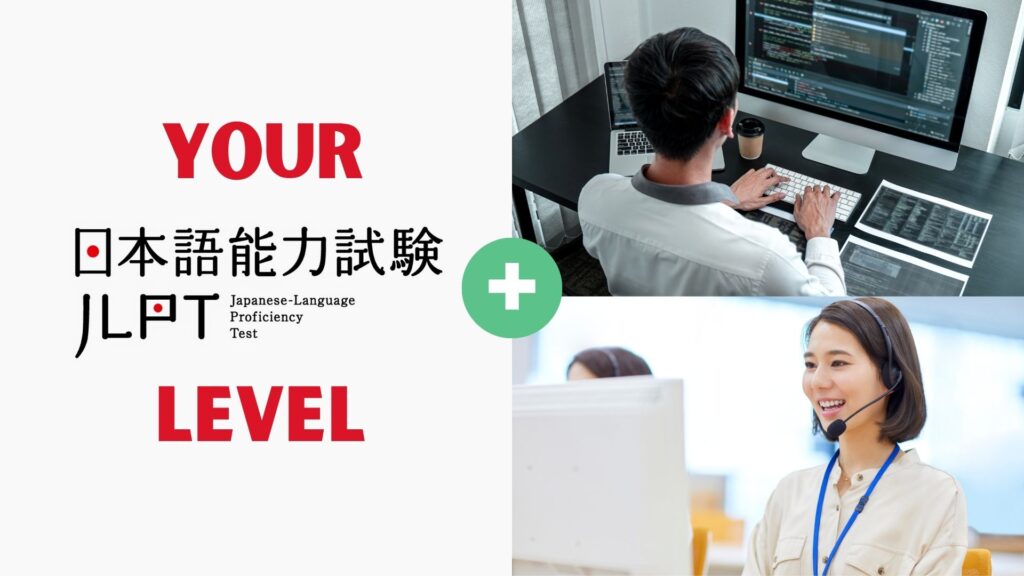
One of the biggest mistakes Japanese learners can make is thinking that JLPT certification alone will create a career.
Employers hire people to perform jobs.
Japanese is often the skill that allows you to perform that job in a Japanese-speaking environment.
For example:
Japanese + IT
can lead toward service desk, development, systems support, or technical bilingual positions.
Japanese + Accounting
can support roles in shared services, finance, accounts payable, or Japanese corporate operations.
Japanese + Customer Service
can support BPO and Japanese customer-support roles.
Japanese + Engineering or Manufacturing
can support coordination with Japanese engineers, managers, suppliers, or factories.
Japanese + Strong English
can be particularly useful in roles requiring communication between Japanese and international teams.
The strongest career strategy is therefore often:
Professional Skill + Japanese Ability + JLPT Certification
rather than JLPT certification alone.
JLRC's Approach to Career-Focused Japanese Learning
JLRC has provided Japanese language education in the Philippines since 2001.
Our courses are structured around JLPT levels from JLPT N5 through N1 and supported by original Japanese learning materials developed through years of research and classroom experience.
JLRC's “Less Time, Less Cost, Less Effort” philosophy focuses on helping students make meaningful progress efficiently—not by rushing learning, but by reducing unnecessary learning time through structured lessons and carefully designed materials.
For serious learners working toward N5 through N2, JLRC also provides a Free JLPT Course Retake Guarantee for students who do not pass the corresponding JLPT exam, subject to the applicable attendance requirements.
This gives learners greater assurance as they continue toward the Japanese level required for their academic or career goals.
Learn more about JLRC Japanese Language School in the Philippines.
Final Answer: What JLPT Level Do You Need for a Japanese Job in the Philippines?
There is no universal JLPT requirement for Japanese-related jobs in the Philippines.
But as a practical guideline:
N5–N4: Build your foundation.
N3: Japanese starts becoming useful for selected career opportunities.
N2: A strong target for many Japanese bilingual and professional roles.
N1: A major advantage for advanced or specialized Japanese-language work.
If your main goal is career growth, N3 should be considered an important milestone—but N2 is an especially valuable long-term target.
Most importantly, combine Japanese with another professional strength.
The goal is not simply to collect a JLPT certificate.
It is to develop Japanese ability that you can actually use to create more choices, stronger career opportunities, and meaningful professional growth.
Ready to Move Toward Your Target JLPT Level?
Explore JLRC's Japanese Language Courses from N5 to N1 to find the level that matches your current Japanese ability and career goals.




Copyright © 2026 JLRC Inc.
All Rights Reserved
For international students, you may visit our Learn Japanese Online page.
For inquiries, you may call us at (63)2-7358-0565 or (63)917-163-3371
Japanese Language Research Center
Unit 506 Cityland Shaw Tower, Shaw Blvd, Mandaluyong, 1552 Metro Manila, Philippines
For international students, you may visit our Learn Japanese Online page.
For inquiries, you may call us at (63)2-7358-0565 or (63)917-163-3371
Japanese Language Research Center
Unit 506 Cityland Shaw Tower, Shaw Blvd, Mandaluyong, 1552 Metro Manila, Philippines
Copyright © 2026 JLRC Inc.
All Rights Reserved