
JLRC Blogs
- Courses
- Study Japan
- Materials
- Community
- About
- FAQ's
- Careers
- Class Details
- Login


JLPT N3 Study Guide: How to Move Up After N4
JLRC - Content Team 2026/06/16

Completing JLPT N4 is an important achievement in Japanese learning.
At N4 level, learners usually understand basic Japanese used in daily situations. They can read simple passages, understand common grammar patterns, recognize beginner kanji, and follow basic conversations.
But when students move from N4 to N3, many notice a clear change.
JLPT N3 is where Japanese begins to move from beginner level to intermediate level.”
The sentences become longer. Vocabulary becomes wider. Reading passages require more context. Listening becomes faster and more natural. Grammar is no longer just about memorizing patterns — it becomes about understanding how ideas connect.
This guide explains what changes from N4 to N3, what you should study, common challenges learners face, and how structured learning can help you move forward with confidence.
If you are still building your N4 foundation, you may first review JLRC’s JLPT N4 Study Guide.
Table of Contents
- What Is JLPT N3?
- JLPT N4 vs N3: What Changes?
- What You Should Review Before Starting N3
- What to Study for JLPT N3
- Common Challenges When Moving from N4 to N3
- Why Structured Lessons Help N3 Learners
- Can You Study JLPT N3 Online?
- How JLRC Supports Students Moving from N4 to N3
- Should You Take a JLPT N3 Course?
- Start Your JLPT N3 Learning Path
- FAQ
What Is JLPT N3?
JLPT N3 is the middle level of the Japanese-Language Proficiency Test.
It connects the beginner levels, N5 and N4, with the more advanced levels, N2 and N1. This makes N3 an important turning point for many learners.
At N3 level, students are expected to understand Japanese used in everyday situations with more detail and context. This includes:
- longer conversations
- short essays and explanations
- practical grammar patterns
- more kanji and vocabulary
- common written expressions
- natural spoken Japanese at a moderate speed
In simple terms, N4 helps you understand basic Japanese, while N3 helps you understand Japanese more independently.
This is why N3 is often an important goal for learners who want to use Japanese for work, study, travel, or future opportunities in Japan.
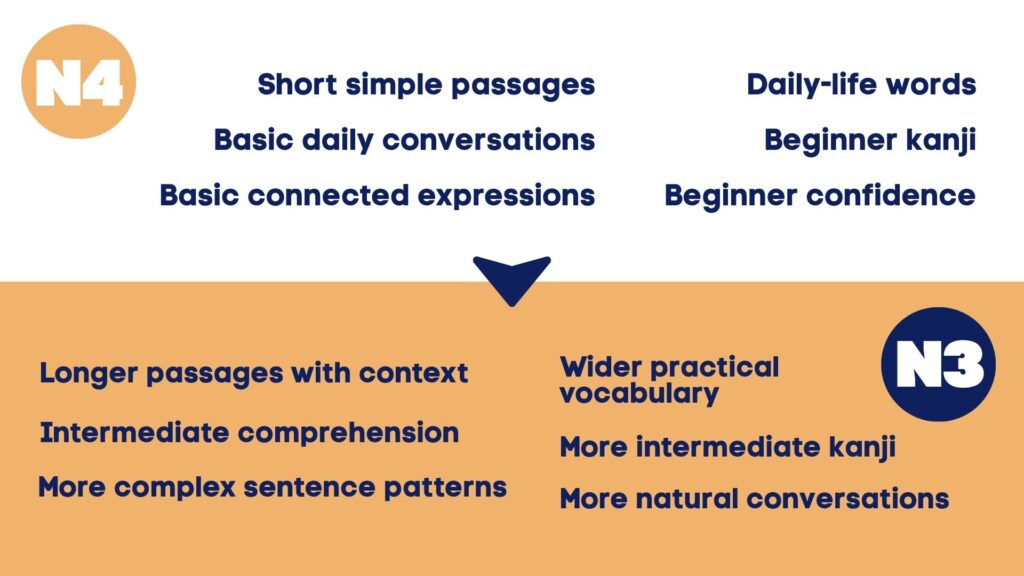
JLPT N4 vs N3: What Changes?
The move from N4 to N3 is bigger than many students expect.
At N4, learners mainly focus on basic daily expressions. At N3, learners need to understand longer ideas and more natural language.
| Area | JLPT N5 | JLPT N4 |
|---|---|---|
| Grammar | Basic connected expressions | More complex sentence patterns |
| Vocabulary | Daily-life words | Wider practical vocabulary |
| Kanji | Beginner kanji | More intermediate kanji |
| Reading | Short simple passages | Longer passages with context |
| Listening | Basic daily conversations | More natural conversations |
| Study focus | Beginner confidence | Intermediate comprehension |
N3 requires learners to connect grammar, vocabulary, reading, and listening more deeply.
You may know the meaning of each word, but still struggle to understand the whole sentence. You may understand grammar in a textbook, but find it harder in real reading or listening.
That is why N3 study needs more integrated practice, not only memorization.
What You Should Review Before Starting N3
Before moving fully into N3 study, it is important to check your N4 foundation.
You should be comfortable with:
- N4 grammar patterns
- common N4 vocabulary
- beginner to lower-intermediate kanji
- basic particles and verb forms
- short reading passages
- daily conversation listening
- simple opinions and explanations
- N5 and N4 sentence patterns
If these areas still feel weak, it does not mean you cannot start N3. However, you should continue reviewing N4 while learning new N3 material.
A common mistake is to move to N3 too quickly without strengthening N4. When this happens, students may feel overwhelmed by longer reading passages and faster listening tasks.
A strong N4 foundation makes N3 much easier to manage.
What to Study for JLPT N3
To prepare for JLPT N3, students should study grammar, vocabulary, kanji, reading, and listening together.
1. N3 Grammar
N3 grammar helps learners express more complex ideas.
You will study patterns used for:
- reasons and causes
- conditions
- contrast
- purpose
- opinions
- assumptions
- changes
- explanations
- emphasis
- more natural sentence connections
At N3, grammar is not only about knowing the English meaning. You need to understand how grammar works inside longer sentences.
For example, N3 learners must become more comfortable reading sentences where multiple ideas are connected in one paragraph.
2. N3 Vocabulary
N3 vocabulary becomes more practical and varied.
You will see words related to:
- work
- school
- daily life
- society
- health
- travel
- opinions
- emotions
- news-like topics
- common written expressions
The challenge is not only learning more words. You also need to recognize them quickly in reading and listening.
3. N3 Kanji
Kanji becomes more important at N3.
At this level, learners should develop stronger recognition of common kanji used in daily written Japanese. Kanji affects reading speed, vocabulary understanding, and test performance.
Studying kanji together with vocabulary is usually more effective than memorizing characters alone.
4. Reading Practice
Reading is one of the biggest changes from N4 to N3.
N3 reading passages are longer and require more context. Students must understand the main idea, sentence connections, and the writer’s intention.
This is why reading practice should be regular, not occasional.
5. Listening Practice
N3 listening may feel much faster than N4.
Students need to understand daily conversations, short explanations, opinions, and situations. Sometimes the answer is not stated directly, so learners must understand context.
N3 listening improves through repeated exposure to natural Japanese.
Common Challenges When Moving from N4 to N3
Many learners find N3 difficult because the learning style changes.
At N5 and N4, students can often make progress by memorizing basic grammar and vocabulary. At N3, that is not enough.
Common challenges include:
- reading passages feel too long
- listening feels too fast
- vocabulary increases quickly
- kanji recognition is slow
- grammar patterns look similar
- students understand examples but not real passages
- self-study becomes less organized
Another common issue is forgetting earlier material. N3 uses many N5 and N4 foundations, so review is still important.
The key is to avoid random study. Learners need a clear plan that connects grammar, vocabulary, reading, listening, and review.
Why Structured Lessons Help N3 Learners
JLPT N3 is the level where structure becomes even more important.
At N3, students need to move from beginner knowledge to intermediate comprehension. This requires organized lessons, level-matched materials, teacher guidance, and regular review.
Structured lessons help students:
- review weak N4 foundations
- learn N3 grammar in context
- build vocabulary gradually
- connect kanji with reading
- practice listening regularly
- understand longer passages
- avoid wasting time on random study
JLRC uses structured lessons and Japanese learning materials designed to help students connect grammar, vocabulary, kanji, reading, and listening step by step.
At JLRC, structured learning helps students avoid random study and make progress with less wasted time.

Can You Study JLPT N3 Online?
Yes, JLPT N3 can be studied online if the class is live, structured, and interactive.
Online N3 learners should look for:
- clear grammar explanations
- reading practice
- listening practice
- teacher correction
- review support
- level-matched materials
- opportunities to ask questions
For students outside the Philippines, JLRC offers options to learn Japanese online from anywhere.
Online learning can work well when students attend regularly, review after class, and actively participate.
How JLRC Supports Students Moving from N4 to N3
JLRC supports learners who want to continue from beginner Japanese to higher JLPT levels.
For students moving from N4 to N3, the goal is not simply to study more. The goal is to build intermediate comprehension in a clear and manageable way.
JLRC’s N3 learning support focuses on:
- reviewing important N4 foundations
- introducing N3 grammar step by step
- expanding vocabulary and kanji
- improving reading and listening skills
- helping students continue toward N2 and N1
- providing group class and 1-on-1 options depending on student needs
JLRC Japanese Language Research Center is a Japanese language school based in Metro Manila, Philippines that supports learners from beginner to higher JLPT levels through structured Japanese language education.
Students who want to understand the full course path can also read JLRC’s guide on JLPT courses from N5 to N1.
Should You Take a JLPT N3 Course?
You can study for JLPT N3 on your own, especially if you are disciplined and have strong N4 foundations.
However, a structured course can help if you:
- are not sure what to study next
- struggle with long reading passages
- find listening too fast
- need grammar explanations
- want teacher correction
- need a regular study schedule
- plan to continue to N2 or higher
N3 is an important bridge level. Studying with structure can help you avoid confusion and continue progressing toward your long-term goal.
If you are looking for a clear path from N4 to higher JLPT levels, you can explore JLRC’s Japanese language courses.
Start Your JLPT N3 Learning Path
JLPT N3 is a major step after N4.
It helps learners move from basic Japanese to more practical intermediate Japanese. It also prepares students for N2, career opportunities, study in Japan, and more confident daily communication.
To prepare for N3 effectively, remember:
- review your N4 foundation
- study grammar in context
- build vocabulary gradually
- review kanji regularly
- practice reading longer passages
- listen to Japanese often
- follow a clear learning path
- avoid random study
With the right structure, N3 becomes a meaningful and achievable next step.
FAQ
What is JLPT N3?
JLPT N3 is the middle level of the Japanese-Language Proficiency Test. It connects beginner Japanese at N5 and N4 with more advanced Japanese at N2 and N1.
Is JLPT N3 much harder than N4?
Yes, N3 is harder than N4 because it includes longer reading passages, faster listening, more grammar, more vocabulary, and more kanji. However, it becomes manageable with a strong N4 foundation and structured study.
What should I study after JLPT N4?
After JLPT N4, students should review N4 grammar, vocabulary, kanji, reading, and listening, then begin studying N3 grammar, vocabulary, kanji, reading, and listening step by step.
Can I study JLPT N3 online?
Yes. JLPT N3 can be studied online if the course is live, structured, interactive, and includes teacher guidance, reading practice, listening practice, materials, and review support.
Should I take a JLPT N3 course?
A JLPT N3 course can help if you need structure, teacher explanations, reading and listening practice, regular review, and a clear path toward N2 or higher levels with less time.




Copyright © 2026 JLRC Inc.
All Rights Reserved
For international students, you may visit our Learn Japanese Online page.
For inquiries, you may call us at (63)2-7358-0565 or (63)917-163-3371
Japanese Language Research Center
Unit 506 Cityland Shaw Tower, Shaw Blvd, Mandaluyong, 1552 Metro Manila, Philippines
For international students, you may visit our Learn Japanese Online page.
For inquiries, you may call us at (63)2-7358-0565 or (63)917-163-3371
Japanese Language Research Center
Unit 506 Cityland Shaw Tower, Shaw Blvd, Mandaluyong, 1552 Metro Manila, Philippines
Copyright © 2026 JLRC Inc.
All Rights Reserved