
JLRC Blogs
- Courses
- Study Japan
- Materials
- Community
- About
- FAQ's
- Careers
- Class Details
- Login


JLPT N2 Reading and Listening Guide: How to Build Advanced Comprehension
JLRC - Content Team 2026/07/10
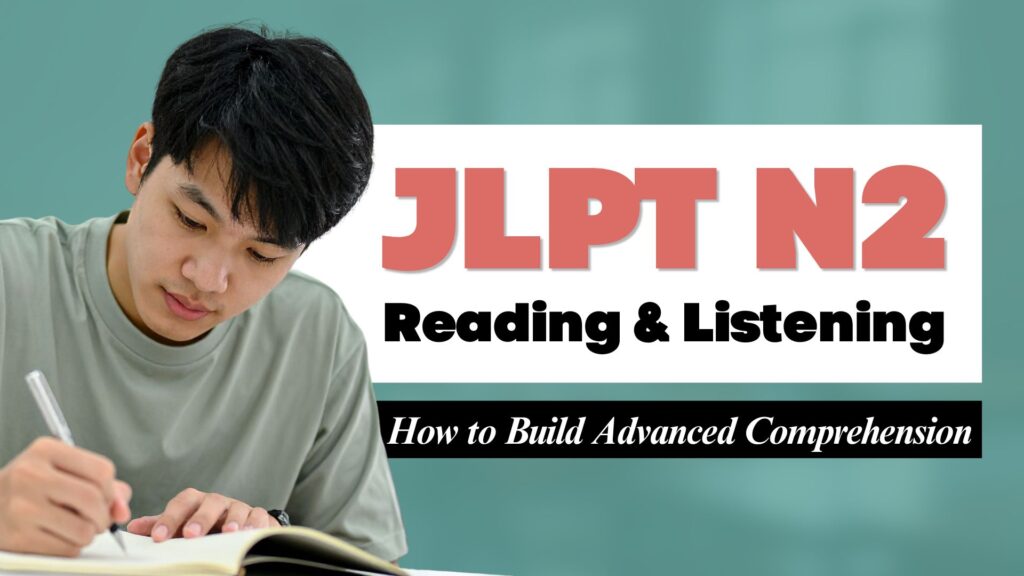
JLPT N2 is a major step up from N3.
At N3 level, many learners begin to understand intermediate Japanese. But at N2, reading passages become longer, listening becomes faster, and the meaning is often less direct.
This is why N2 preparation is not only about memorizing more words or grammar patterns
JLPT N2 requires stronger comprehension — the ability to understand longer, faster, and more complex Japanese.
This guide explains how to improve N2 reading and listening skills, what makes them difficult, and how structured study can help learners prepare more effectively.
If you are still planning your overall N2 preparation, you may first read JLRC’s JLPT N2 Study Guide.
Table of Contents
- Why N2 Reading and Listening Feel More Difficult
- N2 Reading: What Learners Need to Improve
- N2 Listening: What Learners Need to Improve
- Common Problems N2 Learners Face
- How to Study N2 Reading More Effectively
- How to Study N2 Listening More Effectively
- Why Structured Learning Helps with N2 Comprehension
- Can You Study N2 Reading and Listening Online?
- Build Stronger Comprehension for JLPT N2
- FAQ
Why N2 Reading and Listening Feel More Difficult
N2 reading and listening are more demanding than N3 because learners must process Japanese more quickly and accurately.
At this level, it is not enough to understand only individual words.
Learners need to understand:
- he main idea
- supporting details
- sentence connections
- speaker intention
- implied meaning
- contrast and cause
- opinions and conclusions
- the overall flow of information
This is why some learners feel frustrated at N2.
They may know many grammar points and vocabulary words, but still struggle to understand a long passage or fast conversation.
At N2, comprehension depends on how well grammar, vocabulary, kanji, reading speed, and listening practice work together.
N2 Reading: What Learners Need to Improve
N2 reading passages can include explanations, opinions, notices, essays, articles, and practical written information.
Compared with N3, the sentences are often longer and the ideas are more abstract.
To improve N2 reading, learners should focus on:
- understanding long sentences
- recognizing sentence connectors
- identifying the writer’s opinion
- finding key information quickly
- understanding abstract vocabulary
- reading without translating every word
- checking why an answer is correct or wrong
One common mistake is reading too slowly.
If learners try to translate every sentence into English, they may lose time and miss the overall meaning.
A better approach is to train yourself to understand the structure of the Japanese sentence and follow the flow of the passage.
N2 Listening: What Learners Need to Improve
N2 listening can feel difficult because conversations are faster and more natural than lower levels.
Learners may understand the words when reading them, but fail to catch them when listening.
At N2 level, learners need to practice:
- catching key words quickly
- understanding the situation
- identifying the speaker’s purpose
- following longer conversations
- recognizing polite and indirect expressions
- understanding changes in tone
- choosing the answer based on the whole context
Listening is not only about hearing words.
Learners must understand what the speaker really means, especially when the answer is not stated directly.
This is one reason why regular listening practice is important.
Common Problems N2 Learners Face
Many N2 learners face similar problems when studying reading and listening.
Problem 1: Knowing vocabulary but not understanding the sentence
Some learners memorize words but still cannot understand long sentences. This happens when vocabulary is not connected with grammar and sentence structure.
Problem 2: Reading too slowly
N2 reading requires speed. If learners read word by word, they may run out of time.
Problem 3: Missing the speaker’s intention
In N2 listening, the answer is not always stated directly. Learners need to understand the situation and implied meaning.
Problem 4: Studying reading and listening separately
Reading and listening are connected. Strong reading skills can help learners understand listening scripts, and listening practice can improve natural comprehension.
Problem 5: Not reviewing mistakes deeply
Simply checking the correct answer is not enough. Learners should ask why they misunderstood the passage or conversation.
For learners who want to strengthen the previous level first, JLRC also has a JLPT N3 Reading and Listening Guide.
How to Study N2 Reading More Effectively
To improve N2 reading, learners need both accuracy and speed.
Here are practical study tips.
Read short passages regularly
Do not wait until you can read perfectly. Regular practice helps you become familiar with N2-style sentences.
Focus on sentence connections
Pay attention to words that show contrast, reason, result, and conclusion. These words help you understand the structure of the passage.
Identify the main point
Ask yourself: What does the writer want to say?
This is especially important for opinion-based passages.
Review wrong answers carefully
When you make a mistake, check whether the problem came from vocabulary, grammar, kanji, sentence structure, or misunderstanding the question.
Avoid translating everything
Translation can help sometimes, but relying on it too much can make reading slow. Try to understand Japanese in larger chunks.
How to Study N2 Listening More Effectively
Listening improves through repeated exposure and careful review.
Here are useful methods.
Listen regularly
Short, consistent listening practice is better than occasional long sessions.
Check the situation first
Before answering, ask: Who is speaking? Where are they? What is the purpose of the conversation?
Listen for the main point
Do not focus only on individual words. Try to understand the speaker’s overall message.
Review with scripts
Listening scripts help learners check what they missed and why they missed it.
Practice natural speed
N2 listening can feel fast. Learners need practice with natural rhythm, pauses, and sentence flow.
With regular review, listening becomes less overwhelming.
Why Structured Learning Helps with N2 Comprehension
N2 reading and listening can be difficult to improve through random study.
Learners need a clear structure that connects grammar, vocabulary, kanji, reading, and listening practice.
Structured learning helps students:
- review weak N3 foundations
- build N2 vocabulary and kanji gradually
- understand grammar in longer sentences
- practice reading with clear strategies
- improve listening through repeated exposure
- learn from mistakes more effectively
- prepare for higher levels step by step
JLRC develops Japanese learning materials designed to support structured Japanese study from beginner to higher JLPT levels (N5 to N1).
For learners who want to understand how JLRC supports Japanese learners, you can also read about JLRC’s structured Japanese learning approach, developed through more than 25 years of teaching students from beginner to higher JLPT levels.
Learners who want to continue their Japanese learning journey can explore JLRC’s Japanese language courses from beginner to higher JLPT levels.
Can You Study N2 Reading and Listening Online?
Yes. N2 reading and listening can be studied online if the lessons are structured and interactive.
Online lessons can help learners review passages, understand listening scripts, ask questions, and receive explanations from instructors.
This is especially helpful for learners who are busy, live far from a physical school, or prefer studying from home.
For learners outside the Philippines or those who want a flexible online option, JLRC also offers a way to learn Japanese online from anywhere.
Build Stronger Comprehension for JLPT N2
JLPT N2 reading and listening require more than memorization.
Learners need to understand longer texts, faster conversations, indirect meaning, and the overall flow of Japanese.
To improve N2 comprehension, remember:
- read regularly
- listen consistently
- review mistakes carefully
- strengthen vocabulary and kanji
- understand grammar in context
- practice with longer materials
- avoid random study
- continue building from your N3 foundation
The goal is not only to know more Japanese, but to understand Japanese more accurately and naturally.
FAQ
Why is JLPT N2 reading difficult?
JLPT N2 reading is difficult because passages are longer, vocabulary is more abstract, and learners need to understand sentence connections, writer intention, and overall meaning.
Why is JLPT N2 listening difficult?
JLPT N2 listening can be difficult because conversations are faster, more natural, and may include indirect meaning. Learners must understand the full situation, not only individual words.
How can I improve N2 reading and listening?
You can improve by reading regularly, listening consistently, reviewing mistakes carefully, studying vocabulary and kanji, and practicing with structured materials.
Can I study JLPT N2 reading and listening online?
Yes. N2 reading and listening can be studied online if the lessons are structured, interactive, and include regular review and explanation.




Copyright © 2026 JLRC Inc.
All Rights Reserved
For international students, you may visit our Learn Japanese Online page.
For inquiries, you may call us at (63)2-7358-0565 or (63)917-163-3371
Japanese Language Research Center
Unit 506 Cityland Shaw Tower, Shaw Blvd, Mandaluyong, 1552 Metro Manila, Philippines
For international students, you may visit our Learn Japanese Online page.
For inquiries, you may call us at (63)2-7358-0565 or (63)917-163-3371
Japanese Language Research Center
Unit 506 Cityland Shaw Tower, Shaw Blvd, Mandaluyong, 1552 Metro Manila, Philippines
Copyright © 2026 JLRC Inc.
All Rights Reserved