
JLRC Blogs
- Courses
- Study Japan
- Materials
- Community
- About
- FAQ's
- Careers
- Class Details
- Login


JLPT N3 Reading and Listening Guide: How to Build Intermediate Comprehension
JLRC - Content Team 2026/06/19
JLPT N3 is a major turning point in Japanese learning.
At N5 and N4, many learners can make progress by memorizing basic grammar, vocabulary, and sentence patterns. But at N3, Japanese begins to feel more natural, longer, and more connected.
This is especially true for reading and listening.
Many students say:
“I know the grammar, but I cannot understand the whole passage.”
“I know the words, but the listening feels too fast.”
“I understand short sentences, but N3 conversations are harder to follow.”
These are common challenges.
N3 reading and listening require more than memorization. Learners need to understand context, follow the flow of ideas, recognize important details, and catch meaning even when Japanese is not translated word by word.
This guide explains why N3 reading and listening feel difficult, how to improve comprehension, and how structured learning can help you move from beginner understanding to intermediate confidence.
If you want a full overview of N3 preparation, you may first read JLRC’s JLPT N3 Study Guide.
Table of Contents
- Why Reading and Listening Become Harder at N3
- JLPT N3 Reading: What Changes After N4?
- JLPT N3 Listening: What Changes After N4?
- Common Problems in N3 Reading and Listening
- How to Improve JLPT N3 Reading Skills
- How to Improve JLPT N3 Listening Skills
- Why Vocabulary and Kanji Still Matter
- Why Structured Lessons Help Build N3 Comprehension
- Can You Improve N3 Reading and Listening Online?
- How JLRC Supports N3 Learners
- Build Intermediate Comprehension Step by Step
- FAQ
Why Reading and Listening Become Harder at N3
N3 is different from N4 because learners need to understand Japanese in a more connected way.
At N4, many questions are still short and direct. At N3, passages and conversations become longer. The meaning is not always found in one word or one sentence.
N3 learners need to understand:
- main ideas
- supporting details
- speaker intention
- sentence connections
- time order
- contrast and reasons
- implied meaning
- natural spoken expressions
This is why N3 can feel difficult even for students who studied grammar seriously.
Knowing grammar is important, but using grammar to understand real context is the next step.
JLPT N3 Reading: What Changes After N4?
N3 reading passages are longer and more connected than N4 passages.
You may see:
- short essays
- notices
- messages
- explanations
- opinion passages
- practical information
- short articles
- longer paragraphs with several ideas
At N3 level, learners need to understand not only individual sentences, but also how the sentences connect.
For example, a passage may include:
- a reason
- an example
- a contrast
- a result
- the writer’s opinion
If you read only sentence by sentence, you may miss the full meaning.
This is why N3 reading practice should focus on comprehension, not only translation.
JLPT N3 Listening: What Changes After N4?
N3 listening also becomes more natural.
Compared with N4, N3 listening may include:
- faster conversations
- more natural sentence endings
- indirect answers
- background noise or context
- conversations between two people
- short explanations
- opinions and reasons
- choices that sound similar
At N4 level, the answer may be easier to identify directly. At N3 level, learners often need to understand the situation first.
For example, the speaker may not say the answer in the exact same words as the question. You may need to understand what the person means from the whole conversation.
This is one reason many students feel that N3 listening is a big jump.
N3 listening requires both language knowledge and situation understanding.
Common Problems in N3 Reading and Listening
Many N3 learners face similar problems.
Common reading problems include:
- reading too slowly
- stopping at every unknown word
- translating every sentence into English
- losing the main idea
- confusing similar grammar patterns
- not recognizing kanji quickly enough
- missing the writer’s opinion
Common listening problems include:
- feeling the audio is too fast
- understanding words but missing the meaning
- forgetting the question while listening
- missing key information
- confusing similar choices
- struggling with natural spoken Japanese
- depending too much on written text
These problems are normal at the N3 stage.
The solution is not simply to memorize more. Learners need a better method for building comprehension.
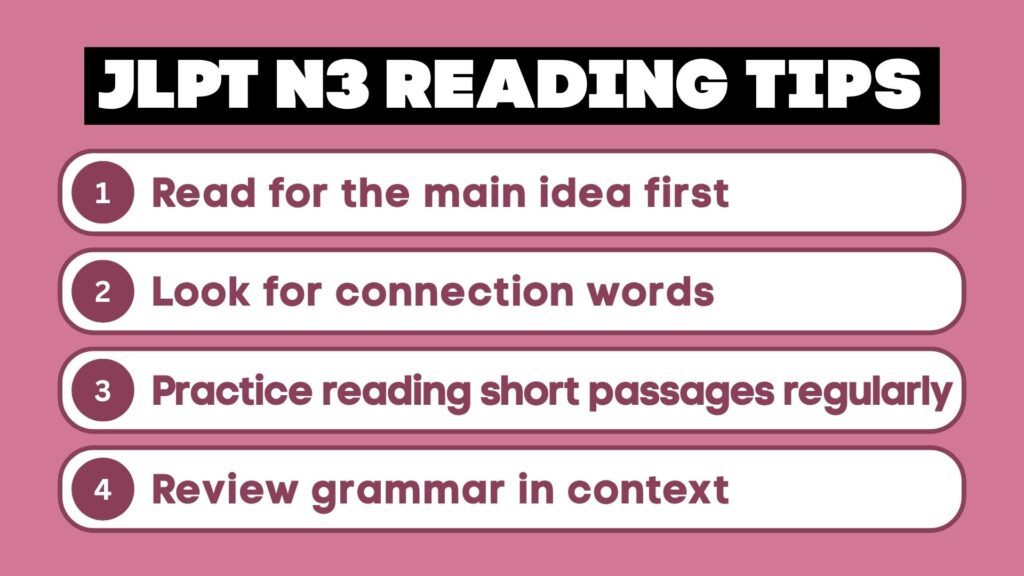
How to Improve JLPT N3 Reading Skills
To improve N3 reading, students should practice reading in a structured way.
1. Read for the main idea first
Do not try to translate every word immediately.
First, ask:
- What is this passage about?
- Who is speaking or writing?
- What is the main message?
- Is the writer explaining, comparing, or giving an opinion?
Understanding the main idea helps you avoid getting lost.
2. Look for connection words
N3 passages often use words that connect ideas.
Pay attention to expressions that show:
- reason
- contrast
- result
- example
- time order
- conclusion
These words help you follow the passage.
3. Practice reading short passages regularly
Reading improves through repeated exposure.
It is better to read short passages often than to read one long passage once in a while.
Regular reading helps you recognize grammar, vocabulary, and kanji more quickly.
4. Review grammar in context
N3 grammar should not be studied only as a list.
When you see grammar in a passage, ask:
- What does it mean here?
- What sentence comes before it?
- What sentence comes after it?
- How does it affect the meaning?
Grammar becomes stronger when you understand it inside real sentences.
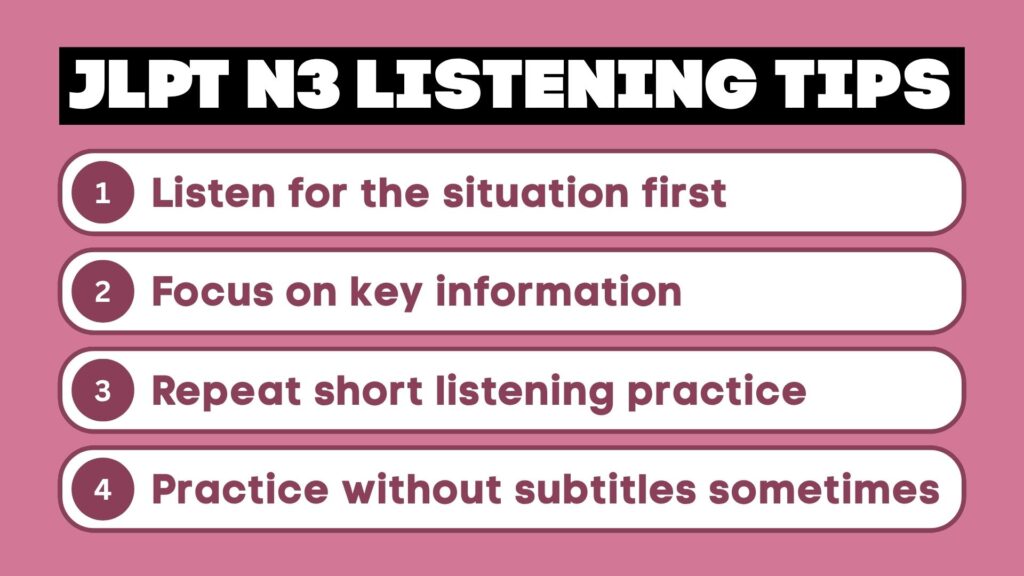
How to Improve JLPT N3 Listening Skills
Listening needs consistent practice.
1. Listen for the situation first
Before focusing on every word, try to understand the situation.
Ask:
- Who is speaking?
- Where are they?
- What are they talking about?
- What is the problem or purpose?
Understanding the situation makes the conversation easier to follow.
2. Focus on key information
You do not need to catch every single word.
In JLPT listening, key information may include:
- time
- place
- person
- action
- reason
- decision
- problem
- final answer
Train yourself to catch the important points.
3. Repeat short listening practice
Short and regular listening practice is more effective than rare long practice.
You can practice by listening once for the main idea, listening again for details, and then checking what you missed.
4. Practice without subtitles sometimes
Subtitles can help, but relying on them too much can slow listening development.
Try listening without subtitles first. Then check the script or subtitles afterward.
This helps train your ears to process Japanese more naturally.
Why Vocabulary and Kanji Still Matter
Reading and listening are comprehension skills, but vocabulary and kanji are still important.
If you do not know enough words, reading becomes slow.
If kanji recognition is weak, passages become tiring.
If vocabulary recognition is slow, listening becomes difficult.
For N3, learners should build vocabulary and kanji together with reading and listening practice.
This means studying words not only as lists, but in:
- sentences
- passages
- conversations
- examples
- listening situations
A word becomes useful when you can recognize it quickly and understand how it is used.
Why Structured Lessons Help Build N3 Comprehension
N3 reading and listening can feel overwhelming if students study randomly.
A structured course helps learners connect the skills needed for comprehension.
Good N3 lessons should include:
- grammar review in context
- vocabulary connected to topics
- kanji recognition practice
- reading passages at the right level
- listening activities
- teacher explanations
- regular review
- feedback on weak areas
JLRC uses structured lessons and Japanese learning materials designed to help learners connect grammar, vocabulary, kanji, reading, and listening step by step.
At JLRC, this structure helps students avoid random study and make progress with less wasted time.
Can You Improve N3 Reading and Listening Online?
Yes. N3 reading and listening can be improved online if the class is live, structured, and interactive.
Online learners should look for:
- clear teacher explanations
- reading practice
- listening practice
- level-matched materials
- opportunities to ask questions
- regular review
- teacher guidance
For students outside the Philippines, JLRC offers options to learn Japanese online from anywhere.
Online learning can be effective when students attend regularly and review after each lesson.
How JLRC Supports N3 Learners
JLRC supports learners who want to move from N4 to N3 and continue toward higher Japanese levels.
For N3 learners, JLRC focuses not only on memorization, but also on building intermediate comprehension.
JLRC’s N3 support includes:
- structured Japanese lessons
- N4 foundation review
- N3 grammar in context
- vocabulary and kanji development
- reading and listening practice
- teacher guidance and correction
- group class and 1-on-1 options
- continued learning toward N2 and N1
JLRC is a leading Japanese language school in the Philippines that supports learners from beginner to higher JLPT levels through structured Japanese language education.
If you are looking for a clear path from N3 to higher levels, you can explore JLRC’s Japanese language courses
Build Intermediate Comprehension Step by Step
JLPT N3 reading and listening are important because they help learners move beyond basic Japanese.
At this level, you begin to understand longer passages, more natural conversations, and more practical communication.
To improve N3 reading and listening, remember:
- read for the main idea first
- look for sentence connections
- practice short passages regularly
- listen for the situation
- focus on key information
- review vocabulary and kanji
- study grammar in context
- avoid random study
With the right structure and consistent practice, N3 comprehension becomes easier to build.
FAQ
Why is JLPT N3 reading difficult?
JLPT N3 reading is difficult because passages are longer than N4 and require understanding of context, sentence connections, vocabulary, kanji, and the writer’s intention.
Why is JLPT N3 listening difficult?
JLPT N3 listening can feel difficult because conversations are faster and more natural. Learners need to understand the situation, key information, and implied meaning.
How can I improve JLPT N3 reading and listening?
You can improve JLPT N3 reading and listening by practicing short passages and short audio regularly. First, focus on the main idea. Then, check key details such as who, where, when, why, and what happened. It is also important to review vocabulary, kanji, and grammar in context so you can understand Japanese more naturally.




Copyright © 2026 JLRC Inc.
All Rights Reserved
For international students, you may visit our Learn Japanese Online page.
For inquiries, you may call us at (63)2-7358-0565 or (63)917-163-3371
Japanese Language Research Center
Unit 506 Cityland Shaw Tower, Shaw Blvd, Mandaluyong, 1552 Metro Manila, Philippines
For international students, you may visit our Learn Japanese Online page.
For inquiries, you may call us at (63)2-7358-0565 or (63)917-163-3371
Japanese Language Research Center
Unit 506 Cityland Shaw Tower, Shaw Blvd, Mandaluyong, 1552 Metro Manila, Philippines
Copyright © 2026 JLRC Inc.
All Rights Reserved