
JLRC Blogs
- Courses
- Study Japan
- Materials
- Community
- About
- FAQ's
- Careers
- Class Details
- Login


JLPT N3 Grammar Guide: Key Patterns You Need After N4
JLRC - Content Team 2026/07/21

JLPT N3 grammar is an important step between beginner and intermediate Japanese.
At N4 level, many grammar patterns are still connected to daily situations and simple sentence structures. But at N3, grammar becomes more flexible, more nuanced, and more connected to reading and listening comprehension.
This is why many learners feel that N3 is not just “more grammar.” It is a different stage of learning.
JLPT N3 grammar requires understanding meaning, context, and sentence flow — not only memorizing patterns.
This guide explains how N3 grammar is different from N4, what kinds of grammar patterns you should focus on, and how to study them more effectively.
If you are preparing for the full N3 level, you may first read JLRC’s JLPT N3 Study Guide.
Table of Contents
- Why JLPT N3 Grammar Feels Different from N4
- N4 vs N3 Grammar: What Changes?
- Common Types of JLPT N3 Grammar Patterns
- Why Memorizing Grammar Alone Is Not Enough
- How to Study N3 Grammar in Context
- Common Mistakes Learners Make with N3 Grammar
- How Structured Lessons Help with N3 Grammar
- Continue from N3 Grammar to Reading and Listening
- Build a Stronger N3 Foundation
- FAQ
Why JLPT N3 Grammar Feels Different from N4
N4 grammar helps learners build a basic foundation. You learn how to form sentences, express basic ideas, and understand common daily communication.
N3 grammar is different because sentences become longer and meanings become less direct.
At N3 level, learners need to understand:
- reasons and results
- conditions
- contrast
- purpose
- speaker intention
- indirect expressions
- sentence connections
- grammar used in reading passages
This is where many learners struggle.
They may know the meaning of a grammar pattern, but they cannot recognize it quickly in a long sentence. Or they may understand the pattern in a textbook but feel confused when it appears in reading or listening.
That is why N3 grammar should be studied in context.
N4 vs N3 Grammar: What Changes?
One of the biggest differences between Japanese and English is the use of particles.
| Area | N4 Grammar | N3 Grammar |
|---|---|---|
| Sentence length | Shorter sentences | Longer sentences |
| Main focus | Basic communication | Meaning and context |
| Usage | Daily situations | Broader situations |
| Difficulty | Easier to memorize | Harder to use naturally |
| Reading connection | Basic reading | More grammar inside passages |
| Listening connection | Clear expressions | More natural expressions |
At N4, many learners can understand grammar by memorizing the pattern and meaning.
At N3, that is not enough.
Learners need to understand how grammar works together with vocabulary, kanji, reading, and listening.
For learners reviewing the previous level, JLRC also has a JLPT N4 Grammar Guide.
Common Types of JLPT N3 Grammar Patterns
JLPT N3 includes many grammar patterns. Instead of trying to memorize them randomly, it is helpful to group them by function.
Here are common types of N3 grammar patterns learners should pay attention to.
1. Reason and Cause
These patterns help explain why something happens.
They are important in reading because many passages explain causes, results, and opinions.
2. Conditions
Condition patterns are used to explain “if,” “when,” or “in case” situations.
At N3, these patterns can become more nuanced than beginner-level condition forms.
3. Contrast
N3 learners need to understand contrast clearly.
This is important because reading passages often compare two ideas or show a difference between expectation and reality.
4. Purpose and Intention
Some N3 grammar patterns express purpose, intention, or planned action.
These are useful in both reading and conversation.
5. Natural Sentence Connection
N3 grammar often connects ideas across longer sentences.
This is why learners need to understand not only one grammar pattern, but also how the whole sentence works.
The goal is not to memorize grammar one by one, but to understand how each pattern helps express meaning.
Why Memorizing Grammar Alone Is Not Enough
Many learners study grammar by memorizing English translations.
This can help at first, but it becomes weak at N3.
For example, two grammar patterns may have similar English meanings but different usage in Japanese. Some patterns may sound formal, some may be used in writing, and others may express the speaker’s feeling.
If you only memorize a short translation, you may choose the wrong answer in grammar questions or misunderstand the meaning in reading passages.
To study N3 grammar well, learners should ask:
- How is this pattern used in a sentence?
- Is it formal or casual?
- Does it express reason, contrast, condition, or intention?
- What words usually appear with this pattern?
- Can I recognize it in reading and listening?
This kind of study helps grammar become more practical.
With the right structure, beginners can make clearer progress with less wasted time.
For learners looking for a structured beginner program, JLRC is a Japanese language school in the Philippines that supports students from basic Japanese to higher JLPT levels since 2001.
Students who want to start or continue their Japanese learning journey can explore JLRC’s Japanese language courses from beginner (N5) to higher JLPT levels (N1).
How to Study N3 Grammar in Context
The best way to study N3 grammar is to connect it with real Japanese sentences.
Here are some practical study tips.
Study with example sentences
Do not study only the grammar formula. Read several example sentences and notice how the pattern is used.
Compare similar patterns
Some N3 grammar patterns look similar but have different meanings or usage. Comparing them helps prevent confusion.
Read short passages
N3 grammar appears often in reading. Short passages help you see how grammar connects ideas.
Listen for grammar in context
Listening practice helps you recognize grammar naturally, not only on paper.
Review mistakes carefully
When you make a mistake, do not only check the correct answer. Ask why your answer was wrong.
This approach helps learners build deeper understanding.
Common Mistakes Learners Make with N3 Grammar
Many learners make similar mistakes when studying N3 grammar.
Mistake 1: Memorizing too many patterns too quickly
N3 has many grammar points. Studying too many at once can create confusion.
Mistake 2: Ignoring N4 foundation
If N4 grammar is weak, N3 becomes much harder.
Mistake 3: Studying grammar separately from reading
N3 grammar often appears inside longer passages. If you study grammar only as isolated rules, reading may still feel difficult.
Mistake 4: Not reviewing similar expressions
Some patterns have close meanings. Without comparison, learners may misunderstand the difference.
Mistake 5: Not practicing output
Even if the JLPT does not test speaking directly, making your own sentences can help you understand grammar more deeply.
How Structured Lessons Help with N3 Grammar
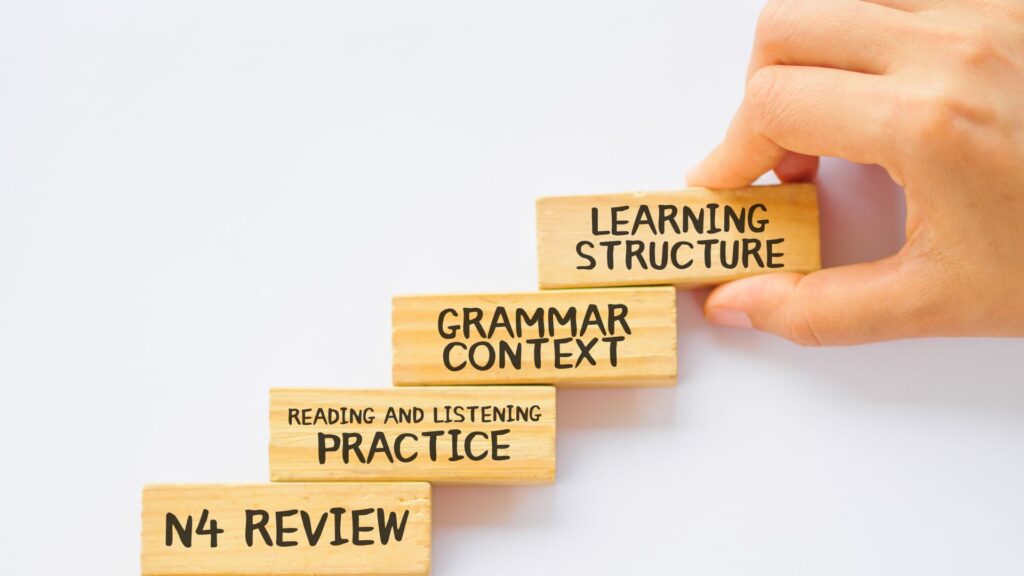
N3 grammar is difficult to study randomly.
Structured lessons help learners study grammar in a clearer order and connect it with vocabulary, kanji, reading, and listening.
JLRC develops Japanese learning materials designed to support structured Japanese study from beginner to higher JLPT levels.
With structured learning, students can:
- review important N4 foundations
- learn N3 grammar step by step
- understand grammar in context
- compare similar patterns
- practice reading and listening more effectively
- avoid random study and confusion
At JLRC, structured lessons are designed to help students make clearer progress with less wasted time.
Students who want to continue their Japanese learning journey can explore JLRC’s Japanese language courses from beginner to higher JLPT levels.
Continue from N3 Grammar to Reading and Listening
N3 grammar is closely connected to reading and listening.
If you understand grammar better, reading passages become easier to follow. You can understand sentence connections, writer intention, and the relationship between ideas.
Listening also becomes clearer because you can recognize patterns naturally in conversation.
For this reason, grammar study should not stop at memorization. It should support your overall comprehension.
For learners who want to improve comprehension, JLRC also has a guide on JLPT N3 Reading and Listening Guide.
For learners outside the Philippines or those who want a flexible online option, JLRC also offers a way to learn Japanese online from anywhere.
Build a Stronger N3 Foundation
JLPT N3 grammar is an important bridge between beginner Japanese and intermediate Japanese.
To study N3 grammar effectively, remember:
- do not memorize patterns randomly
- understand grammar in context
- compare similar expressions
- review your N4 foundation
- read short passages regularly
- listen for grammar in natural sentences
- study with a clear structure
N3 grammar may feel difficult at first, but with the right approach, it becomes more manageable.
The goal is not only to know grammar rules, but to understand how Japanese expresses meaning.
FAQ
Is JLPT N3 grammar much harder than N4?
Yes. JLPT N3 grammar is harder than N4 because sentences become longer, meanings become more nuanced, and grammar is more closely connected to reading and listening.
How should I study JLPT N3 grammar?
Study N3 grammar with example sentences, short passages, listening practice, and regular review. Avoid memorizing grammar patterns without context.
Do I need to review N4 grammar before studying N3?
Yes. A strong N4 foundation makes N3 grammar easier to understand. If your N4 grammar is weak, N3 may feel confusing.
Is memorizing grammar enough for JLPT N3?
No. Memorization can help, but N3 requires understanding how grammar works in context, especially in reading and listening.




Copyright © 2026 JLRC Inc.
All Rights Reserved
For international students, you may visit our Learn Japanese Online page.
For inquiries, you may call us at (63)2-7358-0565 or (63)917-163-3371
Japanese Language Research Center
Unit 506 Cityland Shaw Tower, Shaw Blvd, Mandaluyong, 1552 Metro Manila, Philippines
For international students, you may visit our Learn Japanese Online page.
For inquiries, you may call us at (63)2-7358-0565 or (63)917-163-3371
Japanese Language Research Center
Unit 506 Cityland Shaw Tower, Shaw Blvd, Mandaluyong, 1552 Metro Manila, Philippines
Copyright © 2026 JLRC Inc.
All Rights Reserved