
JLRC Blogs
- Courses
- Study Japan
- Materials
- Community
- About
- FAQ's
- Careers
- Class Details
- Login


Japanese Job Interview Questions and Phrases: 20 Essential Examples
JLRC - Content Team 2026/08/22

A job interview in Japanese can feel challenging—even if you already know basic Japanese.
You may understand the interviewer’s question but still wonder: How formal should my answer be? Should I use keigo? How should I introduce myself?
Japanese job interviews require more than simply translating what you would say in English. How you greet the interviewer, explain your experience, and describe your strengths can all affect the impression you make.
The good news is that you do not need complicated Japanese. Learning a few useful interview questions and phrases can help you communicate more clearly and confidently.
In this guide, we introduce 20 essential Japanese job interview questions and phrases, with meanings, examples, and practical tips for learners preparing to work with Japanese companies.
If you are building Japanese skills for your career, you may also want to read our guide to Japanese for Work: How Nihongo Skills Can Support Your Career.
Table of Contents
- Why Japanese Job Interviews Can Feel Different
- 20 Essential Japanese Job Interview Questions and Phrases
- Do You Need Keigo for a Japanese Job Interview?
- What JLPT Level Is Useful for a Japanese-Speaking Job?
- How to Prepare for a Japanese Job Interview
- Learn Japanese for Your Career with JLRC
- Final Thoughts
- FAQ About Japanese Job Interviews
Why Japanese Job Interviews Can Feel Different
Japanese job interviews often place importance not only on what you say, but also on how you communicate.
Interviewers may pay attention to:
- Politeness and professional language
- Clear and concise answers
- Your reason for applying
- Your understanding of the company
- Your attitude toward teamwork and responsibility
- Your ability to communicate respectfully
For Japanese learners, this means that grammar and vocabulary are only part of the preparation.
You also need to understand the expressions commonly used during interviews.
You do not necessarily need perfect Japanese. What matters is being able to communicate your background, motivation, and strengths clearly while showing appropriate professionalism.
20 Essential Japanese Job Interview Questions and Phrases
1. 本日はよろしくお願いいたします。
Honjitsu wa yoroshiku onegai itashimasu.
Meaning: Thank you for meeting with me today. / I appreciate your time today.
This is a polite expression you can use at the beginning of an interview.
The familiar phrase よろしくお願いします (yoroshiku onegai shimasu) becomes more formal with よろしくお願いいたします.
Example
本日はよろしくお願いいたします。
Honjitsu wa yoroshiku onegai itashimasu.
Thank you for meeting with me today.
A short bow together with this greeting creates a professional first impression.
2. 自己紹介をお願いします。
Jiko shōkai o onegai shimasu.
Meaning: Please introduce yourself.
This is one of the most common questions in a Japanese job interview.
Your answer should normally be short and focus on information relevant to the position.
Example
マリア・サントスと申します。大学では経営学を専攻しました。現在は営業の仕事をしています。
Maria Santos to mōshimasu. Daigaku de wa keieigaku o senkō shimashita. Genzai wa eigyō no shigoto o shite imasu.
My name is Maria Santos. I majored in business administration at university, and I currently work in sales.
For more expressions you can use when introducing yourself, see How to Introduce Yourself in Japanese: 20 Phrases for Beginners.
3. 〜と申します。
~ to mōshimasu.
Meaning: My name is ~.
In professional situations, 〜と申します is more polite than simply saying 〜です.
Example
ジョン・クルーズと申します。
John Cruz to mōshimasu.
My name is John Cruz.
This is an easy phrase to memorize and is useful well beyond job interviews.
4. 志望動機を教えてください。
Shibō dōki o oshiete kudasai.
Meaning: Please tell us why you applied.
This is another very common Japanese interview question.
志望動機 (shibō dōki) means your motivation or reason for applying.
Your answer should connect your background and goals with the company or position.
5. 御社で働きたいと思い、応募しました。
Onsha de hatarakitai to omoi, ōbo shimashita.
Meaning: I applied because I would like to work for your company.
御社 (onsha) is a respectful way to refer to the interviewer's company in spoken Japanese.
Example
日本語を使った仕事に興味があり、御社で働きたいと思い、応募しました。
Nihongo o tsukatta shigoto ni kyōmi ga ari, onsha de hatarakitai to omoi, ōbo shimashita.
I am interested in work that uses Japanese, so I applied because I would like to work for your company.
6. なぜこの仕事に興味がありますか。
Naze kono shigoto ni kyōmi ga arimasu ka?
Meaning: Why are you interested in this job?
A good answer connects the position with your experience, skills, or career goals.
Example
これまでの経験を生かせる仕事だと思ったからです。
Kore made no keiken o ikaseru shigoto da to omotta kara desu.
I am interested in work that uses Japanese, so I applied because I would like to work for your company.
7. あなたの強みは何ですか。
Anata no tsuyomi wa nan desu ka?
Meaning: What are your strengths?
強み (tsuyomi) means a strength or strong point.
Instead of simply saying “I work hard,” try to give a specific strength and, if possible, a short example.
Example
私の強みは責任感が強いことです。
Watashi no tsuyomi wa sekininkan ga tsuyoi koto desu.
My strength is that I have a strong sense of responsibility.
8. 私の強みは〜です。
Watashi no tsuyomi wa ~ desu.
Meaning: My strength is ~.
Useful words include:
- 責任感 (sekininkan) — sense of responsibility
- 協調性 (kyōchōsei) — ability to cooperate
- コミュニケーション能力 — communication skills
- 問題解決能力 (mondai kaiketsu nōryoku) — problem-solving ability
- 適応力 (tekiōryoku) — adaptability
Try to choose a strength that relates directly to the job.
9. あなたの弱みは何ですか。
Anata no yowami wa nan desu ka?
Meaning: What is your weakness?
This question can be difficult in any language.
In Japanese interviews, avoid saying that you have no weaknesses. Instead, explain a genuine weakness while showing how you are improving it.
Example
慎重になりすぎることがありますが、最近は優先順位を意識して仕事を進めています。
Shinchō ni nari sugiru koto ga arimasu ga, saikin wa yūsen jun'i o ishiki shite shigoto o susumete imasu.
Sometimes I can be too cautious, but recently I have been working on prioritizing tasks more effectively.
10. これまでの仕事について教えてください。
Kore made no shigoto ni tsuite oshiete kudasai.
Meaning: Please tell us about your previous work experience.
Prepare a concise explanation of:
- Your position
- Your main responsibilities
- Relevant achievements
- Skills related to the new position
Avoid explaining your entire employment history unless the interviewer asks for more detail.
11. 〜を担当していました。
~ o tantō shite imashita.
Meaning: I was responsible for ~.
This is extremely useful when describing professional experience.
Examples
営業を担当していました。
Eigyō o tantō shite imashita.
I was responsible for sales.
顧客対応を担当していました。
Kokyaku taiō o tantō shite imashita..
I was responsible for customer service.
プロジェクト管理を担当していました。
Purojekuto kanri o tantō shite imashita.
I was responsible for project management.
12. 日本語をどのくらい勉強していますか。
Nihongo o dono kurai benkyō shite imasu ka?
Meaning: How long have you been studying Japanese?
This question is especially likely when Japanese ability is relevant to the job.
Example
日本語を2年間勉強しています。
Nihongo o ni-nenkan benkyō shite imasu.
I have been studying Japanese for two years.
You may also be asked about your JLPT level.
If Japanese ability is important for your career, see JLPT Certificate in the Philippines: Career Benefits and Opportunities for Filipinos.
13. JLPT N〜に合格しました。
JLPT N~ ni gōkaku shimashita.
Meaning: I passed JLPT N~.
Example
JLPT N3に合格しました。
JLPT N3 ni gōkaku shimashita.
I passed JLPT N3.
However, remember that your JLPT level is only one way to demonstrate Japanese ability. Employers may also evaluate whether you can actually understand questions and communicate in workplace situations.
14. 日本語を仕事で使った経験があります
Nihongo o shigoto de tsukatta keiken ga arimasu.
Meaning: I have experience using Japanese at work.
This is useful if you have communicated with Japanese colleagues, customers, managers, or business partners.
Example
日本人のお客様と話すために、日本語を仕事で使った経験があります。
Nihonjin no okyakusama to hanasu tame ni, Nihongo o shigoto de tsukatta keiken ga arimasu.
I have experience using Japanese at work to communicate with Japanese customers.
15. 将来の目標は何ですか。
Shōrai no mokuhyō wa nan desu ka?
Meaning: What are your future goals?
Japanese employers may want to understand how the position fits into your longer-term career direction.
Example
日本語力をさらに伸ばし、将来は日本語を使う仕事でより大きな責任を持ちたいです。
Nihongo-ryoku o sara ni nobashi, shōrai wa Nihongo o tsukau shigoto de yori ōkina sekinin o mochitai desu.
I would like to further improve my Japanese and eventually take on greater responsibilities in a position where I can use Japanese.
16. チームで働くことは得意ですか。
Chīmu de hataraku koto wa tokui desu ka?
Meaning: Are you good at working in a team?
Teamwork is an important topic in many Japanese workplaces.
Example
はい。周りの人とコミュニケーションを取りながら仕事を進めることを大切にしています。
Hai. Mawari no hito to komyunikēshon o torinagara shigoto o susumeru koto o taisetsu ni shite imasu.
Yes. I value communicating with the people around me while working toward our goals.
17. もう一度お願いできますか。
Mō ichido onegai dekimasu ka?
Meaning: Could you please say that again?
Do not panic if you do not understand a question.
Politely asking the interviewer to repeat it is usually better than answering something completely unrelated.
You can also say:
すみません。もう一度お願いできますか。
Sumimasen. Mō ichido onegai dekimasu ka?
Excuse me. Could you please repeat that?
18. 〜という意味でしょうか。
~ to iu imi deshō ka?
Meaning: Do you mean ~?
Example
これまでの仕事の経験について、という意味でしょうか。
Kore made no shigoto no keiken ni tsuite, to iu imi deshō ka?
Do you mean my previous work experience?
Being able to clarify professionally is itself an important communication skill.
19. 何か質問はありますか。
Nanika shitsumon wa arimasu ka?
Meaning: Do you have any questions?
This often comes near the end of an interview.
Avoid automatically answering ありません (arimasen / no).
Prepare one or two meaningful questions in advance.
For Example:
入社後の研修について教えていただけますか。
Nyūsha-go no kenshū ni tsuite oshiete itadakemasu ka?
Could you please tell me about the training after joining the company?
Or:
このポジションで最も大切なスキルは何でしょうか。
Kono pojishon de mottomo taisetsu na sukiru wa nan deshō ka?
What would you say is the most important skill for this position?
20. 本日は貴重なお時間をいただき、ありがとうございました。
Honjitsu wa kichō na ojikan o itadaki, arigatō gozaimashita.
Meaning: Thank you very much for giving me your valuable time today.
This is an excellent phrase to close a Japanese job interview politely.
You can follow it with:
よろしくお願いいたします。
Yoroshiku onegai itashimasu.
Thank you, and I appreciate your consideration.
Do You Need Keigo for a Japanese Job Interview?

You do not need to use extremely complicated keigo in every sentence.
For many Japanese learners, trying to use advanced honorific language that they do not fully understand can actually make speaking more difficult.
Instead, focus first on:
- Using polite です / ます forms consistently
- Learning several standard interview expressions
- Avoiding overly casual Japanese
- Speaking clearly and respectfully
- Practicing answers until they feel natural
As your Japanese improves, learning keigo (敬語) becomes increasingly useful, especially for professional communication with Japanese companies.
What JLPT Level Is Useful for a Japanese-Speaking Job?
There is no single JLPT level required for every job.
The level needed depends on the position and how Japanese will be used.
For example, a role involving basic communication may require a different level from one involving detailed documents, meetings, negotiation, or communication with Japanese clients
JLPT N3 can represent an important intermediate milestone, while N2 is commonly associated with stronger professional Japanese comprehension.
You can learn more in:
JLPT N3 and Career Growth in the Philippines and
JLPT N2 and Career Opportunities in the Philippines.
However, passing the JLPT alone does not automatically make someone ready for a Japanese job interview. Speaking practice, listening skills, appropriate expressions, and confidence are also important.
How to Prepare for a Japanese Job Interview
Memorizing phrases is useful, but preparation should go further.
Start by preparing short answers to the most common questions:
- Tell me about yourself.
- Why are you applying?
- What are your strengths?
- What is your work experience?
- Why do you want to use Japanese?
- What are your future goals?
Then practice saying your answers aloud.
Do not memorize very long scripts word for word. If you forget one sentence, you may lose your entire answer.
Instead, remember the main points and key Japanese phrases.
Recording yourself can also help you notice pronunciation problems, long pauses, or answers that are unnecessarily complicated.
For more speaking practice strategies, see How to Practice Japanese Speaking for Beginners.
Learn Japanese for Your Career with JLRC
Japanese ability can become a valuable career skill for professionals working with Japanese companies, clients, managers, and business partners.
As a Japanese language school in the Philippines, JLRC provides structured learning options for students and professionals with different goals.
JLRC offers structured Japanese language courses from JLPT N5 through N1 for learners who want to develop their Japanese step by step.
Learners who prefer a more personalized approach can also choose 1-on-1 Japanese lessons with a study schedule and pace suited to their individual goals.
Whether your objective is passing the JLPT, improving workplace communication, preparing for a Japanese-speaking position, or building long-term career opportunities, consistent practice and structured learning can help you move forward with greater confidence.
Final Thoughts
A Japanese job interview does not require perfect Japanese.
What matters most is being able to introduce yourself clearly, explain your experience and motivation, respond politely, and communicate with confidence.
Start with the essential expressions in this guide, practice your answers aloud, and gradually build the Japanese skills you need for your career.
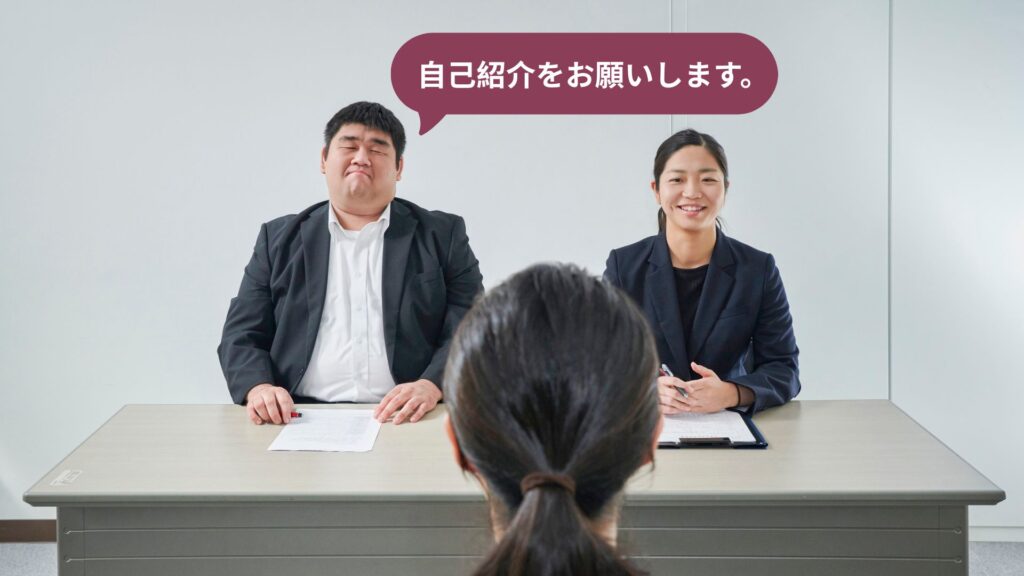
Even learning a few professional phrases can make a major difference when the interview begins with:
自己紹介をお願いします。
Jiko shōkai o onegai shimasu.
“Please introduce yourself.”
FAQ About Japanese Job Interviews
What Japanese level do I need for a job interview in Japanese?
There is no single Japanese level required for every job. The level you need depends on the position, company, and how much Japanese you will use at work. JLPT N3 can be a useful intermediate milestone, while N2 or higher may be preferred for roles requiring more advanced communication and comprehension.
Do I need to use keigo in a Japanese job interview?
You do not need to use advanced keigo in every sentence, especially if you are still learning Japanese. However, using polite です・ます forms consistently and learning several standard interview expressions can help you communicate professionally and respectfully.
Is JLPT N2 enough for a Japanese-speaking job?
JLPT N2 can be valuable for many Japanese-related jobs because it demonstrates a relatively high level of reading and listening comprehension. However, employers may also evaluate speaking ability, workplace communication, experience, and the specific Japanese skills required for the position.
How can I practice Japanese for a job interview?
Prepare short answers to common interview questions, practice speaking them aloud, and focus on expressing your experience, strengths, and motivation clearly. Recording yourself or practicing with an instructor can also help improve pronunciation, listening, and confidence before the interview.




Copyright © 2026 JLRC Inc.
All Rights Reserved
For international students, you may visit our Learn Japanese Online page.
For inquiries, you may call us at (63)2-7358-0565 or (63)917-163-3371
Japanese Language Research Center
Unit 506 Cityland Shaw Tower, Shaw Blvd, Mandaluyong, 1552 Metro Manila, Philippines
For international students, you may visit our Learn Japanese Online page.
For inquiries, you may call us at (63)2-7358-0565 or (63)917-163-3371
Japanese Language Research Center
Unit 506 Cityland Shaw Tower, Shaw Blvd, Mandaluyong, 1552 Metro Manila, Philippines
Copyright © 2026 JLRC Inc.
All Rights Reserved