JLRC Blogs
- Courses
- Study Japan
- Materials
- Community
- About
- FAQ's
- Careers
- Class Details
- Login


JLPT and CEFR Levels Explained: What A1–C1 Means for N5–N1
JLRC - Content Team 2026/09/26

If you are studying Japanese, you may already know about the JLPT levels: N5, N4, N3, N2, and N1.
But recently, another level system has become more important for Japanese learners: CEFR, which uses levels such as A1, A2, B1, B2, and C1.
This is especially useful for learners who want to understand their Japanese level in a broader international framework.
The JLPT is still the most familiar Japanese proficiency test for many learners. However, CEFR can help students, schools, employers, and training organizations describe language ability in a way that is easier to compare across different languages.
In this guide, we will explain what CEFR means, how it relates to JLPT N5–N1, and how learners can use both systems when planning their Japanese study.
If you are still learning the overall JLPT pathway, you may also read JLRC’s JLPT Course in the Philippines: N5 to N1 Learning Path.
Table of Contents
- What Is CEFR?
- What Is JLPT?
- Why CEFR Matters for JLPT Learners Now
- JLPT and CEFR Level Comparison
- Official JLPT Total Score and CEFR Reference
- Important Point: CEFR Reference Is Not a Replacement for JLPT
- Important Point: JLPT Does Not Directly Test Speaking and Writing
- What A1–C1 Means for Japanese Learners
- What N5–N1 Means for Learners
- Why JLPT and CEFR Are Both Useful
- How Learners Should Use JLPT and CEFR Together
- How JLRC Helps Learners Build a Clear Japanese Path
- Understand Your Level, Then Build Your Path
- FAQ
What Is CEFR?
CEFR stands for Common European Framework of Reference for Languages.
It is an international framework used to describe language ability. CEFR is commonly used for many languages, including English, French, German, Spanish, and other foreign languages.
CEFR levels are usually shown as:
| CEFR Level | General Meaning |
|---|---|
| A1 | Beginner |
| A2 | Elementary |
| B1 | Intermediate |
| B2 | Upper-intermediate |
| C1 | Advanced |
| C2 | Proficient |
In simple terms, CEFR focuses on what learners can do with a language.
For example, it may describe whether a learner can understand simple expressions, handle daily conversations, explain opinions, understand complex texts, or communicate in professional situations.
This is why CEFR is often called a “can-do” framework.
What Is JLPT?
JLPT stands for Japanese-Language Proficiency Test.
It is one of the most widely recognized tests for Japanese learners.
The JLPT has five levels:
| JLPT Level | General Image |
|---|---|
| N5 | Basic beginner level |
| N4 | Upper beginner level |
| N3 | Intermediate bridge level |
| N2 | Advanced-intermediate / career-useful level |
| N1 | Advanced level |
For many learners, JLPT is a practical goal because it is commonly used for study, career, employment, and Japanese language certification.
However, the JLPT mainly tests:
- vocabulary
- grammar
- reading
- listening
It does not directly test speaking or writing.
This is important when comparing JLPT and CEFR.
Why CEFR Matters for JLPT Learners Now
CEFR is becoming more relevant for JLPT learners because official JLPT score reports now include CEFR reference information for successful examinees from the December 2025 JLPT.
According to the official JLPT website, CEFR levels are added as reference information to JLPT score reports for examinees who pass the test from the December 2025 JLPT. The CEFR level is based on the JLPT total score and is provided as reference information, not as a replacement for the JLPT level itself.
You can check the official JLPT explanation here: official JLPT CEFR reference information.
This means learners may begin to see both:
- their JLPT level, such as N5, N4, N3, N2, or N1
- their CEFR reference level, such as A1, A2, B1, B2, or C1
on their score report if they pass the test.
For students, this can make JLPT results easier to understand in a broader international language-learning context.
JLPT and CEFR Level Comparison
The official JLPT reference indication links JLPT total scores with CEFR levels.
However, it is important to understand that JLPT and CEFR are not exactly the same type of system.
JLPT is a Japanese test with levels from N5 to N1. CEFR is an international language framework that describes language ability from A1 to C2.
Still, for reference, the official JLPT explanation shows the following relationship based on JLPT total scores:
| JLPT Level | CEFR Reference Level |
|---|---|
| N5 | A1 |
| N4 | A2 |
| N3 | A2 or B1, depending on total score |
| N2 | B1 or B2, depending on total score |
| N1 | B2 or C1, depending on total score |
This means that one JLPT level does not always equal only one CEFR level.
For example:
- A person who passes N3 may be shown as A2 or B1 depending on the total score.
- A person who passes N2 may be shown as B1 or B2.
- A person who passes N1 may be shown as B2 or C1.
This is why learners should not oversimplify the relationship by saying, “N2 always equals B2” or “N1 always equals C1.”
The CEFR reference depends on the JLPT level and total score.
Official JLPT Total Score and CEFR Reference
The official JLPT explanation provides more detailed score-based reference indications.
All JLPT levels are scored out of 180 points. The CEFR reference shown below is based on the total score of the JLPT level passed.
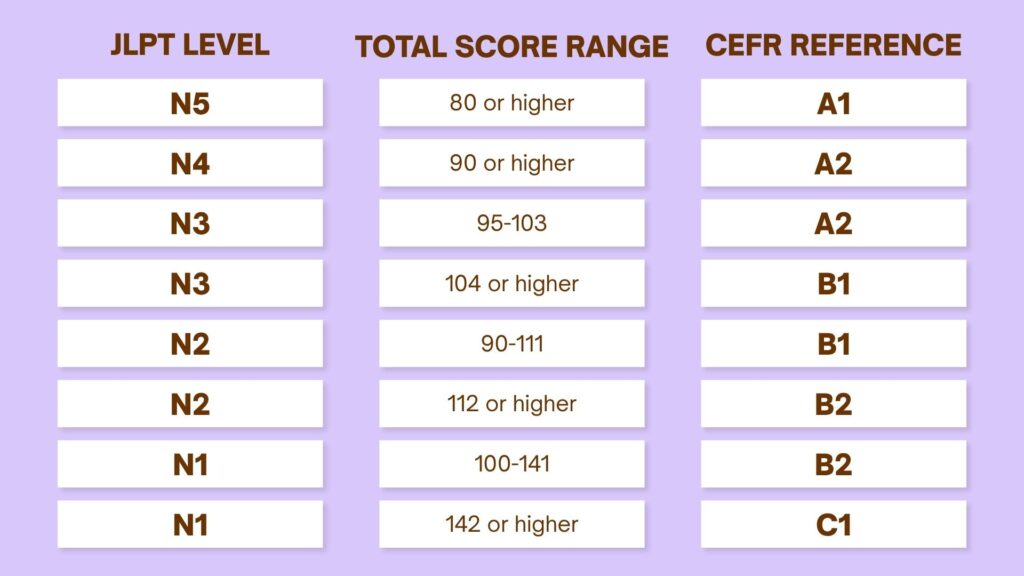
This table is useful because it shows that CEFR reference levels are not simply attached to the JLPT level name. They are connected to the total score of the level that the learner passed.
For example, two students may both pass N2, but one may receive a B1 reference and the other may receive a B2 reference depending on total score.
This makes the score report more informative for learners, schools, and employers.
Important Point: CEFR Reference Is Not a Replacement for JLPT
The CEFR level shown on the JLPT score report is reference information.
It does not replace the JLPT level.
For example, if a learner passes N2, the main certification is still JLPT N2. The CEFR level helps explain the result in a broader framework, but it does not change the fact that the learner passed N2.
This distinction is important.
Learners should use CEFR as a helpful reference, not as a separate test result.
Important Point: JLPT Does Not Directly Test Speaking and Writing
This is one of the most important things learners should understand.
The JLPT tests vocabulary, grammar, reading, and listening. It does not directly test speaking or writing.
CEFR, on the other hand, is often associated with broader language ability, including what learners can do in real communication.
The official JLPT explanation also notes that the CEFR reference indication is for the competence tested by the JLPT, especially language knowledge, reading, and listening. It does not include production skills such as speaking and writing or interaction skills.
This means that even if a learner receives a CEFR reference level on a JLPT score report, speaking and writing ability may still need separate practice.
This is very important for learners who want to use Japanese at work, in interviews, in emails, or in daily communication.
Students who want to build practical Japanese for work may also read JLRC’s Japanese for Work in the Philippines.
What A1–C1 Means for Japanese Learners
Here is a simple way to understand CEFR levels in a Japanese learning context.
| CEFR Level | Simple Meaning for Japanese Learners |
|---|---|
| A1 | Can understand and use very basic Japanese expressions |
| A2 | Can handle simple daily communication |
| B1 | Can understand more independent daily and practical Japanese |
| B2 | Can understand more complex Japanese and communicate more confidently in many situations |
| C1 | Can understand advanced Japanese in complex texts and formal situations |
These descriptions are only simplified explanations.
Real language ability depends on many factors, including vocabulary, grammar, reading speed, listening ability, speaking practice, writing ability, and exposure to real Japanese.
Still, the CEFR framework can help learners understand the general direction of their progress.
What N5–N1 Means for Learners
JLPT levels are also useful because they give learners a clear study path.
JLPT N5
N5 is the beginner level. Learners study basic vocabulary, grammar, hiragana, katakana, simple kanji, and short sentences.
If you are just starting Japanese, you may read JLRC’s How to Pass JLPT N5
JLPT N4
N4 builds on N5 and helps learners understand more daily expressions and basic conversations.
You may also read JLRC’s JLPT N4 Study Guide.
JLPT N3
N3 is an important bridge level between basic and more advanced Japanese. It can help learners move toward practical reading, listening, and career-related Japanese.
You may also read JLRC’s JLPT N3 Study Guide.
JLPT N2
N2 is often important for learners who want to use Japanese for work, career development, or higher-level study.
You may also read JLRC’s JLPT N2 Study Guide
JLPT N1
N1 is the highest JLPT level and requires advanced reading, listening, vocabulary, grammar, and comprehension skills.
You may also read JLRC’s JLPT N1 Study Guide.
Why JLPT and CEFR Are Both Useful

JLPT and CEFR are useful in different ways.
JLPT gives learners a clear Japanese-specific study path. It is familiar to Japanese learners, schools, and employers.
CEFR gives learners a broader language framework. It can help people understand Japanese ability in a way that is easier to compare internationally.
Together, they can help learners answer questions such as:
- What JLPT level am I aiming for?
- What does my JLPT result mean in a broader language framework?
- How close am I to intermediate or advanced Japanese?
- What level might be useful for work or study?
- Do I need speaking and writing practice in addition to JLPT study?
For learners, the best approach is not to choose between JLPT and CEFR. It is better to understand both.
How Learners Should Use JLPT and CEFR Together
Learners can use JLPT and CEFR together when planning their study.
For example:
| Goal | Useful Focus |
|---|---|
| Beginner Japanese | N5 / A1 foundation |
| Daily communication | N4–N3 / A2–B1 direction |
| Career preparation | N3–N2 / B1–B2 direction |
| Advanced study or professional reading | N2–N1 / B2–C1 direction |
| Practical work communication | JLPT study plus speaking, writing, and keigo practice |
This is especially important because JLPT alone may not show all communication skills.
A learner may pass N2 but still need more speaking practice. Another learner may understand grammar but need more confidence in business emails, meetings, or interviews.
For companies and organizations, understanding JLPT and CEFR can also help when setting Japanese training goals for employees. JLRC provides corporate Japanese language training in the Philippines for organizations that need structured Japanese learning support.
That is why structured learning should include not only test preparation, but also practical language development.
How JLRC Helps Learners Build a Clear Japanese Path
JLRC helps students study Japanese through a structured path from beginner to advanced levels.
Instead of studying randomly, learners can follow a clearer progression from N5 to N1 while building vocabulary, grammar, kanji, reading, listening, and practical understanding step by step.
Students who want to begin or continue their Japanese study can explore JLRC’s Japanese language courses.
You can also learn more about JLRC’s overall approach to Japanese language education in the Philippines.
For learners outside the Philippines, JLRC also offers online Japanese lessons for international students.
The goal is to help learners understand where they are, where they want to go, and what kind of study path can help them get there with less wasted time and effort.
Understand Your Level, Then Build Your Path
JLPT and CEFR are both useful tools for understanding Japanese level.
JLPT gives learners a clear Japanese-specific test pathway from N5 to N1. CEFR helps learners understand their ability in a broader international framework from A1 to C1.
Because CEFR reference information is now connected to JLPT score reports for successful examinees from the December 2025 JLPT, learners should understand both systems.
However, the most important point is not only the label on the score report.
The real goal is to build Japanese ability that supports your purpose, whether that is study, work, daily communication, career growth, or personal development.
FAQ
What is CEFR in Japanese learning?
CEFR stands for Common European Framework of Reference for Languages. It is an international framework used to describe language ability, usually from A1 to C2. For Japanese learners, it can help explain language ability in a broader international context.
How does JLPT relate to CEFR?
The official JLPT reference information links JLPT total scores to CEFR levels. N5 corresponds to A1, N4 to A2, N3 to A2 or B1, N2 to B1 or B2, and N1 to B2 or C1, depending on the total score.
Does JLPT N2 always equal CEFR B2?
No. JLPT N2 may be shown as B1 or B2 depending on the total score. According to the official JLPT reference indication, N2 scores of 90–111 correspond to B1, while 112 or higher corresponds to B2.
Does the CEFR reference replace JLPT certification?
No. The CEFR level is reference information. It does not replace the JLPT level. If you pass JLPT N2, your main result is still JLPT N2, with CEFR reference information added when applicable.
Does JLPT test speaking and writing?
No. JLPT tests language knowledge, reading, and listening. It does not directly test speaking or writing. Learners who want to use Japanese at work or in real communication should also practice speaking, writing, and practical expressions.




Copyright © 2026 JLRC Inc.
All Rights Reserved
For international students, you may visit our Learn Japanese Online page.
For inquiries, you may call us at (63)2-7358-0565 or (63)917-163-3371
Japanese Language Research Center
Unit 506 Cityland Shaw Tower, Shaw Blvd, Mandaluyong, 1552 Metro Manila, Philippines
For international students, you may visit our Learn Japanese Online page.
For inquiries, you may call us at (63)2-7358-0565 or (63)917-163-3371
Japanese Language Research Center
Unit 506 Cityland Shaw Tower, Shaw Blvd, Mandaluyong, 1552 Metro Manila, Philippines
Copyright © 2026 JLRC Inc.
All Rights Reserved