
JLRC Blogs
- Courses
- Study Japan
- Materials
- Community
- About
- FAQ's
- Careers
- Class Details
- Login


JLPT Passing Scores for N5–N1: Total and Sectional Score Guide
JLRC - Content Team 2026/08/11
Many Japanese learners ask the same question before taking the JLPT:
What score do I need to pass the JLPT?
The answer is not only about the total score. To pass the JLPT, you need to meet both the overall passing score and the minimum sectional scores.
This means that even if your total score is high, you may still fail if one section is below the required sectional pass mark.
In this guide, we will explain the JLPT passing scores for N5, N4, N3, N2, and N1, how sectional scores work, and how learners can prepare more effectively.
If you are still deciding which level to take, you may also read JLRC’s JLPT Course in the Philippines: N5 to N1 Learning Path.
Table of Contents
- How JLPT Scoring Works
- JLPT Passing Scores from N5 to N1
- JLPT N5 Passing Score
- JLPT N4 Passing Score
- JLPT N3 Passing Score
- JLPT N2 Passing Score
- JLPT N1 Passing Score
- Why Sectional Scores Matter
- Why the Passing Score Does Not Mean the Test Is Easy
- How to Prepare for Balanced JLPT Scores
- How JLRC Helps Students Prepare for the JLPT
- Choose the Right JLPT Level and Prepare Strategically
- FAQ
How JLPT Scoring Works
The JLPT has five levels:
- N5
- N4
- N3
- N2
- N1
N5 is the most basic level, while N1 is the most advanced.
All JLPT levels are scored out of 180 points, but the passing score is different for each level.
The JLPT score is divided into scoring sections. According to the official JLPT scoring system, N1, N2, and N3 have three scoring sections:
- Language Knowledge, including vocabulary and grammar
- Reading
- Listening
N4 and N5 have two scoring sections:
- Language Knowledge, including vocabulary and grammar, combined with Reading
- Listening
This difference is important because N4 and N5 do not show Reading as a separate scoring section in the same way as N1, N2, and N3.
JLPT Passing Scores from N5 to N1
The table below shows the official JLPT passing scores.
| JLPT Level | Total Score Range | Overall Passing Score | Scoring Sections | Sectional Pass Mark |
|---|---|---|---|---|
| N1 | 0–180 | 100 (56%) | Language Knowledge, Reading, Listening | 19 / 60 (32%) each |
| N2 | 0–180 | 90 (50%) | Language Knowledge, Reading, Listening | 19 / 60 (32%) each |
| N3 | 0–180 | 95 (53%) | Language Knowledge, Reading, Listening | 19 / 60 (32%) each |
| N4 | 0–180 | 90 (50%) | Language Knowledge, Reading, Listening | 38 / 120 (32%) and 19 / 60 (32%) |
| N5 | 0–180 | 80 (45%) | Language Knowledge, Reading, Listening | 38 / 120 (32%) and 19 / 60 (32%) |
This means that passing the JLPT is not simply about reaching a total score. You must also avoid scoring below the minimum required score in any section.
JLPT N5 Passing Score
To pass N5, you need:
| Item | Score |
|---|---|
| Total score range | 0–180 |
| Overall passing score | 80 |
| Language Knowledge・Reading sectional pass | 38 / 120 |
| Listening sectional pass mark | 19 / 60 |
N5 tests basic vocabulary, kanji, grammar, reading, and listening. Since N5 is the first level, many beginners focus only on memorizing words and grammar. However, listening should not be ignored.
Some students fail not because they lack all basic knowledge, but because one section is too weak.
If you are preparing for N5, you may also read JLRC’s How to Pass JLPT N5 and JLPT N5 Study Plan.
JLPT N4 Passing Score
JLPT N4 is the next step after N5.
To pass N4, you need:
| Item | Score |
|---|---|
| Total score range | 0–180 |
| Overall passing score | 90 |
| Language Knowledge・Reading sectional pass | 38 / 120 |
| Listening sectional pass mark | 19 / 60 |
N4 requires stronger grammar, vocabulary, kanji, and sentence comprehension than N5. Students should begin practicing longer sentences and more natural listening questions.
If you are moving up from N5, you may also read JLRC’sJLPT N4 Study Guide, JLPT N4 Grammar Guide, and JLPT N4 Vocabulary and Kanji Guide.
JLPT N3 Passing Score
JLPT N3 is often considered the bridge between beginner and intermediate Japanese.
To pass N3, you need:
| Item | Score |
|---|---|
| Total score range | 0–180 |
| Overall passing score | 95 |
| Language Knowledge sectional pass mark | 19 / 60 |
| Reading sectional pass mark | 19 / 60 |
| Listening sectional pass mark | 19 / 60 |
N3 is different from N4 and N5 because Language Knowledge, Reading, and Listening are shown as separate scoring sections.
This means students need more balanced preparation. You cannot depend only on vocabulary or grammar. Reading and listening also become very important.
Students moving from N4 to N3 can read JLRC’s JLPT N3 Study Guide, JLPT N3 Reading and Listening Guide, and JLPT N3 Grammar Guide.
JLPT N2 Passing Score
JLPT N2 is an advanced level and is often important for career, study, and Japan-related opportunities.
To pass N2, you need:
| Item | Score |
|---|---|
| Total score range | 0–180 |
| Overall passing score | 90 |
| Language Knowledge sectional pass mark | 19 / 60 |
| Reading sectional pass mark | 19 / 60 |
| Listening sectional pass mark | 19 / 60 |
At N2 level, the passing score is 90 out of 180. However, N2 is not easy simply because the passing score looks like 50%.
N2 requires advanced vocabulary, kanji, grammar, reading speed, and listening comprehension. Students also need to understand more formal Japanese, longer passages, and natural conversations.
If you are preparing for N2, you may also read JLRC’s JLPT N2 Study Guide, JLPT N2 Reading and Listening Guide, JLPT N2 Grammar Guide.
JLPT N1 Passing Score
JLPT N1 is the highest level of the JLPT.
To pass N1, you need:
| Item | Score |
|---|---|
| Total score range | 0–180 |
| Overall passing score | 100 |
| Language Knowledge sectional pass mark | 19 / 60 |
| Reading sectional pass mark | 19 / 60 |
| Listening sectional pass mark | 19 / 60 |
N1 requires the ability to understand complex Japanese used in a wide range of situations. This includes written Japanese, news-style content, abstract topics, and fast listening materials.
Although the sectional pass mark is the same as N2 and N3, the content is much more difficult. Learners should not look only at the numbers. The level of Japanese required is significantly higher.
Students who plan to continue after N2 can use JLPT N1 as the next long-term goal. If you are preparing for N1, you may also read JLRC’s JLPT N1 Study Guide.
Why Sectional Scores Matter
One of the most important things to understand about JLPT scoring is the sectional pass mark.
To pass, you need to meet:
- the overall passing score
- the sectional pass mark for each scoring section
For example, if a student gets a high total score but scores below the required minimum in Listening, that student will not pass.
This system encourages balanced Japanese ability. The JLPT does not only test whether you are strong in one area. It checks whether you have enough ability across different skills.
This is why students should not study only vocabulary or grammar. Reading and listening must also be part of the study plan.
Why the Passing Score Does Not Mean the Test Is Easy
Some learners may look at the passing score and think that N2 requires only 90 out of 180, or N5 requires only 80 out of 180.
However, JLPT scores should not be understood as simple percentages.
The JLPT uses scaled scores, not a simple count of correct answers. This means your final score is not exactly the same as the number of questions you answered correctly.
Because of this, students should not aim only for the minimum passing score. It is safer to prepare with a higher target in each section.
A practical goal is to build enough ability so that you can handle the test even if one section feels more difficult on exam day.
How to Prepare for Balanced JLPT Scores
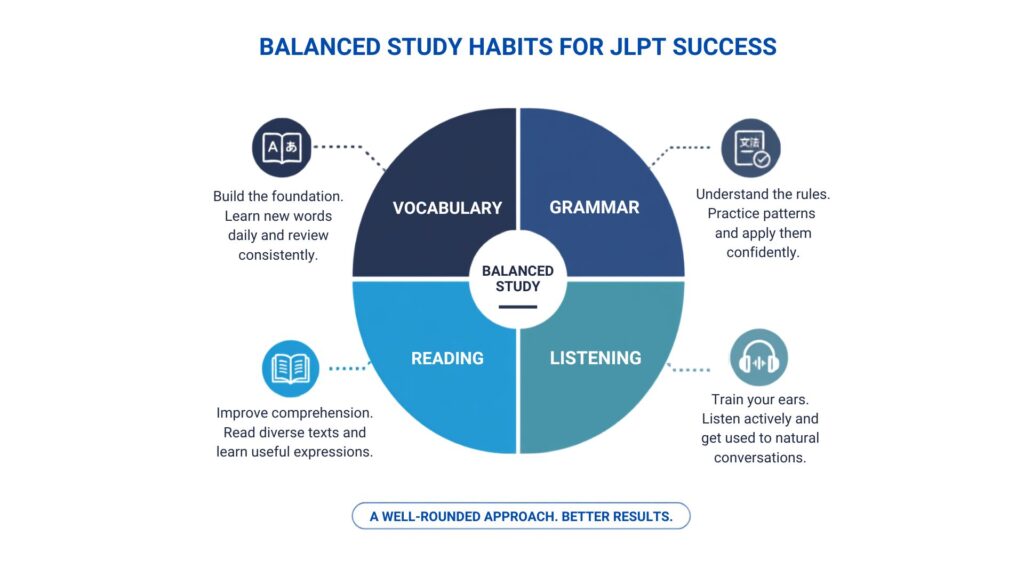
Since the JLPT requires both total and sectional scores, learners should prepare in a balanced way.
A good JLPT study plan should include:
- vocabulary and kanji review
- grammar study
- reading practice
- listening practice
- mock test practice
- regular review of weak points
For N5 and N4 learners, basic vocabulary, grammar, and listening are especially important. For N3, N2, and N1 learners, reading speed and listening comprehension become more important.
Students should also check their weak section early. If listening is weak, do not wait until the final month. If reading is slow, start practicing longer passages earlier.
How JLRC Helps Students Prepare for the JLPT
JLRC Japanese language school offers structured Japanese language courses from N5 to N1 to help students prepare step by step.
Instead of studying randomly, students can follow a clear learning path based on their level. JLRC’s lessons help learners build vocabulary, grammar, reading, listening, and test readiness in a more organized way.
JLRC also develops structured Japanese learning materials to support efficient study. You can learn more about JLRC’s materials here: Japanese learning materials.
Students who want guided JLPT preparation can explore JLRC’s JLPT Japanese language courses.
With structured lessons and regular practice, learners can aim for clearer progress with less wasted time.
Choose the Right JLPT Level and Prepare Strategically
Understanding JLPT passing scores can help you prepare more realistically.
You need to know not only the total passing score, but also the sectional pass marks. A balanced score is important because one weak section can affect your result.
Before taking the JLPT, students should choose the right level, understand the test structure, and prepare with a clear plan.
FAQ
What is the passing score for JLPT N5?
The JLPT N5 overall passing score is 80 out of 180. Students also need at least 38 out of 120 in Language Knowledge・Reading and 19 out of 60 in Listening.
What is the passing score for JLPT N4?
The JLPT N4 overall passing score is 90 out of 180. Students need at least 38 out of 120 in Language Knowledge・Reading and 19 out of 60 in Listening.
What is the passing score for JLPT N3?
The JLPT N3 overall passing score is 95 out of 180. Students need at least 19 out of 60 in Language Knowledge, 19 out of 60 in Reading, and 19 out of 60 in Listening.
What is the passing score for JLPT N2?
The JLPT N2 overall passing score is 90 out of 180. Students need at least 19 out of 60 in Language Knowledge, 19 out of 60 in Reading, and 19 out of 60 in Listening.
What is the passing score for JLPT N1?
The JLPT N1 overall passing score is 100 out of 180. Students need at least 19 out of 60 in Language Knowledge, Reading, and Listening.
Can I pass the JLPT with a high total score but one low section?
No. To pass the JLPT, you must meet both the overall passing score and the sectional pass mark for each scoring section. If one section is below the required minimum, you will not pass.
Is the JLPT score based only on the number of correct answers?
No. The JLPT uses scaled scores, so the final score is not simply the number of correct answers. This is why students should prepare for balanced ability instead of aiming only for the minimum score.




Copyright © 2026 JLRC Inc.
All Rights Reserved
For international students, you may visit our Learn Japanese Online page.
For inquiries, you may call us at (63)2-7358-0565 or (63)917-163-3371
Japanese Language Research Center
Unit 506 Cityland Shaw Tower, Shaw Blvd, Mandaluyong, 1552 Metro Manila, Philippines
For international students, you may visit our Learn Japanese Online page.
For inquiries, you may call us at (63)2-7358-0565 or (63)917-163-3371
Japanese Language Research Center
Unit 506 Cityland Shaw Tower, Shaw Blvd, Mandaluyong, 1552 Metro Manila, Philippines
Copyright © 2026 JLRC Inc.
All Rights Reserved