
JLRC Blogs
- Courses
- Study Japan
- Materials
- Community
- About
- FAQ's
- Careers
- Class Details
- Login


JLPT Exam Format N5–N1: Sections, Test Time & What to Expect
JLRC - Content Team 2026/10/09

If you are preparing for the JLPT, it is important to understand not only what to study, but also how the exam is structured.
The JLPT has five levels: N5, N4, N3, N2, and N1. N5 is the beginner level, while N1 is the most advanced level. Each level tests Japanese language knowledge, reading, and listening, but the number of sections and test time are different depending on the level.
Understanding the JLPT exam format can help you prepare more effectively. It can also help you avoid surprises on test day.
In this guide, we will explain the JLPT exam format from N5 to N1, including sections, test time, and what learners should expect.
If you are still reviewing the overall JLPT learning path, you may also read JLRC’s JLPT Course in the Philippines: N5 to N1 Learning Path.
Table of Contents
- What Does the JLPT Test?
- JLPT Exam Format Overview
- JLPT Test Sections and Test Time
- Total Test Time by JLPT Level
- JLPT N5 Exam Format
- JLPT N4 Exam Format
- JLPT N3 Exam Format
- JLPT N2 Exam Format
- JLPT N1 Exam Format
- What to Expect on JLPT Exam Day
- Why Time Management Matters
- Common Mistakes Students Make
- How to Prepare for Each JLPT Section
- Why Structured JLPT Lessons Help
- Prepare for the JLPT with a Clear Plan
- FAQ
What Does the JLPT Test?
The JLPT mainly tests three broad areas:
- Language knowledge
- Reading
- Listening
Language knowledge includes vocabulary, grammar, kanji, and sentence structure. Reading tests whether learners can understand written Japanese. Listening tests whether learners can understand spoken Japanese in different situations.
The JLPT does not directly test speaking or writing.
This is important because passing the JLPT shows a certain level of Japanese comprehension, but learners who want to use Japanese for work, interviews, emails, or daily communication should also practice speaking and writing separately.
Students who want to understand how JLPT levels relate to career goals may also read JLRC’s JLPT Certificate in the Philippines.
JLPT Exam Format Overview
The JLPT exam format differs by level.
In general:
- N1 and N2 have two main test sections.
- N3, N4, and N5 have three main test sections.
- All levels include listening.
- Reading becomes longer and more complex at higher levels.
- Vocabulary and grammar become more advanced as the level increases.
Here is a simple overview.
| JLPT Level | Main Sections | General Difficulty |
|---|---|---|
| N5 | Vocabulary, Grammar/Reading, Listening | Beginner |
| N4 | Vocabulary, Grammar/Reading, Listening | Upper beginner |
| N3 | Vocabulary, Grammar/Reading, Listening | Intermediate bridge |
| N2 | Language Knowledge/Reading, Listening | Advanced-intermediate |
| N1 | Language Knowledge/Reading, Listening | Advanced |
The official JLPT website provides the latest test section and test time information here: official JLPT test sections and test times.
JLPT Test Sections and Test Time
The following table summarizes the JLPT test sections and test time for N5 to N1.
| JLPT Level | Test Sections | Test Time |
|---|---|---|
| N5 | Language Knowledge Vocabulary | 20 minutes |
| N5 | Language Knowledge Grammar / Reading | 40 minutes |
| N5 | Listening | 30 minutes |
| N4 | Language Knowledge Vocabulary | 25 minutes |
| N4 | Language Knowledge Grammar / Reading | 55 minutes |
| N4 | Listening | 35 minutes |
| N3 | Language Knowledge Vocabulary | 30 minutes |
| N3 | Language Knowledge Grammar / Reading | 70 minutes |
| N3 | Listening | 40 minutes |
| N2 | Language Knowledge Vocabulary / Grammar / Reading | 105 minutes |
| N2 | Listening | 50 minutes |
| N1 | Language Knowledge Vocabulary / Grammar / Reading | 110 minutes |
| N1 | Listening | 55 minutes |
Please note that the time allotted for each section may change, and the listening section time may differ slightly depending on the length of the recorded materials. Students should always confirm the latest details from the official JLPT website or their local test organizer before the exam.
Total Test Time by JLPT Level
If we add the section times together, the approximate total test time is as follows.
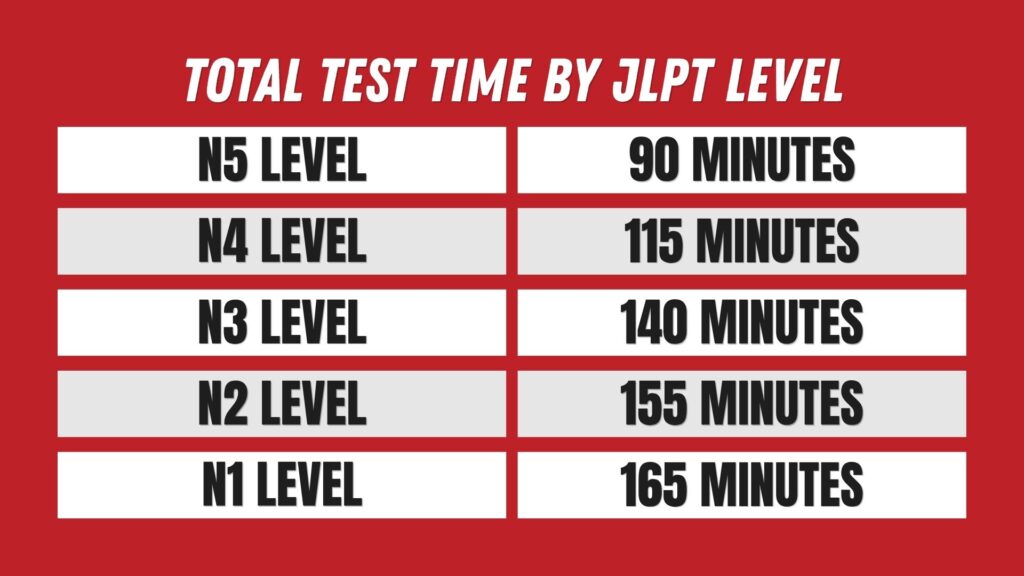
These totals do not include check-in time, instructions, breaks, waiting time, or administrative procedures at the test site.
On exam day, students should expect to spend more time at the venue than the actual test time.
JLPT N5 Exam Format
JLPT N5 is the beginner level.
It tests basic Japanese language knowledge, simple reading, and basic listening.
N5 Sections
| Section | Time |
|---|---|
| Language Knowledge Vocabulary | 20 minutes |
| Language Knowledge Grammar / Reading | 40 minutes |
| Listening | 30 minutes |
At N5 level, learners need to understand basic words, simple grammar patterns, hiragana, katakana, basic kanji, and short sentences.
N5 reading is usually short and simple. Listening questions are also basic, but students still need to recognize Japanese quickly.
If you are preparing for N5, you may also read JLRC’s How to Pass JLPT N5 and JLPT N5 Study Plan.
JLPT N4 Exam Format
JLPT N4 is the next step after N5.
It is still a beginner-level exam, but the sentences become longer, vocabulary becomes wider, and reading and listening require stronger comprehension.
N4 Sections
| Section | Time |
|---|---|
| Language Knowledge Vocabulary | 25 minutes |
| Language Knowledge Grammar / Reading | 55 minutes |
| Listening | 35 minutes |
At N4 level, learners should be able to understand more everyday Japanese.
They need to read short passages, understand sentence connections, and follow simple daily conversations.
Students preparing for N4 may also read JLRC’s JLPT N4 Study Guide and JLPT N4 Reading and Listening Guide.
JLPT N3 Exam Format
JLPT N3 is often considered the bridge between beginner Japanese and more practical intermediate Japanese.
It is an important level because learners begin to handle longer texts, more natural listening, and more complex sentence structures.
N3 Sections
| Section | Time |
|---|---|
| Language Knowledge Vocabulary | 30 minutes |
| Language Knowledge Grammar / Reading | 70 minutes |
| Listening | 40 minutes |
At N3 level, learners need to understand Japanese used in everyday situations with more detail.
Reading passages become longer, and listening questions may require understanding the speaker’s intention, situation, or key details.
Students preparing for N3 may also read JLRC’s JLPT N3 Study Guide.
JLPT N2 Exam Format
JLPT N2 is an important level for many learners who want to use Japanese for career growth, work, or higher-level study.
At N2 level, vocabulary, grammar, reading, and listening become much more demanding.
N2 Sections
| Section | Time |
|---|---|
| Language Knowledge Vocabulary / Grammar / Reading | 105 minutes |
| Listening | 50 minutes |
Unlike N3, N4, and N5, N2 combines language knowledge and reading into one longer section.
This means learners need stronger concentration and time management. Reading passages can be longer and more abstract, and learners must understand both details and overall meaning.
Students preparing for N2 may also read JLRC’s JLPT N2 Study Guide and JLPT N2 Reading and Listening Guide.
JLPT N1 Exam Format
JLPT N1 is the highest JLPT level.
It requires advanced Japanese reading, listening, vocabulary, grammar, and comprehension skills.
N1 Sections
| Section | Time |
|---|---|
| Language Knowledge Vocabulary / Grammar / Reading | 110 minutes |
| Listening | 55 minutes |
At N1 level, learners need to understand complex Japanese used in advanced reading materials, formal writing, opinion-based passages, and natural listening situations.
Time management is very important because the reading section can be long and demanding.
Students preparing for N1 may also read JLRC’s JLPT N1 Study Guide.
What to Expect on JLPT Exam Day
On exam day, students should expect a formal testing environment.
The exact procedure may depend on the country, city, and local test organizer, but students should generally prepare for:
- identity checking
- test voucher or admission document checking
- assigned seating
- instructions from proctors
- strict timing for each section
- no extra time between test sections except scheduled breaks
- listening played only during the listening section
- rules about phones, watches, bags, and personal items
Students should arrive early and carefully follow the rules of the local test organizer.
It is also important to bring all required documents and materials. These may include an admission voucher, valid ID, pencils, eraser, and other items specified by the test organizer.
Why Time Management Matters

JLPT is not only a knowledge test.
It is also a time management test.
Many students understand the vocabulary or grammar, but they lose points because they spend too much time on one question.
This is especially important for reading sections.
For example:
- N5 learners may spend too long reading simple sentences.
- N4 learners may struggle with longer sentences.
- N3 learners may lose time on short passages.
- N2 and N1 learners may struggle with long reading passages and complex grammar.
The solution is regular practice.
Students should practice answering questions within time limits before the actual exam.
Common Mistakes Students Make
Many JLPT learners make similar mistakes when preparing for the exam format.
Common mistakes include:
- studying vocabulary and grammar only
- ignoring listening practice until the last few weeks
- not practicing reading under time pressure
- not knowing the test sections before exam day
- focusing only on weak areas and forgetting review
- using random materials without a clear study plan
- not taking mock exams
- underestimating the length of the test day
These mistakes can be avoided with structured preparation.
Learners should understand the exam format early and study according to the requirements of their target level.
How to Prepare for Each JLPT Section
Each section requires a slightly different preparation method.
Vocabulary
Study words by topic and in example sentences. Do not only memorize isolated word lists.
Grammar
Learn grammar patterns with sentence examples and short passages. At higher levels, compare similar grammar patterns.
Reading
Practice short and long passages depending on your level. Learn how to identify the main idea, details, and context.
Listening
Practice regularly. Listen for the situation, speaker intention, key details, and final answer.
Mock Exams
Take practice tests or mock exams to understand timing, question style, and weak points.
If you want to understand how JLPT passing scores work, you may also read JLRC’s JLPT Passing Scores for N5 to N1.
Why Structured JLPT Lessons Help
Because the JLPT has different sections and test times for each level, random study can easily become inefficient.
A structured JLPT course helps learners understand:
- what to study
- when to review
- how to connect vocabulary and grammar
- how to improve reading and listening
- how to prepare for test-style questions
- how to manage time
- how to move from one level to the next
JLRC helps students study Japanese through a structured path from beginner to advanced levels. Students can build vocabulary, grammar, kanji, reading, listening, and practical understanding step by step.
Students who want guided JLPT preparation can explore JLRC’s Japanese language courses.
You can also learn more about JLRC’s overall approach to Japanese language education in the Philippines.
With structured lessons, learners can prepare more efficiently and reduce wasted time, cost, and effort.
Prepare for the JLPT with a Clear Plan
Understanding the JLPT exam format is an important first step.
Each level has different sections, test times, and difficulty. N5 and N4 focus on beginner-level Japanese, N3 builds intermediate comprehension, and N2 and N1 require stronger reading, listening, and language knowledge.
Students should not wait until the exam is near before learning the format.
The earlier you understand the sections, timing, and question types, the easier it becomes to build a practical study plan.
FAQ
What are the sections of the JLPT?
The JLPT tests language knowledge, reading, and listening. N1 and N2 have two main sections: Language Knowledge / Reading and Listening. N3, N4, and N5 have three sections: Vocabulary, Grammar / Reading, and Listening.
How long is the JLPT exam?
The total test time depends on the level. N5 is about 90 minutes, N4 about 115 minutes, N3 about 140 minutes, N2 about 155 minutes, and N1 about 165 minutes, not including breaks, check-in, or instructions.
Does the JLPT test speaking and writing?
No. The JLPT does not directly test speaking or writing. It mainly tests vocabulary, grammar, reading, and listening.
Which JLPT level should beginners take?
Complete beginners usually start with JLPT N5. N5 helps learners build basic vocabulary, grammar, hiragana, katakana, simple kanji, reading, and listening.
Is N2 harder because the test section is longer?
N2 is harder not only because of the longer section, but also because vocabulary, grammar, reading passages, and listening situations are more advanced. Time management becomes very important.
Does JLRC offer JLPT preparation courses?
Yes. JLRC offers structured Japanese language courses from beginner to advanced levels. Students can explore JLRC’s course options here: JLRC Japanese language courses.




Copyright © 2026 JLRC Inc.
All Rights Reserved
For international students, you may visit our Learn Japanese Online page.
For inquiries, you may call us at (63)2-7358-0565 or (63)917-163-3371
Japanese Language Research Center
Unit 506 Cityland Shaw Tower, Shaw Blvd, Mandaluyong, 1552 Metro Manila, Philippines
For international students, you may visit our Learn Japanese Online page.
For inquiries, you may call us at (63)2-7358-0565 or (63)917-163-3371
Japanese Language Research Center
Unit 506 Cityland Shaw Tower, Shaw Blvd, Mandaluyong, 1552 Metro Manila, Philippines
Copyright © 2026 JLRC Inc.
All Rights Reserved